

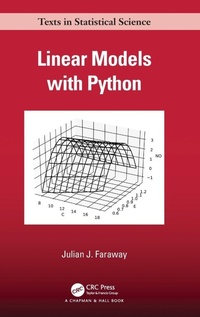
Linear Models with Python
1st Edition
Published on 28. December 2020
Book
Hardback
308 pages
978-1-138-48395-8 (ISBN)
Description
Praise for Linear Models with R:
This book is a must-have tool for anyone interested in understanding and applying linear models. The logical ordering of the chapters is well thought out and portrays Faraway's wealth of experience in teaching and using linear models. ... It lays down the material in a logical and intricate manner and makes linear modeling appealing to researchers from virtually all fields of study. -Biometrical Journal
Throughout, it gives plenty of insight ... with comments that even the seasoned practitioner will appreciate. Interspersed with R code and the output that it produces one can find many little gems of what I think is sound statistical advice, well epitomized with the examples chosen...I read it with delight and think that the same will be true with anyone who is engaged in the use or teaching of linear models. -Journal of the Royal Statistical Society
Like its widely praised, best-selling companion version, Linear Models with R, this book replaces R with Python to seamlessly give a coherent exposition of the practice of linear modeling. Linear Models with Python offers up-to-date insight on essential data analysis topics, from estimation, inference and prediction to missing data, factorial models and block designs. Numerous examples illustrate how to apply the different methods using Python.
Features:
Python is a powerful, open source programming language increasingly being used in data science, machine learning and computer science. Python and R are similar, but R was designed for statistics, while Python is multi-talented.
This version replaces R with Python to make it accessible to a greater number of users outside of statistics, including those from Machine Learning.
A reader coming to this book from an ML background will learn new statistical perspectives on learning from data.
Topics include Model Selection, Shrinkage, Experiments with Blocks and Missing Data.
Includes an Appendix on Python for beginners.
Linear Models with Python explains how to use linear models in physical science, engineering, social science and business applications. It is ideal as a textbook for linear models or linear regression courses.
This book is a must-have tool for anyone interested in understanding and applying linear models. The logical ordering of the chapters is well thought out and portrays Faraway's wealth of experience in teaching and using linear models. ... It lays down the material in a logical and intricate manner and makes linear modeling appealing to researchers from virtually all fields of study. -Biometrical Journal
Throughout, it gives plenty of insight ... with comments that even the seasoned practitioner will appreciate. Interspersed with R code and the output that it produces one can find many little gems of what I think is sound statistical advice, well epitomized with the examples chosen...I read it with delight and think that the same will be true with anyone who is engaged in the use or teaching of linear models. -Journal of the Royal Statistical Society
Like its widely praised, best-selling companion version, Linear Models with R, this book replaces R with Python to seamlessly give a coherent exposition of the practice of linear modeling. Linear Models with Python offers up-to-date insight on essential data analysis topics, from estimation, inference and prediction to missing data, factorial models and block designs. Numerous examples illustrate how to apply the different methods using Python.
Features:
Python is a powerful, open source programming language increasingly being used in data science, machine learning and computer science. Python and R are similar, but R was designed for statistics, while Python is multi-talented.
This version replaces R with Python to make it accessible to a greater number of users outside of statistics, including those from Machine Learning.
A reader coming to this book from an ML background will learn new statistical perspectives on learning from data.
Topics include Model Selection, Shrinkage, Experiments with Blocks and Missing Data.
Includes an Appendix on Python for beginners.
Linear Models with Python explains how to use linear models in physical science, engineering, social science and business applications. It is ideal as a textbook for linear models or linear regression courses.
Reviews / Votes
'Multiple Python program scripts and screenshots of the outcomes fill the book, and each chapter suggests numerous exercises for training in coding. The book presents an amazingly valuable source of knowledge on statistical modeling and Python tools for students and practitioners.'- Stan Lipovetsky, Technometrics, Vol 63, Issue 3 2021
'Therefore, this book is very valuable for understanding paired and multivariate linear regressions.[...] The book is clearly structured, containing all the necessary theoretical calculations and theoretical results on which the calculations are based'
- Igor Malyk, International Society for Clinical Biostatistics, 72, 2021
More details
Series
Language
English
Place of publication
London
United Kingdom
Publishing group
Taylor & Francis Ltd
Target group
College/higher education
Postgraduate
Illustrations
85 s/w Abbildungen, 5 s/w Tabellen
5 Tables, black and white; 85 Illustrations, black and white
Dimensions
Height: 240 mm
Width: 161 mm
Thickness: 21 mm
Weight
631 gr
ISBN-13
978-1-138-48395-8 (9781138483958)
Copyright in bibliographic data and cover images is held by Nielsen Book Services Limited or by the publishers or by their respective licensors: all rights reserved.
Schweitzer Classification
Other editions
Additional editions
Julian J. Faraway
Linear Models with Python
E-Book
02/2021
1st Edition
Chapman & Hall/CRC
€125.99
Available for download
Julian J. Faraway
Linear Models with Python
E-Book
02/2021
1st Edition
Chapman & Hall/CRC
€125.99
Available for download
Person
Julian J. Faraway is a professor of statistics in the Department of Mathematical Sciences at the University of Bath. His research focuses on the analysis of functional and shape data with particular application to the modeling of human motion. He earned a PhD in statistics from the University of California, Berkeley.
Content
1.Introduction 2.Estimation 3.Inference 4.Prediction 5.Explanation 6.Diagnostics 7.Problems with the Predictors 8.Problems with the Errors 9.Transformation10.Model Selection 11.Shrinkage Methods 12.Insurance Redlining -A Complete Example 13.Missing Data 14.Categorical Predictors 15.One Factor Models 16.Models with Several Factors 17.Experiments with Blocks 18.About Python