

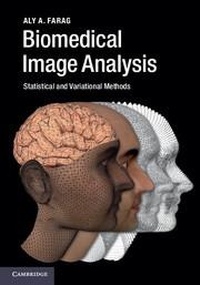
Biomedical Image Analysis
Statistical and Variational Methods
Published on 30. October 2014
Book
Hardback
496 pages
978-0-521-19679-6 (ISBN)
Description
Ideal for classroom use and self-study, this book explains the implementation of the most effective modern methods in image analysis, covering segmentation, registration and visualisation, and focusing on the key theories, algorithms and applications that have emerged from recent progress in computer vision, imaging and computational biomedical science. Structured around five core building blocks - signals, systems, image formation and modality; stochastic models; computational geometry; level set methods; and tools and CAD models - it provides a solid overview of the field. Mathematical and statistical topics are presented in a straightforward manner, enabling the reader to gain a deep understanding of the subject without becoming entangled in mathematical complexities. Theory is connected to practical examples in x-ray, ultrasound, nuclear medicine, MRI and CT imaging, removing the abstract nature of the models and assisting reader understanding.
More details
Language
English
Place of publication
Cambridge
United Kingdom
Target group
Professional and scholarly
Product notice
sewn/stitched
Cloth over boards
Illustrations
100 Halftones, unspecified; 100 Line drawings, unspecified
Dimensions
Height: 249 mm
Width: 170 mm
Thickness: 28 mm
Weight
1157 gr
ISBN-13
978-0-521-19679-6 (9780521196796)
Copyright in bibliographic data and cover images is held by Nielsen Book Services Limited or by the publishers or by their respective licensors: all rights reserved.
Schweitzer Classification
Other editions
Additional editions
E-Book
10/2014
Cambridge University Press
€76.49
Available for download
E-Book
10/2014
1st Edition
Cambridge University Press
€90.49
Available for download
Person
Aly A. Farag is a Professor of Electrical and Computer Engineering, and founding Director of the Computer Vision and Image Processing Laboratory, at the University of Louisville. His research interests centre around object modelling with biomedical applications, and his more recent biomedical inventions have led to the development of improved methods for tubular object modelling, virtual colonoscopies and lung nodule detection and classification based on CT scans, real-time monitoring of vital signs from thermal imaging, and image-based reconstruction of the human jaw.
Content
1. Overview of biomedical image analysis; Part I. Signals and Systems, Image Formation, and Image Modality: 2. Overview of two-dimensional signals and systems; 3. Biomedical imaging modalities; Part II. Stochastic Models: 4. Random variables; 5. Random processes; 6. Basics of random fields; 7. Probability density estimation by linear models; Part III. Computational Geometry: 8. Basics of topology and computational geometry; 9. Geometric features extraction; Part IV. Variational Calculus and Level Set Methods: 10. Variational approaches and level sets; Part V. Image Analysis Tools: 11. Segmentation - statistical approach; 12. Segmentation - variational approach; 13. Basics of registration; 14. Variational methods for shape registrations; 15. Statistical models of shape and appearance.