

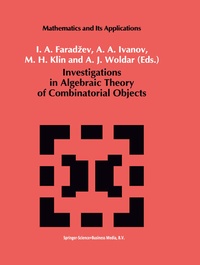
Investigations in Algebraic Theory of Combinatorial Objects
Published on 30. November 1993
Book
Hardback
XII, 510 pages
978-0-7923-1927-6 (ISBN)
Description
X Köchendorffer, L.A. Kalu:lnin and their students in the 50s and 60s. Nowadays the most deeply developed is the theory of binary invariant relations and their combinatorial approximations. These combinatorial approximations arose repeatedly during this century under various names (Hecke algebras, centralizer rings, association schemes, coherent configurations, cellular rings, etc.-see the first paper of the collection for details) andin various branches of mathematics, both pure and applied. One of these approximations, the theory of cellular rings (cellular algebras), was developed at the end of the 60s by B. Yu. Weisfeiler and A.A. Leman in the course of the first serious attempt to study the complexity of the graph isomorphism problem, one of the central problems in the modern theory of combinatorial algorithms. At roughly the same time G.M. Adelson-Velskir, V.L. Arlazarov, I.A. Faradtev and their colleagues had developed a rather efficient tool for the constructive enumeration of combinatorial objects based on the branch and bound method. By means of this tool a number of "sports-like" results were obtained. Some of these results are still unsurpassed.
More details
Series
Edition
1994 ed.
Language
English
Place of publication
Dordrecht
Netherlands
Target group
Professional and scholarly
Research
Illustrations
XII, 510 p.
Dimensions
Height: 241 mm
Width: 160 mm
Thickness: 33 mm
Weight
948 gr
ISBN-13
978-0-7923-1927-6 (9780792319276)
DOI
10.1007/978-94-017-1972-8
Schweitzer Classification
Other editions
Additional editions
I.A. Faradzev | A.A. Ivanov | M. Klin
Investigations in Algebraic Theory of Combinatorial Objects
Book
12/2010
Springer
€139.09
Shipment within 15-20 days
Content
1.1 Cellular rings and groups of automorphisme of graphs.- 1.2 On p-local analysis of permutation groups.- 1.3 Amorphic cellular rings.- 1.4 The subschemes of the Hamming scheme.- 1.5 A description of subrings in % MathType!MTEF!2!1!+-
% feaagCart1ev2aaatCvAUfeBSjuyZL2yd9gzLbvyNv2CaerbuLwBLn
% hiov2DGi1BTfMBaeXatLxBI9gBaerbd9wDYLwzYbItLDharqqtubsr
% 4rNCHbGeaGqiVu0Je9sqqrpepC0xbbL8F4rqqrFfpeea0xe9Lq-Jc9
% vqaqpepm0xbba9pwe9Q8fs0-yqaqpepae9pg0FirpepeKkFr0xfr-x
% fr-xb9adbaqaaeGaciGaaiaabeqaamaabaabaaGcbaGaamOvamaabm
% aabaGaam4uamaaBaaaleaacaWGWbWaaSbaaWqaaiaaigdaaeqaaaWc
% beaakiabgEna0kaadofadaWgaaWcbaGaamiCamaaBaaameaacaaIYa
% aabeaaaSqabaGccqGHxdaTcaGGUaGaaiOlaiaac6cacqGHxdaTcaWG
% tbWaaSbaaSqaaiaadchadaWgaaadbaGaamyBaaqabaaaleqaaaGcca
% GLOaGaayzkaaaaaa!49CD!]]