

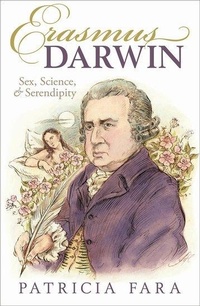
Erasmus Darwin
Sex, Science, and Serendipity
Published on 11. June 2020
Book
Paperback/Softback
336 pages
978-0-19-884854-7 (ISBN)
Description
Dr Erasmus Darwin seemed an innocuous Midlands physician, a respectable stalwart of eighteenth-century society. But there was another side to him.
Botanist, physician, Lunar inventor and popular poet, Darwin was internationally renowned for extraordinary poems explaining his theories about sex and science. Yet he became a target for the political classes, the victim of a sustained and vitriolic character assassination by London's most savage satirists.
Intrigued, prize-winning historian Patricia Fara set out to investigate why Darwin had provoked such fierce intellectual and political reaction. Inviting her readers to accompany her, she embarked on what turned out to be a circuitous and serendipitous journey.
Her research led her to discover a man who possessed, according to Samuel Taylor Coleridge, 'perhaps a greater range of knowledge than any other man in Europe.' His evolutionary ideas influenced his grandson Charles, were banned by the Vatican, and scandalized his reactionary critics. But for modern readers he shines out as an impassioned Enlightenment reformer who championed the abolition of slavery, the education of women, and the optimistic ideals of the French Revolution.
As she tracks down her quarry, Patricia Fara uncovers a ferment of dangerous ideas that terrified the establishment, inspired the Romantics, and laid the ground for Victorian battles between faith and science.
Botanist, physician, Lunar inventor and popular poet, Darwin was internationally renowned for extraordinary poems explaining his theories about sex and science. Yet he became a target for the political classes, the victim of a sustained and vitriolic character assassination by London's most savage satirists.
Intrigued, prize-winning historian Patricia Fara set out to investigate why Darwin had provoked such fierce intellectual and political reaction. Inviting her readers to accompany her, she embarked on what turned out to be a circuitous and serendipitous journey.
Her research led her to discover a man who possessed, according to Samuel Taylor Coleridge, 'perhaps a greater range of knowledge than any other man in Europe.' His evolutionary ideas influenced his grandson Charles, were banned by the Vatican, and scandalized his reactionary critics. But for modern readers he shines out as an impassioned Enlightenment reformer who championed the abolition of slavery, the education of women, and the optimistic ideals of the French Revolution.
As she tracks down her quarry, Patricia Fara uncovers a ferment of dangerous ideas that terrified the establishment, inspired the Romantics, and laid the ground for Victorian battles between faith and science.
Reviews / Votes
Erasmus Darwin [...] subverts the genre, along the way making it the most enjoyable relatively heavy-duty history of science book I've ever read ... this is a wonderful way to make the process of exploring the history of science come alive. * Brian Clegg, Popular Science *More details
Language
English
Place of publication
Oxford
United Kingdom
Target group
College/higher education
Professional and scholarly
Product notice
Paperback (trade)
Unsewn / adhesive bound
Illustrations
8 black and white illustrations
Dimensions
Height: 213 mm
Width: 132 mm
Thickness: 23 mm
Weight
340 gr
ISBN-13
978-0-19-884854-7 (9780198848547)
Copyright in bibliographic data and cover images is held by Nielsen Book Services Limited or by the publishers or by their respective licensors: all rights reserved.
Schweitzer Classification
Other editions
Additional editions
E-Book
06/2020
1st Edition
OUP eBook
€9.49
Available for download
E-Book
06/2020
1st Edition
OUP eBook
€9.49
Available for download
Person
Patricia Fara lectures in the history of science at Cambridge University, where she is a Fellow of Clare College. She is the President of the British Society for the History of Science, and her prize-winning book, Science: A Four Thousand Year History (2009), has been translated into nine languages. In addition to many academic publications, her popular works include Newton: The Making of Genius (2002), An Entertainment for Angels (2002), Sex, Botany and Empire (2003), Pandora's Breeches: Women, Science and Power in the Enlightenment (2004) and A Lab of One's Own: Science and Suffrage in the First World War (2018). An experienced public lecturer, Patricia Fara appears regularly in TV documentaries and radio programmes such as In our Time. She also contributes articles and reviews to many journals, including History Today, BBC History, New Scientist, Nature and the Times Literary Supplement.
Content
Introduction: Serendipity
The Love of Triangles
1: Erasmus Darwin
2: 'The Loves of the Triangles'
3: A Triangle of Poets
The Loves of the Plants
4: The Loves of the Plants
5: Women on Trial
6: Seraglios
The Economy of Vegetation
7: The Lunar Society
8: The Economy of Vegetation
9: The Triangular Slave Trade
The Temple of Nature
10: Defining People
11: The Temple of Nature
12: Origins
Conclusion: Reputations and Reflections
Appendix: 'The Loves of the Triangles'
Notes
Bibliography
Index
The Love of Triangles
1: Erasmus Darwin
2: 'The Loves of the Triangles'
3: A Triangle of Poets
The Loves of the Plants
4: The Loves of the Plants
5: Women on Trial
6: Seraglios
The Economy of Vegetation
7: The Lunar Society
8: The Economy of Vegetation
9: The Triangular Slave Trade
The Temple of Nature
10: Defining People
11: The Temple of Nature
12: Origins
Conclusion: Reputations and Reflections
Appendix: 'The Loves of the Triangles'
Notes
Bibliography
Index