


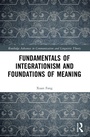
Fundamentals of Integrationism and Foundations of Meaning
1st Edition
Published on 3. November 2025
Book
Hardback
192 pages
978-1-032-88461-5 (ISBN)
Description
This book looks at a long-standing question about "meaning" and the human experience - specifically, why meaning seems easy to recognize but hard to fully explain, especially from the perspective of integrationism.
Fang's book pins down the fundamentals of Roy Harris's integrational linguistics and explores the relation between the nature of meaningfulness and human condition - the given features of human beings and human activities. The book rebuilds the main ideas behind the integrationist philosophy, placing them in the tradition of neo-Kantian, Fichtean phenomenology and existentialism. Fang also uses research from psychology, focusing on human-centred and developmental studies, to strengthen the arguments.
The chapters review different theories of meaning, attributing the insurmountable obstacles encountered by the depersonalized - systemic, formalist, and decontextualized - approaches to their problematic philosophical presuppositions. The book also points to earlier thinkers who had important insights into language and communication, supporting an integrationist view of meaning.
The text further pinpoints the foundations of meaning and its philosophical implications within the human context. It explains the vital importance of personalized and contextualized factors, and explores feasible ways of including those factors in theorizing to ultimately conclude that the nature of meaning is embedded in what we are as human beings.
This book is a valuable read for anyone interested in integrationism, language theory, or the deeper questions about how meaning works.
Fang's book pins down the fundamentals of Roy Harris's integrational linguistics and explores the relation between the nature of meaningfulness and human condition - the given features of human beings and human activities. The book rebuilds the main ideas behind the integrationist philosophy, placing them in the tradition of neo-Kantian, Fichtean phenomenology and existentialism. Fang also uses research from psychology, focusing on human-centred and developmental studies, to strengthen the arguments.
The chapters review different theories of meaning, attributing the insurmountable obstacles encountered by the depersonalized - systemic, formalist, and decontextualized - approaches to their problematic philosophical presuppositions. The book also points to earlier thinkers who had important insights into language and communication, supporting an integrationist view of meaning.
The text further pinpoints the foundations of meaning and its philosophical implications within the human context. It explains the vital importance of personalized and contextualized factors, and explores feasible ways of including those factors in theorizing to ultimately conclude that the nature of meaning is embedded in what we are as human beings.
This book is a valuable read for anyone interested in integrationism, language theory, or the deeper questions about how meaning works.
More details
Series
Language
English
Place of publication
London
United Kingdom
Publishing group
Taylor & Francis Ltd
Target group
College/higher education
Postgraduate
Dimensions
Height: 240 mm
Width: 161 mm
Thickness: 15 mm
Weight
467 gr
ISBN-13
978-1-032-88461-5 (9781032884615)
Copyright in bibliographic data and cover images is held by Nielsen Book Services Limited or by the publishers or by their respective licensors: all rights reserved.
Schweitzer Classification
Other editions
Additional editions
E-Book
11/2025
Routledge
€60.49
Available for download
E-Book
11/2025
Routledge
€60.49
Available for download
Person
Xuan Fang is a lecturer at Hanshan Normal University, China.
Content
Introduction
1. Dimensions of integrational linguistics
2. Implications of the problematics of meaning
3. The foundations of meaning from an integrational perspective
Conclusion
1. Dimensions of integrational linguistics
2. Implications of the problematics of meaning
3. The foundations of meaning from an integrational perspective
Conclusion