

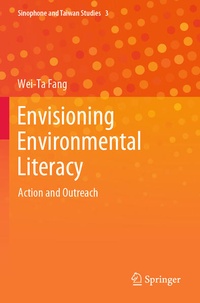
Envisioning Environmental Literacy
Action and Outreach
Published on 24. July 2021
Book
Paperback/Softback
XXXI, 345 pages
978-981-15-7008-7 (ISBN)
Description
This book bridges the gap between two critical issues-environmental literacy and social norms - and explores various topics and case studies from Sinophone and Taiwanese perspectives. Each chapter includes extensive information on pro-environmental behaviors, and on people with working experiences, home experiences, and actual philosophies in their daily lives. In keeping with the Sustainable Development Goals (SDGs), this book highlights our potential to contribute to social inclusion and environmental protection, and offers a comprehensive guide for scholars, students, practitioners, and entrepreneurs in environmental education and related disciplines.
More details
Series
Edition
2020 ed.
Language
English
Place of publication
Singapore
Singapore
Target group
Professional and scholarly
Illustrations
89 farbige Abbildungen, 34 s/w Abbildungen
XXXI, 345 p. 123 illus., 89 illus. in color.
Dimensions
Height: 235 mm
Width: 155 mm
Thickness: 21 mm
Weight
575 gr
ISBN-13
978-981-15-7008-7 (9789811570087)
DOI
10.1007/978-981-15-7006-3
Schweitzer Classification
Other editions
Additional editions
Book
07/2020
Springer
€139.09
Shipment within 3-4 weeks
Person
Wei-Ta Fang, Ph.D., is a Distinguished Professor and Director of the Graduate Institute of Environmental Education, National Taiwan Normal University, and President of the Society of Wetland Scientists Asia Chapter. He is an environmental educator and the first research fellow awarded the status of Professional Wetland Scientist (PWS) in Asia. He received the President's Service Award (2017 & 2011), and the Doug Wilcox Award (2015), both from the Society of Wetland Scientists, and has also served as an Associate Editor of Wetlands (SCI journal, Springer), since 2012. His publications include Tourism in Emerging Economies (Springer, 2020) and Envisioning Environmental Literacy.
Content
Part 1: Contextualization.- Chapter 1. Orientation.- Chapter 2. Indigenous Knowledge.- Chapter 3. Environmental Literacy: Behavior Oriented.- Chapter 4. Environmental Governance.- Part 2: Agents.- Chapter 5. Government Officials.- Chapter 6. Farmers.- Chapter 7. Laborers.- Chapter 8. Visitors to a College Campus.- Chapter 9. College Students.- Part 3: Actors.- Chapter 10. Children.- Chapter 11. Parents.- Chapter 12. Outreach Media.