

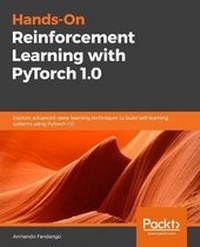
Hands-On Reinforcement Learning with PyTorch 1.0
Explore advanced deep learning techniques to build self-learning systems using PyTorch 1.0
Published on 11. July 2019
Book
Paperback/Softback
331 pages
978-1-78953-902-8 (ISBN)
Description
Simplify artificial intelligence (AI) by designing and implementing self-learning agents using PyTorch
About This Book
* Implement reinforcement learning(RL) algorithms to build your own self-learning agents
* Understand how deep RL can be used in different segments of enterprise applications such as natural language processing (NLP)
* Solve challenges in computer vision, NLP, and data forecasting using PyTorch 1.0 and OpenAI gym
Who This Book Is For
If you are a data scientist, machine learning engineer, deep learning practitioner or AI researcher looking for practical content that will help you implement reinforcement learning algorithms, this book is ideal. With this beginner-level guide, you'll be able to use PyTorch 1.0's offerings to build your own self-learning agents. Working knowledge of Python programming language is a must.
What You Will Learn
* Understand how to implement neural networks using PyTorch 1.0
* Implement the cross-entropy (CE) method in OpenAI Gym Games
* Discover the policy gradient algorithm for reinforcement learning
* Explore Q-Learning with Q-Network for reinforcement learning
* Apply reinforcement learning to resolve problems in computer vision
* Understand steps in reinforcement learning for time series forecasting
* Implement reinforcement learning in text data for NLP problems
In Detail
Reinforcement learning is widely used in segments such as robotic process automation and self-navigating cars. This book will help you get up to speed with reinforcement learning using PyTorch 1.0.
The book starts by introducing you to major concepts that will help you to understand how reinforcement learning algorithms work. You will then explore a variety of topics that focus on the most important and practical details of the reinforcement learning domain. The book will also boost your knowledge of the different reinforcement learning methods and their algorithms. As you progress, you'll cover concepts such as the Multi-Armed Bandit problem, Markov Decision Processes (MDPs), and Q-learning, which will further hone your skills in developing self-learning agents. The goal of this book is to help you understand why and how each RL algorithm plays an important role in building these agents. Hands-On Reinforcement Learning with PyTorch 1.0 will also give you insights on implementing PyTorch functionalities and services to cover a range of RL tasks. Following this, you'll explore how deep RL can be used in different segments of enterprise applications such as NLP, time series, and computer vision. As you wrap up the final chapters, you'll cover a segment on evaluating algorithms by using environments from the popular OpenAI Gym toolkit.
By the end of this book, you'll have the skills you need to implement reinforcement learning algorithms to solve common and not-so-common challenges faced.
About This Book
* Implement reinforcement learning(RL) algorithms to build your own self-learning agents
* Understand how deep RL can be used in different segments of enterprise applications such as natural language processing (NLP)
* Solve challenges in computer vision, NLP, and data forecasting using PyTorch 1.0 and OpenAI gym
Who This Book Is For
If you are a data scientist, machine learning engineer, deep learning practitioner or AI researcher looking for practical content that will help you implement reinforcement learning algorithms, this book is ideal. With this beginner-level guide, you'll be able to use PyTorch 1.0's offerings to build your own self-learning agents. Working knowledge of Python programming language is a must.
What You Will Learn
* Understand how to implement neural networks using PyTorch 1.0
* Implement the cross-entropy (CE) method in OpenAI Gym Games
* Discover the policy gradient algorithm for reinforcement learning
* Explore Q-Learning with Q-Network for reinforcement learning
* Apply reinforcement learning to resolve problems in computer vision
* Understand steps in reinforcement learning for time series forecasting
* Implement reinforcement learning in text data for NLP problems
In Detail
Reinforcement learning is widely used in segments such as robotic process automation and self-navigating cars. This book will help you get up to speed with reinforcement learning using PyTorch 1.0.
The book starts by introducing you to major concepts that will help you to understand how reinforcement learning algorithms work. You will then explore a variety of topics that focus on the most important and practical details of the reinforcement learning domain. The book will also boost your knowledge of the different reinforcement learning methods and their algorithms. As you progress, you'll cover concepts such as the Multi-Armed Bandit problem, Markov Decision Processes (MDPs), and Q-learning, which will further hone your skills in developing self-learning agents. The goal of this book is to help you understand why and how each RL algorithm plays an important role in building these agents. Hands-On Reinforcement Learning with PyTorch 1.0 will also give you insights on implementing PyTorch functionalities and services to cover a range of RL tasks. Following this, you'll explore how deep RL can be used in different segments of enterprise applications such as NLP, time series, and computer vision. As you wrap up the final chapters, you'll cover a segment on evaluating algorithms by using environments from the popular OpenAI Gym toolkit.
By the end of this book, you'll have the skills you need to implement reinforcement learning algorithms to solve common and not-so-common challenges faced.
More details
Language
English
Place of publication
Birmingham
United Kingdom
Target group
Professional and scholarly
Dimensions
Height: 235 mm
Width: 191 mm
ISBN-13
978-1-78953-902-8 (9781789539028)
Copyright in bibliographic data and cover images is held by Nielsen Book Services Limited or by the publishers or by their respective licensors: all rights reserved.
Schweitzer Classification
Person
Armando Fandango creates AI empowered products by leveraging his expertise in deep learning, machine learning, distributed computing, and computational methods and has provided thought leadership roles as Chief Data Scientist and Director at startups and large enterprises. He has been advising high-tech AI-based startups. Armando has authored books titled Python Data Analysis - Second Edition and Mastering TensorFlow. He has also published research in international journals and conferences.