

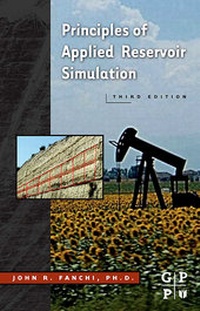
Principles of Applied Reservoir Simulation
3rd Edition
Published on 20. December 2005
Book
Hardback
536 pages
978-0-7506-7933-6 (ISBN)
Description
The hottest, most important topic to reservoir engineers is reservoir simulation. Reservoir simulations are literally pictures of what a reservoir of oil or gas looks, or should look, like under the surface of the earth. A multitude of tools is available to the engineer to generate these pictures, and, essentially, the more accurate the picture, the easier the engineer can get the product out of the ground, and, thus, the more profitable the well will be.
Completely revised and updated throughout, this new edition of a GPP industry standard has completely new sections on coalbed methane, CO2 sequestration (important for environmental concerns), Co2 Flood, more sophisticated petrophysical models for geoscientists, examples of subsidence, additional geomechanical calculations, and much more. What makes this book so different and valuable to the engineer is the accompanying software, used by reservoir engineers all over the world every day. The new software, IFLO (replacing WINB4D, in previous editions), is a simulator that the engineer can easily install in a Windows operating environment. IFLO generates simulations of how the well can be tapped and feeds this to the engineer in dynamic 3D perspective. This completely new software is much more functional, with better graphics and more scenarios from which the engineer can generate simulations.
This book and software helps the reservoir engineer do his or her job on a daily basis, better, more economically, and more efficiently. Without simulations, the reservoir engineer would not be able to do his or her job at all, and the technology available in this product is far superior to most companies' internal simulation software. It is also much less expensive ($89.95 versus hundreds or even thousands of dollars) than off-the-shelf packages available from independent software companies servicing the oil and gas industry. It is, however, just as, or more accurate than these overpriced competitors, having been created by a high-profile industry expert and having been used by engineers in the real world with successful and profitable results.
Completely revised and updated throughout, this new edition of a GPP industry standard has completely new sections on coalbed methane, CO2 sequestration (important for environmental concerns), Co2 Flood, more sophisticated petrophysical models for geoscientists, examples of subsidence, additional geomechanical calculations, and much more. What makes this book so different and valuable to the engineer is the accompanying software, used by reservoir engineers all over the world every day. The new software, IFLO (replacing WINB4D, in previous editions), is a simulator that the engineer can easily install in a Windows operating environment. IFLO generates simulations of how the well can be tapped and feeds this to the engineer in dynamic 3D perspective. This completely new software is much more functional, with better graphics and more scenarios from which the engineer can generate simulations.
This book and software helps the reservoir engineer do his or her job on a daily basis, better, more economically, and more efficiently. Without simulations, the reservoir engineer would not be able to do his or her job at all, and the technology available in this product is far superior to most companies' internal simulation software. It is also much less expensive ($89.95 versus hundreds or even thousands of dollars) than off-the-shelf packages available from independent software companies servicing the oil and gas industry. It is, however, just as, or more accurate than these overpriced competitors, having been created by a high-profile industry expert and having been used by engineers in the real world with successful and profitable results.
Reviews / Votes
"The talents of this very special author make up this book that is first of its kind in petroleum engineering and is a very useful tool for any engineering discipline interested in fluid flow in porous media." --Saeid Mokhatab, Advisor of Natural Gas Engineering Research Projects, Chemical and Petroleum Engineering Department, University of Wyoming, Laramie, Wyoming, USAMore details
Edition
3rd edition
Language
English
Place of publication
Oxford
United Kingdom
Publishing group
Elsevier Science & Technology
Target group
Professional and scholarly
Reservoir Engineers, Petroleum Geologists, Geophysists
Edition type
New edition
Illustrations
Approx. 100 illustrations
Dimensions
Height: 229 mm
Width: 152 mm
Weight
970 gr
ISBN-13
978-0-7506-7933-6 (9780750679336)
Copyright in bibliographic data and cover images is held by Nielsen Book Services Limited or by the publishers or by their respective licensors: all rights reserved.
Schweitzer Classification
Other editions
New editions
John R. Fanchi
Principles of Applied Reservoir Simulation
Book
06/2018
4th Edition
Gulf Professional Publishing
€174.56
Shipment within 15-20 days
Additional editions
John R. Fanchi
Principles of Applied Reservoir Simulation
E-Book
12/2005
3rd Edition
Gulf Professional Publishing
€94.95
Available for download
Previous edition

John R. Fanchi
Principles of Applied Reservoir Simulation
Book
07/2001
2nd Edition
Butterworth-Heinemann
€100.47
Article exhausted; check for reprint
Person
John R. Fanchi is a Professor in the Department of Engineering and Energy Institute at Texas Christian University in Fort Worth, Texas. He holds the Ross B. Matthews Chair of Petroleum Engineering and teaches courses in energy and engineering. Before this appointment, he taught petroleum and energy engineering courses at the Colorado School of Mines and worked in the technology centers of four energy companies (Chevron, Marathon, Cities Service and Getty). He is a Distinguished Member of the Society of Petroleum Engineers and authored numerous books, including Integrated Reservoir Asset Management, Energy: Technology and Directions for the Future, Shared Earth Modeling, and Integrated Flow Modeling, all published with Elsevier.
Content
1. Introduction to Reservoir Management
Part I - Reservoir Engineering Primer2. Basic Reservoir Analysis3. Multiphase Flow Concepts4. Fluid Displacement5. Frontal Stability6. Pattern Floods7. Recovery of Subsurface Resources8. Economics and the Environment
Part II - Reservoir Simulation9. Fluid Flow Equations10. Fundamentals of Reservoir Simulation11. Overview of the Modeling Process12. Conceptual Reservoir Scales13. Flow Units14. Rock Properties15. Distributing Rock Properties16. Fluid Properties17. Model Initialization18. History Matching19. Predictions
Part III: IFLO User's Manual20. Introduction to IFLO21. Initialization Data22. Recurrent DataAppendix A: Unit Conversion FactorsAppendix B: Example IFLO Input Data Set
Part I - Reservoir Engineering Primer2. Basic Reservoir Analysis3. Multiphase Flow Concepts4. Fluid Displacement5. Frontal Stability6. Pattern Floods7. Recovery of Subsurface Resources8. Economics and the Environment
Part II - Reservoir Simulation9. Fluid Flow Equations10. Fundamentals of Reservoir Simulation11. Overview of the Modeling Process12. Conceptual Reservoir Scales13. Flow Units14. Rock Properties15. Distributing Rock Properties16. Fluid Properties17. Model Initialization18. History Matching19. Predictions
Part III: IFLO User's Manual20. Introduction to IFLO21. Initialization Data22. Recurrent DataAppendix A: Unit Conversion FactorsAppendix B: Example IFLO Input Data Set