

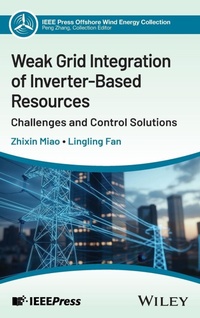
Weak Grid Integration of Inverter-Based Resources
Challenges and Control Solutions
1st Edition
Will be published approx. on 9. February 2026
Book
Hardback
176 pages
978-1-394-31608-3 (ISBN)
Description
Comprehensive resource discussing specific challenges and control solutions associated with operating inverter-based resources in weak grid scenarios
Weak Grid Integration of Inverter-Based Resources delves into current operational challenges and control solutions associated with inverter-based resources (IBR) in weak grid scenarios, with real-world examples included throughout to elucidate key concepts. The book introduces the control architecture of IBR power plants and the underlying AC circuit topology, providing readers with a comprehensive overview of the system. It discusses specific operational challenges and examines how they relate to the grid-following control system and circuit characteristics. The book also reviews various grid-forming control designs and their role in enhancing weak-grid operation, while analyzing potential challenges arising from interactions between IBRs and series or shunt compensation. In addition, it investigates the different fault behaviors associated with grid-following and grid-forming control.
Written by two highly qualified experts, Weak Grid Integration of Inverter-Based Resources includes information on:
IBR inverter-level and power plant-level control logic
Root causes of a variety of oscillation phenomena
Impact of series and shunt compensation on grid characteristics
Stability analysis and associated modeling techniques, including complex vector-based modeling and analysis and forming customized feedback systems
Fault behaviors and their connection to IBR control logic
Comprehensive in scope, Weak Grid Integration of Inverter-Based Resources appeals to a wide spectrum of readers in the field, including professionals in the power industry and university students in related programs of study.
Weak Grid Integration of Inverter-Based Resources delves into current operational challenges and control solutions associated with inverter-based resources (IBR) in weak grid scenarios, with real-world examples included throughout to elucidate key concepts. The book introduces the control architecture of IBR power plants and the underlying AC circuit topology, providing readers with a comprehensive overview of the system. It discusses specific operational challenges and examines how they relate to the grid-following control system and circuit characteristics. The book also reviews various grid-forming control designs and their role in enhancing weak-grid operation, while analyzing potential challenges arising from interactions between IBRs and series or shunt compensation. In addition, it investigates the different fault behaviors associated with grid-following and grid-forming control.
Written by two highly qualified experts, Weak Grid Integration of Inverter-Based Resources includes information on:
IBR inverter-level and power plant-level control logic
Root causes of a variety of oscillation phenomena
Impact of series and shunt compensation on grid characteristics
Stability analysis and associated modeling techniques, including complex vector-based modeling and analysis and forming customized feedback systems
Fault behaviors and their connection to IBR control logic
Comprehensive in scope, Weak Grid Integration of Inverter-Based Resources appeals to a wide spectrum of readers in the field, including professionals in the power industry and university students in related programs of study.
More details
Series
Language
English
Place of publication
United States
Publishing group
John Wiley & Sons Inc
Target group
Professional and scholarly
Dimensions
Height: 236 mm
Width: 159 mm
Thickness: 17 mm
Weight
382 gr
ISBN-13
978-1-394-31608-3 (9781394316083)
Copyright in bibliographic data and cover images is held by Nielsen Book Services Limited or by the publishers or by their respective licensors: all rights reserved.
Schweitzer Classification
Other editions
Additional editions
Zhixin Miao | Lingling Fan
Weak Grid Integration of Inverter-Based Resources
Challenges and Control Solutions
E-Book
12/2025
1st Edition
Wiley
€94.99
Available for download
Zhixin Miao | Lingling Fan
Weak Grid Integration of Inverter-Based Resources
Challenges and Control Solutions
E-Book
12/2025
1st Edition
Wiley
€94.99
Available for download
Persons
Zhixin Miao, PhD, is a Professor in the Department of Electrical Engineering, University of South Florida, Tampa FL. Prior to becoming a researcher, he worked in a variety of engineering roles.
Lingling Fan, PhD, is a Professor in the Department of Electrical Engineering, University of South Florida, Tampa FL. She is an IEEE Fellow and the recipient of IEEE Power and Energy Society's 2025 Wanda Reder Pioneer in Power Award.
Lingling Fan, PhD, is a Professor in the Department of Electrical Engineering, University of South Florida, Tampa FL. She is an IEEE Fellow and the recipient of IEEE Power and Energy Society's 2025 Wanda Reder Pioneer in Power Award.
Content
Introduction 1 IBR Power Plant Control and AC Delivery
1.1 IBR Grid Integration Circuit Topology
1.2 Inverter-Level Control Logic
1.2.1 Inner current control
1.2.2 Synchronizing units
1.2.3 Outer control functions 1.3 Power Plant-Level Control Logic
1.4 Study methods: analysis and electromagnetic transient simulation
1.5 Summary
Bibliography
2 Operational Challenges and Root Cause Analysis
2.1 PLL Loss of Synchronism
2.1.1 Analysis of phase angle jump
2.1.2 EMT simulation results
2.1.3 Mitigation strategy
2.2 Voltage Oscillations Below 10 Hz
2.2.1 Voltage-reactive power feedback system
2.2.2 The role of real power
2.2.3 Inclusion of PLL dynamics
2.2.4 Interactions of DC-link voltage control, PLL, and AC voltage control
2.3 Oscillations Above 10 Hz
2.3.1 Complex grid impedance
2.3.2 Analysis
2.4 Oscillatory versus Monotonic Dynamics: Another Perspective
2.4.1 The simplified system model
2.4.2 Open-loop analysis via MIMO system decomposition
2.4.3 EMT testbed and simulation results
2.4.4 Concluding remarks
2.5 Countermeasures
2.5.1 Plant-level voltage feedback
2.5.2 Inverter-level voltage stability enhancement
Bibliography
3 Grid-Forming Control
3.1 Why Grid-Forming Control?
3.1.1 Grid codes
3.1.2 Benefits of GFM
3.2 Multi-loop GFM Control: Virtual Admittance
3.2.1 Strong grid fault ride-through tests
3.2.2 Weak grid fault ride-through tests
3.3 Multi-Loop GM Control: Vector Control
3.3.1 Strong grid fault ride-through tests
3.3.2. Weak grid fault ride-through tests
3.4 Single-Loop Control
3.4.1 Strong grid fault ride-through tests
3.4.2 Weak grid fault ride-through tests
3.5 Summary
Bibliography
4 Interactions of IBRs with Series or Shunt Compensation
4.1 Introduction
4.2 Sources and Grid Characteristics
4.2.1 Series compensated circuits powered by different sources
4.2.2 Shunt compensated circuits powered by different sources
4.31 Interactions of GFL-IBR and Series or Shunt Compensation
4.3.1 Influence of series or shunt compensation on grid impedance
4.3.2 Feedback systems and stability analysis
4.3.3 Summary
4.4 Interactions of GFM-IBR and Series Compensation
4.4.1 EMT study results
4.4.2 Analysis
4.4.3 Summary
Bibliography
5 Fault Behavior of IBR Penetrated Power Grids
5.1 Sequence Network Interconnection
5.2 IBR's representation in circuits
5.3 Single Phase Open-Circuit Faults
5.1.1 EMT testbeds and simulation results
5.1.2 Analysis
5.1.3 Summary
5.3 Unbalanced Grounding Faults
5.2.1 Interconnected sequence network
5.2.2 EMT simulation results
5.2.3 Fault behavior of a GFM-IBR system
5.2.3 Conclusion
Bibliography
1.1 IBR Grid Integration Circuit Topology
1.2 Inverter-Level Control Logic
1.2.1 Inner current control
1.2.2 Synchronizing units
1.2.3 Outer control functions 1.3 Power Plant-Level Control Logic
1.4 Study methods: analysis and electromagnetic transient simulation
1.5 Summary
Bibliography
2 Operational Challenges and Root Cause Analysis
2.1 PLL Loss of Synchronism
2.1.1 Analysis of phase angle jump
2.1.2 EMT simulation results
2.1.3 Mitigation strategy
2.2 Voltage Oscillations Below 10 Hz
2.2.1 Voltage-reactive power feedback system
2.2.2 The role of real power
2.2.3 Inclusion of PLL dynamics
2.2.4 Interactions of DC-link voltage control, PLL, and AC voltage control
2.3 Oscillations Above 10 Hz
2.3.1 Complex grid impedance
2.3.2 Analysis
2.4 Oscillatory versus Monotonic Dynamics: Another Perspective
2.4.1 The simplified system model
2.4.2 Open-loop analysis via MIMO system decomposition
2.4.3 EMT testbed and simulation results
2.4.4 Concluding remarks
2.5 Countermeasures
2.5.1 Plant-level voltage feedback
2.5.2 Inverter-level voltage stability enhancement
Bibliography
3 Grid-Forming Control
3.1 Why Grid-Forming Control?
3.1.1 Grid codes
3.1.2 Benefits of GFM
3.2 Multi-loop GFM Control: Virtual Admittance
3.2.1 Strong grid fault ride-through tests
3.2.2 Weak grid fault ride-through tests
3.3 Multi-Loop GM Control: Vector Control
3.3.1 Strong grid fault ride-through tests
3.3.2. Weak grid fault ride-through tests
3.4 Single-Loop Control
3.4.1 Strong grid fault ride-through tests
3.4.2 Weak grid fault ride-through tests
3.5 Summary
Bibliography
4 Interactions of IBRs with Series or Shunt Compensation
4.1 Introduction
4.2 Sources and Grid Characteristics
4.2.1 Series compensated circuits powered by different sources
4.2.2 Shunt compensated circuits powered by different sources
4.31 Interactions of GFL-IBR and Series or Shunt Compensation
4.3.1 Influence of series or shunt compensation on grid impedance
4.3.2 Feedback systems and stability analysis
4.3.3 Summary
4.4 Interactions of GFM-IBR and Series Compensation
4.4.1 EMT study results
4.4.2 Analysis
4.4.3 Summary
Bibliography
5 Fault Behavior of IBR Penetrated Power Grids
5.1 Sequence Network Interconnection
5.2 IBR's representation in circuits
5.3 Single Phase Open-Circuit Faults
5.1.1 EMT testbeds and simulation results
5.1.2 Analysis
5.1.3 Summary
5.3 Unbalanced Grounding Faults
5.2.1 Interconnected sequence network
5.2.2 EMT simulation results
5.2.3 Fault behavior of a GFM-IBR system
5.2.3 Conclusion
Bibliography