

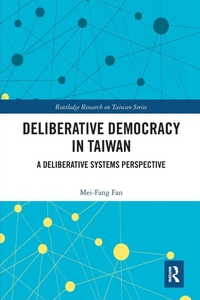
Deliberative Democracy in Taiwan
A Deliberative Systems Perspective
1st Edition
Published on 30. May 2022
Book
Paperback/Softback
188 pages
978-0-367-62905-2 (ISBN)
Description
This book is a pioneering analysis of the deliberative systems approach in Taiwan, extending an understanding of Taiwanese democratic politics and consolidating links between theoretical development and a practical application of deliberative practices.
As a front-runner of new democracies in Asia and a relatively open society, Taiwan provides a model for deliberative governance, with a view towards institutional innovation and increasing democratisation. This book considers how components within the intricate web of micro- and macro- deliberative systems perform different functions, complement each other, and contribute both to policy change and democratic innovation. Specific cases are provided - such as participatory budgeting in Taipei City and the government-academia alliance model - to demonstrate the long-term systemic effects of mini-publics and citizen actions. In addition, the book proposes the possibility of deliberative democracy for other countries in the world, alongside various policy issues, including mini-publics, e-participation, co-governance, citizen science, negotiation mechanisms, and the deliberative practices of indigenous peoples.
Deliberative Democracy in Taiwan will appeal to students and scholars of East Asian studies, Taiwanese politics, political science and social movement studies.
As a front-runner of new democracies in Asia and a relatively open society, Taiwan provides a model for deliberative governance, with a view towards institutional innovation and increasing democratisation. This book considers how components within the intricate web of micro- and macro- deliberative systems perform different functions, complement each other, and contribute both to policy change and democratic innovation. Specific cases are provided - such as participatory budgeting in Taipei City and the government-academia alliance model - to demonstrate the long-term systemic effects of mini-publics and citizen actions. In addition, the book proposes the possibility of deliberative democracy for other countries in the world, alongside various policy issues, including mini-publics, e-participation, co-governance, citizen science, negotiation mechanisms, and the deliberative practices of indigenous peoples.
Deliberative Democracy in Taiwan will appeal to students and scholars of East Asian studies, Taiwanese politics, political science and social movement studies.
Reviews / Votes
"Fan presents a pioneering whole-country application of the deliberative systems approach that not only deepens our understanding of democratic governance and institutional inno>vations in Taiwan, but encourages reflection on how the political functioning of democracies worldwide might be strengthened."Bart Dessein, International Journal of Taiwan Studies (2022)
More details
Series
Language
English
Place of publication
London
United Kingdom
Publishing group
Taylor & Francis Ltd
Target group
College/higher education
Postgraduate and Undergraduate
Illustrations
2 s/w Tabellen
2 Tables, black and white
Dimensions
Height: 234 mm
Width: 156 mm
Thickness: 11 mm
Weight
316 gr
ISBN-13
978-0-367-62905-2 (9780367629052)
Copyright in bibliographic data and cover images is held by Nielsen Book Services Limited or by the publishers or by their respective licensors: all rights reserved.
Schweitzer Classification
Other editions
Additional editions
Book
11/2020
1st Edition
Routledge
€205.30
Shipment within 15-20 days
E-Book
11/2020
1st Edition
Routledge
€59.49
Available for download
E-Book
11/2020
1st Edition
Routledge
€59.49
Available for download
Person
Mei-Fang Fan is professor at the Institute of Science, Technology and Society, National Yang-Ming University; researcher of Risk Society and Policy Research Center of National Taiwan University. Research interests include environmental justice, deliberative democracy and governance. Her recent book chapters on environmental justice in East Asia and wind turbine construction in Taiwan appeared in the Routledge Handbook of Environmental Justice (2018) and Energy Transition in East Asia (2017).
Content
1. Introduction: democracy as deliberative systems Part 1: Complex interactions of micro- and macro- deliberative systems 2. The Public space 3. The Empowered space 4. Transmission and accountability Part 2: Deliberative policy-making and democratic innovations 5. The democratisation of science in deliberative systems 6. Indigenous grassroots participation and the co-evolution of deliberative systems 7. Democratic innovations and participatory budgeting in deliberative systems 8. Conclusion