

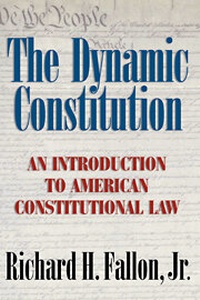
The Dynamic Constitution
An Introduction to American Constitutional Law
Published on 6. September 2004
Book
Hardback
360 pages
978-0-521-84094-1 (ISBN)
Description
In this 2004 book Harvard law professor Richard H. Fallon introduces non-lawyers to the workings of American constitutional law. He writes with clarity and vigor about leading constitutional doctrines and issues, including the freedom of speech, the freedom of religion, the guarantee of equal protection, rights to fair procedures and rights to privacy and sexual autonomy. Along the way, Fallon describes many of the fascinating cases and personalities that have shaped constitutional law. He shows how historical, cultural and other factors have influenced constitutional adjudication, making clear the dynamic nature of the Constitution. For both the courts and the American people, Fallon argues, the Constitution must serve as a dynamic document that adapts to the changing conditions inherent in human affairs. Fallon goes on to defend dynamic constitutionalism by confronting head on the concerns that some critics have raised.
Reviews / Votes
"Fallon...here offers what is arguably the best single introduction to modern American constitutional law short of a casebook. Highly recommended." J.R. Vile, Middle Tennessee State University, Choice "This is a superb book. Though written for non-lawyers, the brilliance of The Dynamic Constitution is that everyone from constitutional law professors to those with no training in law can enjoy, understand, and learn from reading it.. I believe that Richard Fallon has produced a successor to Robert McCloskey's classic, The American Supreme Court." Erwin Chemerinsky, University of Southern California Law School "Fallon's work here offers ascinating insight into the complexities of constitutional law." Kennebec Journal "For each controversial issue that concerns Americans today, Fallon supplies fascinating judicial history." The Victoria AdvocateMore details
Language
English
Place of publication
Cambridge
United Kingdom
Target group
Professional and scholarly
Illustrations
Worked examples or Exercises
Dimensions
Height: 234 mm
Width: 159 mm
Thickness: 28 mm
Weight
604 gr
ISBN-13
978-0-521-84094-1 (9780521840941)
Copyright in bibliographic data and cover images is held by Nielsen Book Services Limited or by the publishers or by their respective licensors: all rights reserved.
Schweitzer Classification
Other editions
New editions
Richard H. Fallon, Jr
The Dynamic Constitution
An Introduction to American Constitutional Law and Practice
Book
04/2013
2nd Edition
Cambridge University Press
€100.00
Shipment within 15-20 days
Additional editions
E-Book
11/2006
1st Edition
Cambridge University Press
€26.49
Available for download
Person
Richard H. Fallon Jr is Professor of Law at the Harvard Law School. He earned his BA from Yale University, matriculated as a Rhodes Scholar at Oxford University and then took his legal education at the Yale Law School. Widely known for his expertise in constitutional law and the federal courts, Fallon has been a valuable advisor to many organizations and litigants facing constitutional issues. Professor Fallon is also an accomplished educator. He is co-editor of a leading constitutional law case book, and was voted the most outstanding teacher on the Harvard Law School faculty by the 2000 graduating class. Born and raised in Maine, Dick Fallon now lives with his family in Belmont, Massachusetts.
Content
Preface; Prologue: Bush v. Gore; 1. The dynamic constitution; 2. Freedom of speech; 3. Freedom of religion; 4. Protection of economic liberties; 5. Rights to fair procedures; 6. Equal protection of the laws; 7. Fundamental rights; 8. The powers of congress; 9. Executive power; 10. Judicial power; 11. Elections, political democracy and the constitution; 12. Structural limits on state power and resulting individual rights; 13. The constitution in war and emergency; 14. The reach of the constitution and Congress's enforcement power; 15. Conclusion.