

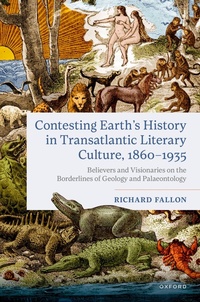
Contesting Earth's History in Transatlantic Literary Culture, 1860-1935
Believers and Visionaries on the Borderlines of Geology and Palaeontology
Published on 3. April 2025
Book
Hardback
288 pages
978-0-19-892616-0 (ISBN)
Description
By the mid-nineteenth century, geologists and palaeontologists had reconstructed an authoritative narrative of Earth's deep history, from the planet's molten origins to the rise of humanity. Many figures in transatlantic science across subsequent decades, however, had problems with this narrative: it was too secular, inhuman, and evolutionary, or controlled too exclusively by elite scientists. Speaking from palaeoscience's unevenly professionalized and controversy-racked borders, Christian fundamentalists, charismatic psychics, and respected scholars alike voiced their objections. Until now, no study has brought their work together for detailed comparative analysis.
Spanning from the 1860s to the interwar decades, Contesting Earth's History examines the fascinating stories of five significant examples of fringe or 'borderline' palaeoscience: old- and young-earth creationism, hollow-earth theory, clairvoyant time-travel, and sunken-continent catastrophism. Innovatively combining methods from literary studies with the history of science, this book attends not just to the conceptual content of these strange sciences, but also to their proponents' communication of truth claims through diverse genres ranging from the scientific textbook and the technical monograph to the lost-world romance and the epic poem. By paying close attention to the hitherto overlooked textual forms and literary strategies of these works of 'pseudoscience', this volume throws into relief the variant conceptions of audience, evidence, and method that jostled and competed in wider scientific culture during this period. It also demonstrates that, for all their diversity, authors of borderline palaeoscience shared the desire to shift the balance of power, creating textual spaces where exclusive hierarchies of scientific expertise could be levelled away.
These conjurors of lost worlds often captivated wide audiences and many of their bizarre, astonishing, and iconoclastic ideas remain with us to this day. Some even inspired early science fiction by the likes of H. P. Lovecraft and Edgar Rice Burroughs. Hijacking geologists' and palaeontologists' longstanding effort at making the prehistoric past visible, authors on the borderlines of palaeoscience asserted their right to scientific authority and encouraged readers to gaze into time's abyss with bold new eyes.
Spanning from the 1860s to the interwar decades, Contesting Earth's History examines the fascinating stories of five significant examples of fringe or 'borderline' palaeoscience: old- and young-earth creationism, hollow-earth theory, clairvoyant time-travel, and sunken-continent catastrophism. Innovatively combining methods from literary studies with the history of science, this book attends not just to the conceptual content of these strange sciences, but also to their proponents' communication of truth claims through diverse genres ranging from the scientific textbook and the technical monograph to the lost-world romance and the epic poem. By paying close attention to the hitherto overlooked textual forms and literary strategies of these works of 'pseudoscience', this volume throws into relief the variant conceptions of audience, evidence, and method that jostled and competed in wider scientific culture during this period. It also demonstrates that, for all their diversity, authors of borderline palaeoscience shared the desire to shift the balance of power, creating textual spaces where exclusive hierarchies of scientific expertise could be levelled away.
These conjurors of lost worlds often captivated wide audiences and many of their bizarre, astonishing, and iconoclastic ideas remain with us to this day. Some even inspired early science fiction by the likes of H. P. Lovecraft and Edgar Rice Burroughs. Hijacking geologists' and palaeontologists' longstanding effort at making the prehistoric past visible, authors on the borderlines of palaeoscience asserted their right to scientific authority and encouraged readers to gaze into time's abyss with bold new eyes.
Reviews / Votes
In this beautifully detailed, intricately researched, and compelling book, Richard Fallon unpacks the central theme of vision: how palaeoscientific experts provided one vision of Earth's history and fringe thinkers-writers on the edge of science and pseudoscience-provided counternarratives. * Patrick Morgan, The Review of English Studies *More details
Language
English
Place of publication
Oxford
United Kingdom
Target group
College/higher education
Product notice
sewn/stitched
Cloth over boards
Illustrations
28 Illustrations
Dimensions
Height: 239 mm
Width: 163 mm
Thickness: 25 mm
Weight
590 gr
ISBN-13
978-0-19-892616-0 (9780198926160)
Copyright in bibliographic data and cover images is held by Nielsen Book Services Limited or by the publishers or by their respective licensors: all rights reserved.
Schweitzer Classification
Person
Richard Fallon is an early career scholar of literature and science in the long nineteenth century working in postdoctoral roles at both the University of Nottingham and the Natural History Museum, London. In 2023, Dr Fallon completed a Leverhulme Trust Early Career Fellowship at the University of Birmingham. This role was based around the interdisciplinary research project, 'Borderline Geoscience and Transatlantic Literature in the Age of Lost Worlds'. Dr Fallon was awarded a PhD by the University of Leicester in 2019 for a thesis examining the popularization of dinosaur palaeontology between the 1870s and the 1920s.
Content
List of Figures Introduction 1: Envisioning the Days of Genesis 2: Deep Clairvoyance 3: Hollow Ground 4: Submerged in the Public Sphere 5: Geohistory, Unimagined Epilogue: To See and To Make Others See Bibliography Index