

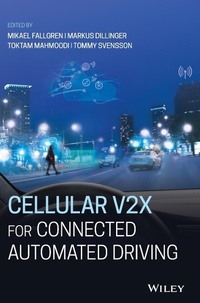
Cellular V2x for Connected Automated Driving
1st Edition
Published on 1. February 2021
Book
Hardback
320 pages
978-1-119-69264-5 (ISBN)
Description
Cellular assisted Vehicles to Everything (C-V2X) technologies in connected automated vehicles will enable information sharing between vehicles, and allow them to communicate both with the network and with each other using highly reliable and responsive, secure, and high capacity communication links. Enabling such connectivity will leverage disruptive new applications, business services resulting in advance driving support, additional road safety, and ultimately, fully automated vehicles widely spread at large scale. On the path to fully automated vehicles, there are significant challenges in serving the mix of vehicles at different automation levels, both for the network and for the vehicles.
More details
Other editions
Additional editions
Mikael Fallgren | Markus Dillinger | Toktam Mahmoodi
Cellular V2X for Connected Automated Driving
E-Book
04/2021
1st Edition
Wiley
€115.99
Available for download
Mikael Fallgren | Markus Dillinger | Toktam Mahmoodi
Cellular V2X for Connected Automated Driving
E-Book
04/2021
1st Edition
Wiley
€115.99
Available for download
Persons
Mikael Fallgren, Senior Researcher, Ericsson, Sweden. His Ph.D. degree was in applied and computational mathematics from KTH (the Royal Institute of Technology), Stockholm. His research interests include V2X and wireless access networks. In the METIS project he led the work on scenarios and requirements as well as on dissemination and standardization.
Markus Dillinger, 5G R&D head for connected cars, Huawei Technologies Duesseldorf, Germany. He received his Diplom-Ing. degree in telecommunications in 1990 from the University of Kaiserslautern, Germany. In 2013 he joined Huawei as Head of Wireless Internet Technologies where he runs private and public R&D programmes for e.g. car-to-car and automation supporting 3GPP standardization and normative work for the vertical industry.
Toktam Mahmoodi, Associate Professor, King?s College London, UK. She received the Ph.D. degree in Telecommunications from King?s College London, U.K. She has led, and contributed to number of FP7, H2020 and EPSRC funded projects in the area of mobile and wireless networks, including industrial networking, mission-critical communication, vehicular networks, teleoperation and haptic communications.
Tommy Svensson, Professor, Chalmers University of Technology, Gothenburg, Sweden. He received a Ph.D. in Information theory from Chalmers in 2003, and he has worked at Ericsson AB with core networks, radio access networks, and microwave transmission products. His research interests include design and analysis of physical layer algorithms, multiple access, resource allocation, cooperative systems, moving networks, and satellite networks.
Content
1. Introduction
1.1. Background
1.1.1. Telecom's roadmap in connected driving
1.1.2. Automotive's roadmap on automated driving
1.1.3. Intelligent transport systems
1.1.4. Standardization and regulation
1.2. Communication aspects of ITS
1.2.1. State of the art
1.2.2. Future developments in C-V2X
1.3. Structure of this book
1.4. References
2. Business Models
2.1. Service Definition
2.1.1. Existing Services
2.1.2. Autonomous driving features
2.1.3. Convenience services
2.2. Technical components
2.3. Practicalities
2.3.1. Profile/SIM card provisioning
2.3.2. Routing strategy
2.3.3. Roaming and Inter-operator co-operation
2.3.4. Network technologies and OEMs status
2.3.5. Possible business model evolution
2.4. Business market opportunities for V2X
2.4.1. 5GCAM business model
2.4.2. Security provision
2.4.3. Over the air updates
2.5. Business model analysis of 5G V2X technical components
2.5.1. Positioning
2.5.2. V2X radio design
2.5.3. Network procedures
2.5.4. End to end security
2.5.5. Edge computing enhancements
2.5.6. Summary
2.6. Conclusions
2.7. References
3. Standardization and regulation
3.1. Standardization process overview
3.1.1. General aspects
3.1.2. Standardization and regulation bodies relevant to ITS specifications
3.1.3. 3GPP structure and standardization process
3.2. Regulatory aspects and spectrum allocation
3.2.1. C-V2X policy and regulations in Europe
3.2.2. Radio frequency spectrum allocation for V2X communications
3.3. Standardization of V2X communication technology solutions
3.3.1. A brief history of V2X communication
3.3.2. Overview of DSRC/C-V2X specifications around the globe
3.3.3. C-V2X standardization in 3GPP; towards and within 5G
3.4. Automotive industry
3.4.1. 5GAA
3.4.2. Industry penetration
3.5. Application aspects
3.5.1. U.S. standardization
3.5.2. E.U. standardization
3.6. Summary
3.7. References
4. Spectrum and Channel Modeling
4.1. Spectrum and regulations for V2X communications
4.1.1. Spectrum bands in Europe
4.1.2. Spectrum bands in other regions
4.1.3. Spectrum Auctions worldwide
4.1.4. Spectrum harmonization worldwide
4.1.5. Summary
4.2. Channel Modeling
4.2.1. Propagation environments
4.2.2. Channel Modeling Framework and Gap Analysis
4.2.3. Path Loss Models
4.2.4. Recent V2X channel measurements and models
4.2.5. Summary
4.3. References
5. V2X Radio Interface
5.1. Introduction
5.2. Beamforming techniques for V2X communication in mm-wave spectrum
5.2.1. Beam refinement for mobile multi-user scenario
5.2.2. Beamformed multicasting
5.2.3. Beam-based broadcasting
5.3. PHY and MAC layer extensions
5.3.1. Channel state information acquisition and MU-MIMO receiver design
5.3.2. Reference signal design
5.3.3. Synchronization
5.3.4. Scheduling and power control
5.4. Technology features enabled by vehicular sidelink
5.4.1. UE Cooperation for enhancing reliability
5.4.2. Full and flexible duplex
5.5. Summary
5.6. References
6. Network Enhancements
6.1. Introduction
6.2. Network Slicing
6.2.1. Network Slicing and 3GPP
6.2.2. Network Slicing and V2X
6.3. Role of SDN and NFV in V2X
6.4. Cloudified Architecture
6.5. Local End to End Path
6.6. Multi-Operator Support
6.7. Summary
6.8. References
7. Enhancements to support V2X application adaptations
7.1. Introduction
7.2. Background
7.3. Enhanced application-network interaction for V2X use case handling
7.3.1. V2X Service negotiation
7.3.2. Use-case aware multi-RAT multi-link connectivity
7.3.3. Location-aware scheduling
7.4. Redundant scheduler for sidelink and Uu
7.4.1. Application or Facilities layer
7.4.2. Transport level
7.4.3. RRC level
7.5. Summary
7.6. References
8. Radio based positioning and video based positioning
8.1. Introduction
8.2. Radio based positioning
8.2.1. Use cases and requirements
8.2.2. Radio-based positioning in New Radio Release 16
8.2.3. Radio-based positioning beyond Release 16
8.2.4. Technology component complementation
8.2.5. Limitations of radio-based positioning
8.2.6. Summary
8.3. Video based positioning
8.3.1. Vehicle positioning system setup
8.3.2. Multi camera calibration
8.3.3. Vehicle detection
8.3.4. Vehicle tracking
8.3.5. Vehicle localization
8.3.6. Accuracy evaluation
8.3.7. Summary
8.4. Conclusions
8.5. References
9. Security and privacy
9.1. Introduction
9.2. V2N Security
9.2.1. Security Challenges
9.2.2. Isolation Challenges
9.2.3. Software-Defined Vehicular Networking Security
9.3. V2V/V2I/I2V security
9.3.1. V2X security
9.3.2. Privacy
9.3.3. E.U. V2X security architecture
9.3.4. U.S. V2X security architecture
9.4. Alternative approaches
9.5. Conclusion
9.6. References
10. Status, Recommendations and Outlook
10.1. Status of Described C-V2X Technical Concepts
10.2. Technical and Non-technical Gaps in Broad
10.3. Recommendations to Stakeholders
10.3.1. Mobile Network Operators
10.3.2. Original Equipment Manufacturers
10.3.3. Regulators
10.3.4. Suppliers and certification
10.4. Outlook
10.5. References