

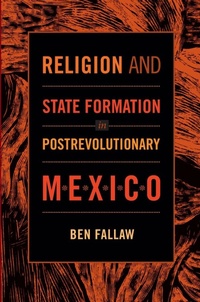
Religion and State Formation in Postrevolutionary Mexico
Published on 21. January 2013
Book
Paperback/Softback
360 pages
978-0-8223-5337-9 (ISBN)
Description
The religion question-the place of the Church in a Catholic country after an anticlerical revolution-profoundly shaped the process of state formation in Mexico. From the end of the Cristero War in 1929 until Manuel Avila Camacho assumed the presidency in late 1940 and declared his faith, Mexico's unresolved religious conflict roiled regional politics, impeded federal schooling, undermined agrarian reform, and flared into sporadic violence, ultimately frustrating the secular vision shared by Plutarco ElIas Calles and LAzaro CArdenas. Ben Fallaw argues that previous scholarship has not appreciated the pervasive influence of Catholics and Catholicism on postrevolutionary state formation. By delving into the history of four understudied Mexican states, he is able to show that religion swayed regional politics not just in states such as Guanajuato, in Mexico's central-west "Rosary Belt," but even in those considered much less observant, including Campeche, Guerrero, and Hidalgo. Religion and State Formation in Postrevolutionary Mexico reshapes our understanding of agrarian reform, federal schooling, revolutionary anticlericalism, elections, the Segunda (a second Cristero War in the 1930s), and indigenism, the Revolution's valorization of the Mesoamerican past as the font of national identity.
Reviews / Votes
"Religion and State Formation in Postrevolutionary Mexico should establish itself as a key text in Mexican revolutionary history. The author has done a prodigious quantity of research and organized it expertly, producing an original and convincing analysis of a major theme: Church-state conflict in the postrevolutionary period. The issue permeated Mexican politics, and its exploration opens a window onto a variety of other themes, including state building, education, land reform, gender, ethnicity, violence, and local politics and elections."-Alan Knight, author of The Mexican Revolution "This important book forces a rethinking of the efficacy and influence of agrarian and cultural revolutions not only in Mexico but throughout the world. In what is nothing short of a massive reappraisal of the pivotal presidency of LAzaro CArdenas, Ben Fallaw demonstrates how conservative Catholic opposition at the local and state levels consistently obstructed Cardenista reform. Based on his detailed reconstruction of circumstances and events in four very different Mexican states, he reminds us that conditions differed enormously among locales, even between two villages in the same state. His research is blockbuster in every possible way."-Terry Rugeley, author of Of Wonders and Wise Men: Religion and Popular Cultures in Southeast Mexico, 1800-1876 "In this impressively researched, organized, and written work, Fallaw (Colby College) examines one of the major themes facing Mexico in the 1930s-the conflict between the Catholic Church and the state."- J. B. Kirkwood (Choice) "...the author provides one of the best portraits of how the Mexican state's anticlericalism, rationalist educational reforms, land reform, anticlerical agitation, and indigenism were intertwined and thus galvanized opponents." - Edward Wright-Rios (American Historical Review) "Fallaw's study proves utterly striking, as his study details in multiple ways clerical and governmental failures to serve the basic needs of an impoverished and poorly educated public. His study reveals some of the ways that widespread cultural ignorance of the complex material cultural needs of the Mexican population persisted during the postrevolutionary period." - Marjorie Becker (Catholic Historical Review) "[Fallaw's] careful marshaling of evidence and his sound analysis make clear why agrarian reform and changing religious practice and devotion were extremely difficult to achieve." - Linda B. Hall (Hispanic American Historical Review) "Overall, Religion and State Formation in Postrevolutionary Mexico is one of the most important books on twentieth century Mexico of the last ten years. Original, thoroughly researched, and ambitious in scope, the work is a must read for those interested in revolutionary Mexico, modern Catholic sensibilities, or the overlap of politics and religion." - Benjamin Smith (The Americas) "Ben Fallaw's extraordinary new book, Religion and State Formation in Postrevolutionary Mexico, ostensibly explains religious violence in four Mexican states: Campeche, Hidalgo, Guerrero, and Guanajuato. In the process, however, Fallaw tells us much more. Challenging a number of widely held assumptions about this period, he describes convincingly how and why the revolutionary project failed in the countryside." - Stephanie Mitchell (The Latin Americanist) "This is a superbly researched and enduring contribution to the history of the Mexican Revolution and Latin America's political and religious history. For the many researchers who continue to ponder how Mexico's regions responded to national institutions and discourses, Fallaw's book will be indispensable." - Thomas Rath (Journal of Latin American Studies) "This is a prodigiously researched work that weaves together the specificity of four cases within a satisfying analytic framework. It is likely to encourage further work on religion and state formation." - Jeffrey Mosher (EIAL)
More details
Language
English
Place of publication
North Carolina
United States
Target group
Professional and scholarly
Product notice
Paperback (trade)
Dimensions
Height: 235 mm
Width: 156 mm
Thickness: 20 mm
Weight
538 gr
ISBN-13
978-0-8223-5337-9 (9780822353379)
Copyright in bibliographic data and cover images is held by Nielsen Book Services Limited or by the publishers or by their respective licensors: all rights reserved.
Schweitzer Classification
Other editions
Additional editions
E-Book
01/2013
1st Edition
De Gruyter
€208.99
Available for download
Person
Ben Fallaw is Associate Professor of History and Latin American Studies at Colby College. He is the author of CArdenas Compromised: The Failure of Reform in Postrevolutionary YucatAn, also published by Duke University Press, and a coeditor of Peripheral Visions: Politics, Society, and the Challenges of Modernity in Yucatan and Heroes and Hero Cults in Latin America.
Content
Acknowledgments ix
List of Abbreviations xi
Glossary xv
Introduction 1
1. The Church and the Religious Question 13
2. Catholic-Socialists against Anti-Priests in Campeche 35
3. "The Devil Is Now Loose in Huejutla": The Bishop, the SEP, and the Emancipation of the Indian in Hidalgo 63
4. Beatas, Ballots, and Bullets in Guerrero 101
5. "Un sin fin de mochos": Catholic Cacicazgos in Guanajuato 157
Conclusion: The End of the Religious Question 219
Notes 227
Bibliography 295
Index 317
List of Abbreviations xi
Glossary xv
Introduction 1
1. The Church and the Religious Question 13
2. Catholic-Socialists against Anti-Priests in Campeche 35
3. "The Devil Is Now Loose in Huejutla": The Bishop, the SEP, and the Emancipation of the Indian in Hidalgo 63
4. Beatas, Ballots, and Bullets in Guerrero 101
5. "Un sin fin de mochos": Catholic Cacicazgos in Guanajuato 157
Conclusion: The End of the Religious Question 219
Notes 227
Bibliography 295
Index 317