

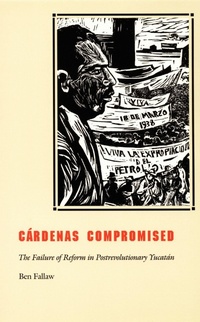
Cardenas Compromised
The Failure of Reform in Postrevolutionary Yucatan
Will be published approx. on 17. August 2001
Book
Hardback
240 pages
978-0-8223-2758-5 (ISBN)
Description
CArdenas Compromised is a political and institutional history of Mexico's urban and rural labor in the YucatAn region during the regime of LAzaro CArdenas from 1934 to 1940. Drawing on archival materials, both official and popular, Fallaw combines narrative, individual case studies, and focused political analysis to reexamine and dispel long-cherished beliefs about the Cardenista era.
For historical, geographical, and ethnic reasons, YucatAn was the center of large-scale land reform after the Mexican Revolution. A long-standing revolutionary tradition, combined with a harsh division between a powerful white minority and a poor, Maya-speaking majority, made the region the perfect site for CArdenas to experiment by launching an ambitious top-down project to mobilize the rural poor along ethnic and class lines. The regime encouraged rural peasants to form collectives, hacienda workers to unionize, and urban laborers to strike. It also attempted to mobilize young people and women, to challenge YucatAn's traditional, patriarchal social structure, to reach out to Mayan communities, and to democratize the political process. Although the project ultimately failed, political dialogue over CArdenas's efforts continues. Rejecting both revisionist (anti-CArdenas) and neopopulist (pro-CArdenas) interpretations, Fallaw overturns the notion that the state allowed no room for the agency of local actors. By focusing on historical connections across class, political, and regional lines, Fallaw transforms ideas on Cardenismo that have long been accepted not only in YucatAn but throughout Mexico.
This book will appeal to scholars of Mexican history and of Latin American state formation, as well as to sociologists and political scientists interested in modern Mexico.
For historical, geographical, and ethnic reasons, YucatAn was the center of large-scale land reform after the Mexican Revolution. A long-standing revolutionary tradition, combined with a harsh division between a powerful white minority and a poor, Maya-speaking majority, made the region the perfect site for CArdenas to experiment by launching an ambitious top-down project to mobilize the rural poor along ethnic and class lines. The regime encouraged rural peasants to form collectives, hacienda workers to unionize, and urban laborers to strike. It also attempted to mobilize young people and women, to challenge YucatAn's traditional, patriarchal social structure, to reach out to Mayan communities, and to democratize the political process. Although the project ultimately failed, political dialogue over CArdenas's efforts continues. Rejecting both revisionist (anti-CArdenas) and neopopulist (pro-CArdenas) interpretations, Fallaw overturns the notion that the state allowed no room for the agency of local actors. By focusing on historical connections across class, political, and regional lines, Fallaw transforms ideas on Cardenismo that have long been accepted not only in YucatAn but throughout Mexico.
This book will appeal to scholars of Mexican history and of Latin American state formation, as well as to sociologists and political scientists interested in modern Mexico.
Reviews / Votes
"A deeply researched and convincingly argued regional study that illuminates the contradictions and ambiguities of Mexico's most radical post-revolutionary regime."-Mary Kay Vaughan, author of Cultural Politics in Revolution: Teachers, Peasants, and Schools in Mexico, 1934-1940 "Fallaw presents a great deal of new information on the history of the key state of YucatAn during the decisive years of the 1930s, when Mexico underwent profound political and social reform. Those working on Mexican revolutionary history will find this book invaluable. Broad-minded political scientists will find the analysis illuminating, as well."-Alan Knight, author of The Mexican RevolutionMore details
Language
English
Place of publication
North Carolina
United States
Target group
Professional and scholarly
Product notice
Cloth over boards
Illustrations
1 map
Dimensions
Height: 241 mm
Width: 158 mm
Thickness: 20 mm
Weight
576 gr
ISBN-13
978-0-8223-2758-5 (9780822327585)
Copyright in bibliographic data and cover images is held by Nielsen Book Services Limited or by the publishers or by their respective licensors: all rights reserved.
Schweitzer Classification
Other editions
Additional editions
E-Book
08/2001
1st Edition
De Gruyter
€198.99
Available for download
Person
Ben Fallaw is Assistant Professor of History and Latin American Studies at Colby College.
Content
Acknowledgments ix
Introduction 1
1 Agrarian Cardenismo, THe Rise of the CGT, and the Fall of Governor Alayola, 1934-1935 15
2 Left-Cardenismo and the Lopez Cardenas Administrations, 1935- 1936 38
3 Cardenismo in Crisiss: Gualbertismo, the Falal of Lopez Cardenas, and the Rise of the Official Camarilla 59
4 The Crusade of the Mayab: Cardenismo from Above 80
5 Alliance Failed: Cardenas, Urban Labor, and the Open Door Election of 1937 97
6 The Retreat of Cardenas: The Great Ejido Plan and the New Political Equilibrium in Yucatan 125
7 Cardenas Compromised: Cardenismo's Legacy in Yucatan 158
Notes 169
List of Abbreviations 201
Bibliography 205
Introduction 1
1 Agrarian Cardenismo, THe Rise of the CGT, and the Fall of Governor Alayola, 1934-1935 15
2 Left-Cardenismo and the Lopez Cardenas Administrations, 1935- 1936 38
3 Cardenismo in Crisiss: Gualbertismo, the Falal of Lopez Cardenas, and the Rise of the Official Camarilla 59
4 The Crusade of the Mayab: Cardenismo from Above 80
5 Alliance Failed: Cardenas, Urban Labor, and the Open Door Election of 1937 97
6 The Retreat of Cardenas: The Great Ejido Plan and the New Political Equilibrium in Yucatan 125
7 Cardenas Compromised: Cardenismo's Legacy in Yucatan 158
Notes 169
List of Abbreviations 201
Bibliography 205