

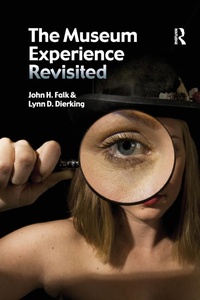
The Museum Experience Revisited
1st Edition
Published on 15. December 2012
Book
Paperback/Softback
416 pages
978-1-61132-045-9 (ISBN)
Description
The first book to take a "visitor's eye view" of the museum visit when it was first published in 1992, The Museum Experience revolutionized the way museum professionals understand their constituents. Falk and Dierking have updated this essential reference, incorporating advances in research, theory, and practice in the museum field over the last twenty years. Written in clear, non-technical style, The Museum Experience Revisited paints a thorough picture of why people go to museums, what they do there, how they learn, and what museum practitioners can do to enhance these experiences.
More details
Language
English
Place of publication
Walnut Creek
United States
Target group
Professional and scholarly
Dimensions
Height: 229 mm
Width: 152 mm
Thickness: 23 mm
Weight
603 gr
ISBN-13
978-1-61132-045-9 (9781611320459)
Copyright in bibliographic data and cover images is held by Nielsen Book Services Limited or by the publishers or by their respective licensors: all rights reserved.
Schweitzer Classification
Other editions
Additional editions
John H. Falk | Lynn D. Dierking
The Museum Experience Revisited
E-Book
06/2016
Routledge
€55.49
Available for download
John H. Falk | Lynn D. Dierking
The Museum Experience Revisited
E-Book
06/2016
Routledge
€55.49
Available for download
John H. Falk | Lynn D. Dierking
The Museum Experience Revisited
Book
12/2012
1st Edition
Left Coast Press Inc
€232.90
Shipment within 3-4 weeks
Persons
John H. Falk is a leading figure in free-choice learning, museum research, and science education in the United States. Currently, he holds the position Sea Grant Professor of Free-Choice Learning at Oregon State University (OSU) and Director, OSU Center for Research on Lifelong STEM Learning. He was founder and, for twenty years, Director of the Institute for Learning Innovation in Annapolis, Maryland, and held several high-level positions during his fourteen years at the Smithsonian Institution. Falk earned a joint doctorate in Biology and Education from the University of California, Berkeley. He is the author of over one hundred scholarly articles and chapters in the areas of biology, psychology, and education, and author or editor of numerous books, including, as author, of Identity and the Museum Visitor Experience; as co-author, with Lynn Dierking, of The Museum Experience, Learning from Museums: Visitor Experiences and the Making of Meaning, and Lessons without Limit: How Free-Choice Learning Is Transforming Education; and as co-author, with Beverly Sheppard, of Thriving in the Knowledge Age: New Business Models for Museums and Other Cultural Institutions.Free-Choice Science Education: How We Learn Science Outside of School is one of the many books he's edited. Falk received a 2010 John Cotton Dana Award for Leadership from the American Association of Museums, the highest honor bestowed upon someone from outside the museum field who exhibits outstanding leadership and promotes the educational responsibility and capacity of museums.
Lynn D. Dierking is Sea Grant Professor in Free-Choice Learning, College of Science, and Interim Associate Dean for Research, College of Education at Oregon State University. Dierking earned a doctorate in Science Education from the University of Florida in 1987. Her research focuses on lifelong learning, particularly free-choice, out-of-school time learning (in after-school, home-, community-based, and cultural contexts), with an emphasis on youth, families, and community, particularly those from poor and/or historically under-represented groups. Dierking has published extensively and serves on editorial boards for the Journal of Research in Science Teaching, the Journal of Museum Management and Curatorship, and Afterschool Matters. Along with John Falk, she created the Science Learning in Everyday Life section of the journal Science Education, which she co-edited with him for over a decade. In addition to books she has written with Falk, she also has co-authored/co-edited three other books-Questioning Our Assumptions from the Start: An Introduction to Front-End Studies in Museums, Collaboration: Critical Criteria for Success, and The Handbook of Small Science Centers. Dierking received a 2010 John Cotton Dana Award for Leadership from the American Association of Museums, the highest honor bestowed upon someone outside the museum field who exhibits outstanding leadership and promotes the educational responsibility and capacity of museums.
Lynn D. Dierking is Sea Grant Professor in Free-Choice Learning, College of Science, and Interim Associate Dean for Research, College of Education at Oregon State University. Dierking earned a doctorate in Science Education from the University of Florida in 1987. Her research focuses on lifelong learning, particularly free-choice, out-of-school time learning (in after-school, home-, community-based, and cultural contexts), with an emphasis on youth, families, and community, particularly those from poor and/or historically under-represented groups. Dierking has published extensively and serves on editorial boards for the Journal of Research in Science Teaching, the Journal of Museum Management and Curatorship, and Afterschool Matters. Along with John Falk, she created the Science Learning in Everyday Life section of the journal Science Education, which she co-edited with him for over a decade. In addition to books she has written with Falk, she also has co-authored/co-edited three other books-Questioning Our Assumptions from the Start: An Introduction to Front-End Studies in Museums, Collaboration: Critical Criteria for Success, and The Handbook of Small Science Centers. Dierking received a 2010 John Cotton Dana Award for Leadership from the American Association of Museums, the highest honor bestowed upon someone outside the museum field who exhibits outstanding leadership and promotes the educational responsibility and capacity of museums.
Content
Chapter 1 Introduction; Part 1 Before the Visit; Chapter 2 The Personal Context; Chapter 3 The Sociocultural Context; Chapter 4 The Personal Context; Part 2 During the Visit; Chapter 5 The Physical Context; Chapter 6 The Physical Context; Chapter 7 The Sociocultural Context; Chapter 8 The Interplay of Contexts; Part 3 After the Visit; Chapter 9 The Museum Experience Remembered; Chapter 10 Measuring the Learning Impact of Museums; Part 4 A Professional's Guide to the Museum Experience; Chapter 11 Supporting the Museum Experience; Part 5 Beyond the Visit; Chapter 12 The Twenty-First-Century Museum;