

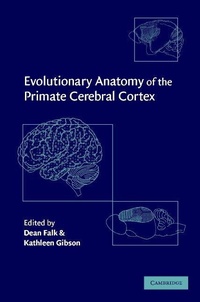
Evolutionary Anatomy of the Primate Cerebral Cortex
Published on 19. April 2001
Book
Hardback
364 pages
978-0-521-64271-2 (ISBN)
Description
Studies of brain evolution have moved rapidly in recent years, building on the pioneering research of Harry J. Jerison. This book provides reviews of primate (including human) brain evolution. The book is divided into two sections, the first gives new perspectives on the developmental, physiological, dietary and behavioural correlates of brain enlargement. It has long been recognized, however, that brains do not merely enlarge globally as they evolve, but that their cortical and internal organization also changes in a process known as reorganization. Species-specific adaptations therefore have neurological substrates that depend on more than just overall brain size. The second section explores these neurological underpinnings for the senses, adaptations and cognitive abilities that are important for primates. With a prologue by Stephen J. Gould and an epilogue by Harry J. Jerison, this is an important reference work for all those working on brain evolution in primates.
Reviews / Votes
"...a good deal of the book's contents will be familiar to the expert reader...an excellent choice for anyone who needs a survey of current evolutionary brain research." Current AnthropolgyMore details
Language
English
Place of publication
Cambridge
United Kingdom
Target group
Professional and scholarly
Illustrations
9 Tables, unspecified; 19 Halftones, unspecified; 51 Line drawings, unspecified
Dimensions
Height: 240 mm
Width: 161 mm
Thickness: 24 mm
Weight
710 gr
ISBN-13
978-0-521-64271-2 (9780521642712)
Copyright in bibliographic data and cover images is held by Nielsen Book Services Limited or by the publishers or by their respective licensors: all rights reserved.
Schweitzer Classification
Other editions
Additional editions
Dean Falk | Kathleen R. Gibson
Evolutionary Anatomy of the Primate Cerebral Cortex
E-Book
10/2015
1st Edition
Cambridge University Press
€49.99
Available for download
Persons
Content
Preface; Prologue Stephen J. Gould; Introduction to Part I Kathleen Gibson; Part I. The Evolution of Brain Size: 1. Encephalization and its developmental structure: how many ways can a brain get big? Peter M. Kaskan and Barbara L. Finlay; 2. Neocortical expansion and elaboration during primate evolution: a view from neuroembryology Pasko Rakic and David R. Kornack; 3. In defense of the expensive tissue hypothesis Leslie C. Aiello, Nicola Bates and Tracey Joffe; 4. Bigger is better: primate brain size in relationship to cognition Kathleen Gibson, Duane Rumbaugh and Michael Beran; 5. The evolution of sex differences in primate brains Dean Falk; 6. Brain evolution in hominids: are we at the end of the road? Michel A. Hofman; Introduction to Part II Dean Falk; Part II. Neurological Substrates of Species-Specific Adaptations: 7. The discovery of cerebral diversity: an unwelcome scientific revolution Todd M. Preuss; 8. Pheromonal communication and socialization Brunetto Chiarelli; 9. Revisiting australopithecine visual striate cortex: newer data from chimpanzee and human brains suggest it could have been reduced during australopithecine times Ralph L. Holloway, Douglas C. Broadfield and Michael S. Yuan; 10. Structural symmetries and asymmetries in human and chimpanzee brains Emmanuel Gilissen; 11. Language areas of the hominid brain: a dynamic communicative shift on the upper east side planum Patrick J. Gannon, Nancy M. Kheck and Patrick R. Hof; 12. The promise and the peril in hominid brain evolution Phillip V. Tobias; 13. Advances in the study of hominid brain evolution: magnetic resonance imaging (MRI) and 3-D reconstruction Katerina Semendeferi; 14. Exo- and endocranial morphometrics in mid-Pleistocene and modern humans Katrin Schafer, Horst Seidler, Fred L. Bookstein, Hermann Prossinger, Dean Falk and Glenn Conroy; Epilogue: the study of primate brain evolution: where do we go from here? Harry Jerison.