

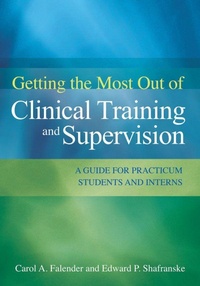
Getting the Most Out of Clinical Training and Supervision
A Guide for Practicum Students and Interns
Published on 15. December 2011
Book
Paperback/Softback
304 pages
978-1-4338-1049-7 (ISBN)
Description
This book shows students how to establish effective working supervisory relationships and understand and make use of formative and summative evaluations.
Clinical training is challenging for supervisees, many of whom are unsure how to navigate the supervisory process and effectively build clinical skills and professional competence. While research and book-length texts on effective supervision have proliferated, these are typically directed towards supervisors and clinical educators. Since it was first published in 2004, Falender and Shafranske's Clinical Supervision: A Competency-Based Approach has become the standard, go-to resource on supervisory and clinical competence. Now the authors have created an empirically-supported yet practical book for student and interns.
Written in an interactive style with "real life" case examples and reflection activities, this book is empirically-supported yet highly practical, this is an essential text that normalizes the anxieties and conflicts that typically arise during supervision.
Clinical training is challenging for supervisees, many of whom are unsure how to navigate the supervisory process and effectively build clinical skills and professional competence. While research and book-length texts on effective supervision have proliferated, these are typically directed towards supervisors and clinical educators. Since it was first published in 2004, Falender and Shafranske's Clinical Supervision: A Competency-Based Approach has become the standard, go-to resource on supervisory and clinical competence. Now the authors have created an empirically-supported yet practical book for student and interns.
Written in an interactive style with "real life" case examples and reflection activities, this book is empirically-supported yet highly practical, this is an essential text that normalizes the anxieties and conflicts that typically arise during supervision.
Reviews / Votes
"Quite simply, this book is one of the best of its kind, geared specifically to clinical psychology trainees who want to get the most from their formal supervision. Although the primary audience for the book is practicum students and interns, supervisors themselves should read it to improve their own skills. The book is so good that I recommend it as a standard text for trainees with supervisors within psychology training programs. Truly, this is a masterful resource that explains and makes manifest the art and science of supervision." - New England PsychologistMore details
Language
English
Place of publication
Washington DC
United States
Target group
Professional and scholarly
College/higher education
Product notice
Paperback (trade)
Dimensions
Height: 249 mm
Width: 173 mm
Thickness: 23 mm
Weight
567 gr
ISBN-13
978-1-4338-1049-7 (9781433810497)
Copyright in bibliographic data and cover images is held by Nielsen Book Services Limited or by the publishers or by their respective licensors: all rights reserved.
Schweitzer Classification
Persons
Carol A. Falender, PhD, has directed APA accredited internship programs and supervised interns and practicum students for over two decades. Currently, she teaches doctoral students, supervises, and provides clinical supervision workshops. She has served as president of APA Division 37, Society for Child and Family Policy and Practice, co-chair of the Los Angeles County Psychological Association Ethics Committee, and as a member of the Association of State and Provincial Psychology Boards Supervision Guidelines Task Force and delegate to the Competencies Conference and to Benchmarks. She is an APA council representative, clinical professor in the Department of Psychology at the University of California, Los Angeles and adjunct professor at Pepperdine University. She is coauthor of Clinical Supervision: A Competency-Based Approach, coeditor of Casebook for Clinical Supervision: A Competency-Based Approach, both published by APA and she has also written numerous journal articles on supervision.
Edward P. Shafranske, PhD, ABPP, currently serves as a professor of psychology, Muriel Lipsey Endowed Chair for Counseling and Clinical Psychology, and director of the PsyD program in clinical psychology at Pepperdine University. He also lectures in the Psychiatry Residency Program at the University of California, Los Angeles and has served as president of APA Division 3 : Psychology of Religion and Spirituality, and on the APA Council of Representatives. He currently teaches courses on psychotherapy, supervises first-year students through post-graduates, and advises students in research on clinical supervision. He is coauthor of Clinical Supervision: A Competency-Based Approach, coeditor of Casebook for Clinical Supervision: A Competency-Based Approach, editor of Religion and the Clinical Practice of Psychology, and coauthor of Spiritually Oriented Psychotherapy, each published by APA.
Edward P. Shafranske, PhD, ABPP, currently serves as a professor of psychology, Muriel Lipsey Endowed Chair for Counseling and Clinical Psychology, and director of the PsyD program in clinical psychology at Pepperdine University. He also lectures in the Psychiatry Residency Program at the University of California, Los Angeles and has served as president of APA Division 3 : Psychology of Religion and Spirituality, and on the APA Council of Representatives. He currently teaches courses on psychotherapy, supervises first-year students through post-graduates, and advises students in research on clinical supervision. He is coauthor of Clinical Supervision: A Competency-Based Approach, coeditor of Casebook for Clinical Supervision: A Competency-Based Approach, editor of Religion and the Clinical Practice of Psychology, and coauthor of Spiritually Oriented Psychotherapy, each published by APA.
Content
Preface
I. Becoming a Competent Supervisee
Beginning Clinical Practice Under Supervision
Entering Competency-Based Supervision
Expectations and the Path to Good Supervision
II. Developing Clinical Competence Through Supervision
Developing Competence to Practice in a Diverse World
Developing the Therapeutic Alliance and Managing Strains and Ruptures
The Use of the Self in Psychotherapy
Case Conceptualization: The Practice of Clinical Understanding
Practicing Ethically
III. Advancing Reflective Practice in Supervision
Transforming Supervision to Be More Successful
Becoming a Reflective Clinician
Appendix A: Competency Benchmarks
Appendix B: The Practicum Competencies Outline: Report on Practicum Competencies
Appendix C: Practices and Beliefs Questionnaire
References
Index
About the Authors
I. Becoming a Competent Supervisee
Beginning Clinical Practice Under Supervision
Entering Competency-Based Supervision
Expectations and the Path to Good Supervision
II. Developing Clinical Competence Through Supervision
Developing Competence to Practice in a Diverse World
Developing the Therapeutic Alliance and Managing Strains and Ruptures
The Use of the Self in Psychotherapy
Case Conceptualization: The Practice of Clinical Understanding
Practicing Ethically
III. Advancing Reflective Practice in Supervision
Transforming Supervision to Be More Successful
Becoming a Reflective Clinician
Appendix A: Competency Benchmarks
Appendix B: The Practicum Competencies Outline: Report on Practicum Competencies
Appendix C: Practices and Beliefs Questionnaire
References
Index
About the Authors