

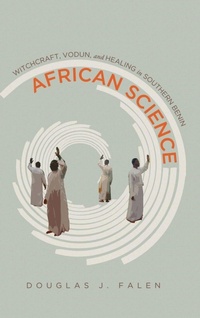
African Science
Witchcraft, Vodun, and Healing in Southern Benin
Published on 30. October 2018
Book
Hardback
240 pages
978-0-299-31890-1 (ISBN)
Description
In this sensitive and personal investigation into Benin's occult world, Douglas J. Falen wrestles with the challenges of encountering a reality in which magic, science, and the Vodun religion converge into a single universal force. He takes seriously his Beninese interlocutors' insistence that the indigenous phenomenon known as aze (""witchcraft"") is an African science, credited with fantastic and productive deeds, such as teleportation and supernatural healing.
Although the Beninese understanding of aze reflects positive scientific properties in its use of specialized knowledge to harness nature's energy and realize economic success, its boundless power is inherently ambivalent because it can corrupt its users, who dispense death and destruction. Witches and healers are equivalent to supervillains and superheroes, locked in epic battles over malevolent and benevolent human desires. Beninese people's discourse about such mystical confrontations expresses a philosophy of moral duality and cosmic balance. Falen demonstrates how a deep engagement with another lived reality opens our minds and contributes to understanding across cultural difference.
Although the Beninese understanding of aze reflects positive scientific properties in its use of specialized knowledge to harness nature's energy and realize economic success, its boundless power is inherently ambivalent because it can corrupt its users, who dispense death and destruction. Witches and healers are equivalent to supervillains and superheroes, locked in epic battles over malevolent and benevolent human desires. Beninese people's discourse about such mystical confrontations expresses a philosophy of moral duality and cosmic balance. Falen demonstrates how a deep engagement with another lived reality opens our minds and contributes to understanding across cultural difference.
Reviews / Votes
A stunning achievement in the anthropology of religion. Weaving together narrative and analysis, Falen provides a gripping account of the imponderables that constitute the occult in Benin. He demonstrates how African science can refine our comprehension of fidelity and betrayal, health and illness, science and religion, and life and death- the philosophical themes that define our humanity."" - Paul Stoller, author of In Sorcery's Shadow,""Guides readers straight into the untranslatable Beninois world of aze on its own terms. Falen's sensitivity and commitment to local framings and his accessible experiential narratives make this an ideal ethnography with which to explore the ontological turn, as well as a marvelously provocative challenge to the bulwarked categories separating science from magic and religion."" - Sasha Newell, author of The Modernity Bluff
More details
Language
English
Place of publication
Wisconsin
United States
Target group
Professional and scholarly
Product notice
Laminated cover
Illustrations
16 black & white illustrations
Dimensions
Height: 229 mm
Width: 152 mm
Thickness: 16 mm
Weight
506 gr
ISBN-13
978-0-299-31890-1 (9780299318901)
Copyright in bibliographic data and cover images is held by Nielsen Book Services Limited or by the publishers or by their respective licensors: all rights reserved.
Schweitzer Classification
Person
Douglas J. Falen is a professor of anthropology at Agnes Scott College in Decatur, Georgia. He is the author of Power and Paradox: Authority, Insecurity, and Creativity in Fon Gender Relations.
Content
List of Illustrations
Acknowledgments
Note on Fon Transcription and Pronunciation
Introduction
1 Aze and B?: Witchcraft and Sorcery in Benin
2 Black and White: Witchcraft, Science, and Identity
3 Whose Reality?
4 Religion and the Occult: Opposition and Connection
5 Healing and the Globalization of Witchcraft
Conclusion
Notes
References
Index
Acknowledgments
Note on Fon Transcription and Pronunciation
Introduction
1 Aze and B?: Witchcraft and Sorcery in Benin
2 Black and White: Witchcraft, Science, and Identity
3 Whose Reality?
4 Religion and the Occult: Opposition and Connection
5 Healing and the Globalization of Witchcraft
Conclusion
Notes
References
Index