

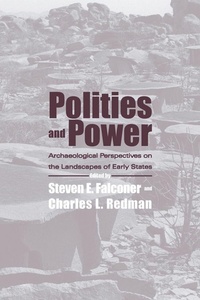
Polities and Power
Archaeological Perspectives on the Landscapes of Early States
Will be published approx. on 30. December 2009
Book
Hardback
256 pages
978-0-8165-2603-1 (ISBN)
Description
This distinctive book is the first to address the topic of landscape archaeology in early states from a truly global perspective. It provides an excellent introduction to, nd overview of the discipline today. The volume grew out of the Fifth Biennial Meeting of the Complex Societies Group, whose theme, States and the Landscape, paid tribute to the work of Robert McC. Adams. When Adams began publishing in the 1960s, the interdependence of cities and their countrysides, and the information revealed through the spatial patterning of communities, went largely unrecognized. Today, as this useful collection makes clear, these interpretive insights are fundamental to all archaeologists who investigate the roles of complex polities in their landscapes. Polities and Power features detailed studies from an intentionally disparate array of regions, including Mesoamerica, Andean South America, southwestern Asia, East Africa, and the Indian subcontinent. Each chapter or pair of chapters is followed by a critical commentary.
In concert, these studies strive to infer social, political, and economic meaning from archaeologically discerned landscapes associated with societies that incorporate some expression of state authority. The contributions engage a variety of themes, including the significance of landscapes as they condition and reflect complex polities; the interplay of natural and cultural elements in defining landscapes of state; archaeological landscapes as ever-dynamic entities; and archaeological landscapes as recursive structures, reflected in palimpsests of human activity. Individually, many of these contributions are provocative, even controversial. Taken together, they reveal the contours of landscape archaeology at this particular evolutionary moment.
In concert, these studies strive to infer social, political, and economic meaning from archaeologically discerned landscapes associated with societies that incorporate some expression of state authority. The contributions engage a variety of themes, including the significance of landscapes as they condition and reflect complex polities; the interplay of natural and cultural elements in defining landscapes of state; archaeological landscapes as ever-dynamic entities; and archaeological landscapes as recursive structures, reflected in palimpsests of human activity. Individually, many of these contributions are provocative, even controversial. Taken together, they reveal the contours of landscape archaeology at this particular evolutionary moment.
More details
Language
English
Place of publication
Tucson
United States
Target group
College/higher education
Product notice
sewn/stitched
Cloth over boards
With dust jacket
Illustrations
illustrations
Dimensions
Height: 229 mm
Width: 155 mm
Thickness: 25 mm
Weight
544 gr
ISBN-13
978-0-8165-2603-1 (9780816526031)
Copyright in bibliographic data and cover images is held by Nielsen Book Services Limited or by the publishers or by their respective licensors: all rights reserved.
Schweitzer Classification
Other editions
Additional editions
Unknown | Steven E. Falconer | Charles L. Redman
Polities and Power
Archaeological Perspectives on the Landscapes of Early States
E-Book
09/2022
1st Edition
University of Arizona Press
€94.99
Available for download
Persons
Steven E. Falconer is a professor of archaeology in the School of Human Evolution and Social Change at Arizona State University. Charles L. Redman is Professor and Director of the Center for Environmental Studies, Arizona State University.