

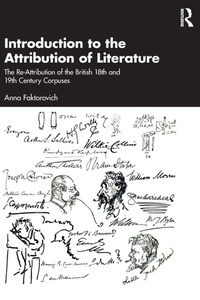
Introduction to the Attribution of Literature
The Re-Attribution of the British 18th and 19th Century Corpuses
1st Edition
Will be published approx. on 19. November 2025
Book
Hardback
230 pages
978-1-032-82111-5 (ISBN)
Description
Introduction to the Attribution of Literature describes the first unbiased and accessible authorship attribution method, and uses it to present the first accurate re-attribution of 311 canonical texts from the 18th century to only 10 ghostwriters, and 323 texts from the 19th century to 11 ghostwriters. For example, the little-known Sir Francis Cowley Burnand is chronologically, stylometrically, and with handwriting analysis, proven to be the ghostwriter behind 55 canonical tested texts, including "Emily Bronte's" Wuthering Heights, "Collins'" Woman in White, "Doyle's" Sherlock Holmes, "Kipling's" Captain Courageous, "Stoker's" Dracula, "Anthony Trollope's" American Senator, "Wells'" Island of Doctor Moreau, "Wilde's" Picture of Dorian Gray, and "Dickens'" Great Expectations. This method applies a combination of 23 to 28 different types of punctuation, parts-of-speech, and lexical linguistic tests. Parts of this book offer extensive statistical evidence in support of why this method's findings are quantitatively reliable. If preceding attribution methods had been equally reliable; then, they would have also concluded canonical British texts have been overwhelmingly ghostwritten. A section in this book explains the methodological flaws of these preceding attribution approaches, because of which they have incorrectly reaffirmed their canonically-accepted bylines. It includes definitions of central stylometric terminology, and explains how readers can apply the described strategies to their own attribution research at any academic level.
Reviews / Votes
"I found it an education."Larry Niven, best-selling Nebula, Hugo and Locus award-winner
"I am delighted to see the publication of Volume I of her fascinating and controversial reattribution project. It is no secret that challenging traditional beliefs and assumptions, regardless of the field, is typically met with criticism. Yet, we know that discovery and enlightenment are always led by risk takers who can see what others cannot see. Thoroughly researched and well written, Faktorovich's Introduction to the Attribution of Literature explains her methodology in determining the true authorship of many post-Renaissance works. It is a valuable contribution to English literature and to the field of philology."
Lesly F. Massey, PhD
"Dr. Anna Faktorovich's re-attribution studies expose previous fraudulent authorship claims for much of the 'ghostwritten' literature in the Western canon. She has examined evidence in handwriting and biographical data to uncover the true identities of the authorship of many of the bylines in respective centuries. The results are astonishing and, I believe, could outmode and transform the current paradigms of both literary theory and criticism."
Dr. Louis Gallo, Professor Emeritus, Radford University
More details
Language
English
Place of publication
London
United Kingdom
Publishing group
Taylor & Francis Ltd
Target group
College/higher education
Postgraduate and Undergraduate Advanced
Illustrations
56 s/w Abbildungen, 56 s/w Zeichnungen
56 Line drawings, black and white; 56 Illustrations, black and white
Dimensions
Height: 260 mm
Width: 183 mm
Thickness: 18 mm
Weight
654 gr
ISBN-13
978-1-032-82111-5 (9781032821115)
Copyright in bibliographic data and cover images is held by Nielsen Book Services Limited or by the publishers or by their respective licensors: all rights reserved.
Schweitzer Classification
Other editions
Additional editions
Anna Faktorovich
Introduction to the Attribution of Literature
The Re-Attribution of the British 18th and 19th Century Corpuses
E-Book
11/2025
Routledge
€73.99
Available for download
Anna Faktorovich
Introduction to the Attribution of Literature
The Re-Attribution of the British 18th and 19th Century Corpuses
E-Book
11/2025
Routledge
€73.99
Available for download
Person
Anna Faktorovich is the Director and Founder of Anaphora Literary Press. She taught English literature and composition for over four years at colleges including the University of Texas Rio Grande Valley, Edinboro University of Pennsylvania and the Middle Georgia College. She has a Ph.D. in English Literature and Criticism. She has published Rebellion as Genre (2013), Formulas of Popular Fiction (2014), and literary and linguistic articles in periodicals such as Humanities Bulletin, Critical Survey and East-West Cultural Passage.
Content
Introduction
Part I: The New Stylometric Attribution Method
Chapter 1. Anti-Assumptions as Pre-Requisites for Computational Stylometry
Chapter 2. The Steps of the Recommended Stylometric Attribution Method
Chapter 3. Selecting a Suitable Corpus
Chapter 4. Preparing Texts for Testing
Chapter 5. Reasons for the Use of Free Accessible Software
Chapter 6. Discussion of the Data in the 18th and 19th Century Corpuses
Chapter 7. A Method for the Quantitative Selection of the Most Likely Ghostwriter in a Linguistic-Group
Part II: Experiments to Explain Weaknesses of Previous Attribution Methods
Chapter 8. Thomas Mendenhall's Visual Curve Word-Length Comparison Model (1887)
Chapter 9. George Udny Yule's Sentence-Length Ranges and Statistics Model (1939)
Chapter 10. George Udny Yule's Vocabulary Model (1944)
Chapter 11. Zhao and Zobel's 634-Text Corpus (2007)
Part III: Experiments to Verify the New Method's Accessibility and Accuracy
Chapter 12. Statistical Comparison of Standard versus Newly Proposed Stylometric Methodologies
Index
Part I: The New Stylometric Attribution Method
Chapter 1. Anti-Assumptions as Pre-Requisites for Computational Stylometry
Chapter 2. The Steps of the Recommended Stylometric Attribution Method
Chapter 3. Selecting a Suitable Corpus
Chapter 4. Preparing Texts for Testing
Chapter 5. Reasons for the Use of Free Accessible Software
Chapter 6. Discussion of the Data in the 18th and 19th Century Corpuses
Chapter 7. A Method for the Quantitative Selection of the Most Likely Ghostwriter in a Linguistic-Group
Part II: Experiments to Explain Weaknesses of Previous Attribution Methods
Chapter 8. Thomas Mendenhall's Visual Curve Word-Length Comparison Model (1887)
Chapter 9. George Udny Yule's Sentence-Length Ranges and Statistics Model (1939)
Chapter 10. George Udny Yule's Vocabulary Model (1944)
Chapter 11. Zhao and Zobel's 634-Text Corpus (2007)
Part III: Experiments to Verify the New Method's Accessibility and Accuracy
Chapter 12. Statistical Comparison of Standard versus Newly Proposed Stylometric Methodologies
Index