

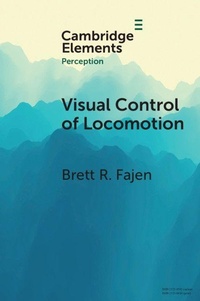
Visual Control of Locomotion
Published on 22. April 2021
Book
Paperback/Softback
80 pages
978-1-108-79927-0 (ISBN)
Description
This Element examines visual perception in the context of activities that involve moving about in complex, dynamic environments. A central theme is that the ability of humans and other animals to perceive their surroundings based on vision is profoundly shaped by the need to adaptively regulate locomotion to variations in the environment. As such, important new insights into what and how we perceive can be gleaned by investigating the connection between vision and the control of locomotion. I present an integrated summary of decades of research on the perception of self-motion and object motion based on optic flow, the perception of spatial layout and affordances, and the control strategies for guiding locomotion based on visual information. I also explore important theoretical issues and debates, including the question of whether visual control relies on internal models.
More details
Series
Language
English
Place of publication
Cambridge
United Kingdom
Target group
Professional and scholarly
Product notice
Paperback (trade)
Illustrations
Worked examples or Exercises
Dimensions
Height: 229 mm
Width: 152 mm
Thickness: 4 mm
Weight
118 gr
ISBN-13
978-1-108-79927-0 (9781108799270)
Copyright in bibliographic data and cover images is held by Nielsen Book Services Limited or by the publishers or by their respective licensors: all rights reserved.
Schweitzer Classification
Other editions
Additional editions
Brett R. Fajen
Visual Control of Locomotion
E-Book
04/2021
Cambridge University Press
€14.49
Available for download
Brett R. Fajen
Visual Control of Locomotion
E-Book
04/2021
Cambridge University Press
€15.49
Available for download
Person
Content
1. Introduction; 2. Optic flow and the perception of self-motion; 3. Perception of spatial layout and affordances by an active observer; 4. Strategies for on-line visual control; 5. The internal-model debate; 6. Concluding remarks.