

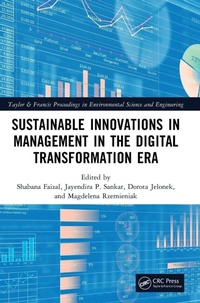
Sustainable Innovations in Management in the Digital Transformation Era
1st Edition
Published on 27. May 2026
Book
Hardback
394 pages
978-1-041-16351-0 (ISBN)
Description
This proceedings compilation presents groundbreaking contemporary research on digital transformation and its profound impact on industries, institutions, and societies. Through 67 peer-reviewed papers, this volume takes a multidisciplinary approach and delves into technological change, sustainability, and innovation in the digital era.
The contributions span artificial intelligence applications, sustainable business practices, fintech and digital finance, technology adoption, innovation and entrepreneurship, human resource transformation, governance, and digital education systems. Several studies examine AI-enabled decision-making, automation, data-driven strategy, and emerging digital infrastructures, while others explore sustainability transitions, inclusive development, financial inclusion, and policy frameworks in technology-mediated environments. The collection also features empirical analyses, conceptual models, technical innovations, and sector-specific case studies from diverse regional contexts. Together, these papers document current research directions, practical implementations, and strategic responses shaping organizations and economies.
This book is intended for researchers, scholars, and professionals engaged in digital transformation, innovation, and technology management. It serves as a reference for academics, industry leaders, policymakers, and research institutions seeking current evidence, interdisciplinary perspectives, and emerging insights into technological change and its organisational, economic, and societal implications.
The contributions span artificial intelligence applications, sustainable business practices, fintech and digital finance, technology adoption, innovation and entrepreneurship, human resource transformation, governance, and digital education systems. Several studies examine AI-enabled decision-making, automation, data-driven strategy, and emerging digital infrastructures, while others explore sustainability transitions, inclusive development, financial inclusion, and policy frameworks in technology-mediated environments. The collection also features empirical analyses, conceptual models, technical innovations, and sector-specific case studies from diverse regional contexts. Together, these papers document current research directions, practical implementations, and strategic responses shaping organizations and economies.
This book is intended for researchers, scholars, and professionals engaged in digital transformation, innovation, and technology management. It serves as a reference for academics, industry leaders, policymakers, and research institutions seeking current evidence, interdisciplinary perspectives, and emerging insights into technological change and its organisational, economic, and societal implications.
More details
Series
Language
English
Place of publication
London
United Kingdom
Publishing group
Taylor & Francis Ltd
Target group
College/higher education
Professional and scholarly
Academic, Postgraduate, and Professional Reference
Product notice
Laminated cover
Dimensions
Height: 244 mm
Width: 170 mm
Thickness: 24 mm
Weight
855 gr
ISBN-13
978-1-041-16351-0 (9781041163510)
Copyright in bibliographic data and cover images is held by Nielsen Book Services Limited or by the publishers or by their respective licensors: all rights reserved.
Schweitzer Classification
Other editions
Additional editions
Shabana Faizal | Jayendira P. Sankar | Dorota Jelonek
Sustainable Innovations in Management in the Digital Transformation Era
E-Book
05/2026
1st Edition
CRC Press
€212.99
Available for download
Shabana Faizal | Jayendira P. Sankar | Dorota Jelonek
Sustainable Innovations in Management in the Digital Transformation Era
E-Book
05/2026
1st Edition
CRC Press
€212.99
Available for download
Persons
Shabana Faizal is an assistant professor at the College of Administrative and Financial Sciences, University of Technology, Bahrain. She received her PhD from Bharathiar University, India. Overall, she has 10 years of academic experience and 2 years of industry experience. Further, she has published articles in various high-impact journals and presented a good number of papers at conferences. She has been Research Chair for multiple terms during her tenure as Assistant Professor. Her current research interests include marketing, online marketing, management, and digital business.
Jayendira P. Sankar is serving as an Associate Professor of MBA and Head of Digital Business Research Center at the University of Technology, Bahrain, and has over nineteen years of academic experience. He is a Senior Fellow of HEA-UK and an Academic Fellow of CIPD-UK. He has published extensively in various high-impact journals and presented at numerous academic conferences. His current research interests include Development Economics, focusing on economic growth, poverty, inequality, market failure, fiscal, economic, and social conditions, healthcare, education, employment sector, and industrial and social infrastructure; Human Resource Management, focusing on employee welfare, work-family balance, corporate social responsibility, sustainability; and innovation in teaching-learning and assessments.
Dorota Jelonek is a professor of Management at the Faculty of Management, Czestochowa University of Technology. She received a PhD degree in 2000, became a habilitated doctor in 2011, and a full professor of Economy Science in 2019. She has held the positions of Associate Dean for Science (2012-2016) and Dean of Faculty (2016-2020). Dorota Jelonek is the President of the Scientific Society for Economic Informatics and a member of many societies including the Polish Association for Innovation Management and Informing Science Institute. She is the author of 6 books and editor of 8 books. In addition, she is the author or co-author of 250 articles in Polish and foreign journals and book chapters. Over the years, she has participated in over 120 conferences in many research centers, and she was a member of 45 conference program committees. Her scientific and research interests focus on solving problems related to the implementation of management information systems in enterprises, improving management information processes, computer-assisted monitoring of the business environment, and management innovation processes.
Magdelena Rzemieniak is a Professor at Lublin University of Technology, where she has been continuously employed since 1995. A graduate of the University with honors, she received the PRIMUS INTER PARES distinction from the President of Poland during her studies. She has held several key academic leadership roles, including Vice-Dean, Head of the Department of Marketing, and Dean of the Faculty of Management. She has participated in numerous national and international research projects and has published over 100 scientific papers, with her habilitation monograph receiving a national award. A highly dedicated and award-winning educator, she has taught across undergraduate, postgraduate, and MBA programs and supervised over 600 graduate theses. Her contributions to academia and society have been recognized with multiple Rector's awards, the Medal of the National Education Commission, and the Silver Cross of Merit.
Jayendira P. Sankar is serving as an Associate Professor of MBA and Head of Digital Business Research Center at the University of Technology, Bahrain, and has over nineteen years of academic experience. He is a Senior Fellow of HEA-UK and an Academic Fellow of CIPD-UK. He has published extensively in various high-impact journals and presented at numerous academic conferences. His current research interests include Development Economics, focusing on economic growth, poverty, inequality, market failure, fiscal, economic, and social conditions, healthcare, education, employment sector, and industrial and social infrastructure; Human Resource Management, focusing on employee welfare, work-family balance, corporate social responsibility, sustainability; and innovation in teaching-learning and assessments.
Dorota Jelonek is a professor of Management at the Faculty of Management, Czestochowa University of Technology. She received a PhD degree in 2000, became a habilitated doctor in 2011, and a full professor of Economy Science in 2019. She has held the positions of Associate Dean for Science (2012-2016) and Dean of Faculty (2016-2020). Dorota Jelonek is the President of the Scientific Society for Economic Informatics and a member of many societies including the Polish Association for Innovation Management and Informing Science Institute. She is the author of 6 books and editor of 8 books. In addition, she is the author or co-author of 250 articles in Polish and foreign journals and book chapters. Over the years, she has participated in over 120 conferences in many research centers, and she was a member of 45 conference program committees. Her scientific and research interests focus on solving problems related to the implementation of management information systems in enterprises, improving management information processes, computer-assisted monitoring of the business environment, and management innovation processes.
Magdelena Rzemieniak is a Professor at Lublin University of Technology, where she has been continuously employed since 1995. A graduate of the University with honors, she received the PRIMUS INTER PARES distinction from the President of Poland during her studies. She has held several key academic leadership roles, including Vice-Dean, Head of the Department of Marketing, and Dean of the Faculty of Management. She has participated in numerous national and international research projects and has published over 100 scientific papers, with her habilitation monograph receiving a national award. A highly dedicated and award-winning educator, she has taught across undergraduate, postgraduate, and MBA programs and supervised over 600 graduate theses. Her contributions to academia and society have been recognized with multiple Rector's awards, the Medal of the National Education Commission, and the Silver Cross of Merit.
Content
1. Strategic Integration of Artificial Intelligence to Drive Sustainable Business Transformation in the Digital Era 2. Key Organizational Practices in Fostering a Sustainable Workplace 3. Artificial Intelligence solutions in the support of e-commerce management - Qualitative approach 4. Revisiting Strategic Fit Theory: Aligning Technological Adoption with Supply Chain Strategy for Competitive Advantage 5. Application of Rough Set Theory to Analyse the Relationship between Students Use of AI Tools and Their Perceived Automation Potential in Enterprises 6. Two Faces of Green AI: Supporting Sustainability and Achieving Sustainable Operation 7. AI and Machine Learning Enhance Fraud Detection Accuracy and Efficiency in Accounting 8. Integrating Artificial Intelligence and Strategic Management for Sustainable Organizational Transformation: A Case Study Approach 9. The Impact of Leadership Style on Employee Satisfaction in Bahrain's Telecom Sector 10. Enhancing Customer Retention through AI-Driven CRM Analytics: A Scikitlearn Approach in Kerala's Service Sector 11. Revitalizing the Entrepreneurial Education: Holistic Approach to Achieving Entrepreneurial Skill Development and Internal Mobility 12. Machine Learning Analysis of GST Impact on Retailers in Chennai: Compliance, Adaptation and Revenue Growth 13. Transforming Digital Finance: The Role of Green Fintech in Advancing ESG Investments and Sustainable Development Among Young Investors in Pakistan 14. Evaluating E-Learning's Impact on Examination Quality - A Systematic Literature Review 15. Econometric Insights into Sustainable Development Practices in GCC Economies: A Panel Data Approach (2010-2023) 16. A SLR Exploring the Intersection of Anti-Counterfeit Tech & AI in Business IT Hardware 17. AI influence on Teachers Productivity; A Perspective from Schools in Bahrain 18. Exposing 2139 Exchange - Identity Fraud, Licensing Deception & Trust Erosion in Digital Finance 19. Sustainable digital marketing: Green branding and Consumer engagement 20. The Role of Artificial Intelligence in Enhancing Marketing Effectiveness: An Empirical Study 21. Cross-Regional Insights on AI Readiness: An Empirical Comparison of MENA and Southeast Asia Using Elastic Net Regression 22. Inclusive Marketing by Hypermarkets for Low-Income Expatriate Consumers in the Middle East: Designing for Affordability Without Compromising Value 23. Sustainable Development and Inclusive Parenting: Social Approaches for Empowering Children with Disabilities 24. Strategic Marketing Approaches on Micro-ventures towards Increased Revenues: An Assessment in Bahrain 25. Optimal working capital policy and sustainable practices in financially constraint firms 26. Reimagining Management and Innovation: Strategies for Digital Finance, E-Commerce & Sustainable HR 27. Sustainable Fishing and Resilience Framework: Mitigating Climatic and Socioeconomic Vulnerabilities of Marine Fishermen 28. Evaluation of a five-year financial ratio analysis of Islamic Banking sector: Liquidity and solvency 29. Technical Analysis & Taxonomy of DNS Based Threats: Deconstructing the Domain Fraud 30. Implementation of Bookkeeping Practices among Micro-Enterprises: A Review Output from Bahrain 31. Tandem Effects of Technologies and Digitalisation in Fostering Sustainability Mediated by Eco-Innovation In Manufacturing Sector 32. AI and Augmented Reality (AR) Marketing: Enhancing Product Visualization and Interactive Advertising 33. Artificial Intelligence : Its transformative impact on students' behaviour and ethics 34. Impact of Technology Adoption in Empowering Women Entrepreneurs 35. Beyond the Veil: A Review of Corporate Governance, Ethics, and Legal Reform in the Digital Era 36. From Challenges to Sustainable Co-parenting and Career Advancement among Divorced Working Women 37. Digital Transformation for Sustainable Growth: Innovation, Entrepreneurship & AI Integration 38. A Network-Based Modeling Approach to Financial Inclusion: An Empirical Study in South Tamil Nadu 39. Exploring the Relationship between Flexible Work Arrangements and Employee Well-being among Working Women in Bahrain 40. Exploring the relationship between demographic attributes and the perception and use of AI tools in academia 41. Exploring the Long-Term Efficacy and Ethical Dimensions of AI-Driven Social Media Recruitment: A Conceptual Framework for Sustainable and Fair Talent Acquisition 42. A Thematic Analysis of Insights from Systematic Reviews on the Influence of Conversational AI on User Engagement- Transformative Technologies Enhancing Human Well-being 43. Exploring the Impact of Visual Interaction on Consumer Behavior in the Retail Industry in the Kingdom of Bahrain 44. Sustainable Energy and Economic Growth: Decoding the G20 Nexus 45. Understanding the Landscape: Entrepreneurs' Challenges in Implementing CSR Initiatives 46. Decomposed Fuzzy Z-CRITIC-GRA for Selecting Investment Stock 47. The relationship between technology-based training (TBT) and employee performance in the renewable energy sector in the Kingdom of Saudi Arabia 48. Growth and Survival Strategies of Small-Scale Industries in Eastern India: A 21st Century Perspective 49. Promoting Sustainability: Behavioural Strategies among Engineering Students and Alumni 50. Application of Digital Technologies in Promoting Sustainability through Technopreneur-Implementation of Business Practices 51. The Impact of FinTech on Financial Inclusion 52. AI-Driven Research Profiling and Contribution Classification for Strategic Hiring and Institutional Decision-Making: A Google Scholar 53. Humanizing AI in HR: Pathways to Decent Work and Economic Growth(SDG 8) through Digital Literacy 54. Data Communication in Environmental Sustainability: Research Agenda for the Global South 55. Driving Change: How Tesla is Shaping the Future of Cars Through Sustainability and Innovation 56. Faculty Readiness and Ethical Concerns in Integrating AI for Teaching in Bahrain Polytechnic 57. Agentic AI for Demand Forecasting and Planning: Autonomous Market Sensing and Adaptive Planning 58. Artificial Intelligence in Banking Sectors: Enhancing Customer Service and Achieving Competitive Advantage - A Comprehensive Review through Bibliometric and Content Analysis 59. Design and Development of a Double Convex Lens Solar Cooker for Clean, Cost-Free Cooking 60. Exploring the perspectives of Human resources management on Employee Engagement: Thematic analysis In Kingdom of Bahrain 61. An Obfuscation Attack Detection Approach in Android APK Using ML classification of Grayscale and RGB Images 62. Sustainable Marital Quality: The Roles of Women in Academia 63. Effect of Nationalization Policy on Human Resource Practice in Gulf Land 64. Financial Literacy and management of personal finances: A study on the young household in Bahrain 65. Evaluating E-Learning's Impact on Examination Quality - A Bibliometric Review 66. Cybercrime Preparedness and the Digital Economy: Empirical Evidence in MENA and South Asia Using Driscoll-Kraay 67. Enhancing employee sustainability through digital culture and transformation: cross-sectoral evidence