

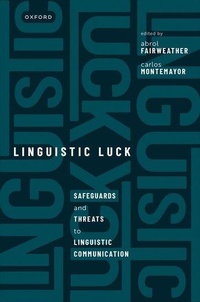
Linguistic Luck
Safeguards and threats to linguistic communication
Published on 22. June 2023
Book
Hardback
340 pages
978-0-19-284545-0 (ISBN)
Description
Despite the considerable attention the topic of luck has received in ethics and epistemology, very little has been published in the philosophical literature overtly on linguistic luck. The essays collected here provide the first sustained examination of the diverse forms of linguistic luck, the mechanisms available to reduce the impact of linguistic luck and how to cope with residual luck not eliminated by the causal, inferential, and intentional mechanisms which aim at its eradication. Of primary interest is not some, hitherto unnoticed widespread prevalence of luck in the determinants of meaning and communication, but rather the impressive extent to which luck is reduced or eliminated therein. Whether through casual, inferential or intentional means, the determinants of meaning and communication are impressively independent of luck and chance. In fact, it is difficult to imagine a world with human language where efforts to communicate succeed no better than chance. Linguistic communication is only possible because robust luck reducing variables are at work. The essays collected seek to understand the diversity, scope and mode of operation of luck reducing mechanisms in language. While it is not possible here to cover the full range of linguistic phenomena affected by luck, a wide range of issues in linguistics and philosophy of language are investigated, including, syntax processing, demonstrative reference, conversational implicature, testimony, lexical innovation, joint attention, communicative value, conventionalism vs. anti-conventionalism, metasemantic safety, and semantic skepticism, to name a few.
More details
Language
English
Place of publication
Oxford
United Kingdom
Target group
College/higher education
Product notice
sewn/stitched
Cloth over boards
Dimensions
Height: 241 mm
Width: 162 mm
Thickness: 24 mm
Weight
653 gr
ISBN-13
978-0-19-284545-0 (9780192845450)
Copyright in bibliographic data and cover images is held by Nielsen Book Services Limited or by the publishers or by their respective licensors: all rights reserved.
Schweitzer Classification
Other editions
Additional editions
Abrol Fairweather | Carlos Montemayor
Linguistic Luck
Safeguards and threats to linguistic communication
E-Book
06/2023
1st Edition
OUP eBook
€71.49
Available for download
Abrol Fairweather | Carlos Montemayor
Linguistic Luck
Safeguards and threats to linguistic communication
E-Book
05/2023
1st Edition
OUP eBook
€71.49
Available for download
Persons
Abrol Fairweather is Emeritus Lecturer in Philosophy at San Francisco State University, USA. He has written and edited books and essays in the field of virtue epistemology, including the first collection of essays in the field, Virtue Epistemology: Essays on Epistemic Virtue and Responsibility (Fairweather, A & Zagzebski, L. eds., 2001), and has emphasized naturalized approaches to this highly normative subject, including Knowledge, Dexterity, and Attention: A Theory of Epistemic Agency (2017).
Carlos Montemayor is Professor of Philosophy at San Francisco State University, USA. His research focuses on philosophy of mind and cognitive science. Montemayor is the author of Minding Time: A Philosophical and Theoretical Approach to the Psychology of Time (2013), and co-author (with Abrol Fairweather) of Knowledge, Dexterity, and Attention: A Theory of Epistemic Agency (2017), among other books including, most recently, his open access book The Prospect of a Humanitarian Artificial Intelligence (2023).
Carlos Montemayor is Professor of Philosophy at San Francisco State University, USA. His research focuses on philosophy of mind and cognitive science. Montemayor is the author of Minding Time: A Philosophical and Theoretical Approach to the Psychology of Time (2013), and co-author (with Abrol Fairweather) of Knowledge, Dexterity, and Attention: A Theory of Epistemic Agency (2017), among other books including, most recently, his open access book The Prospect of a Humanitarian Artificial Intelligence (2023).
Content
1: Abrol Fairweather and Carlos Montemayor: Introduction
2: Maria de Ponte (University of the Basque Country), Kepa Korta (University of the Basque Country) and John Perry (Stanford University): Language and Luck
Nomological, Formal and Cognitive Luck Reduction
3: Imogen Dickie (University of Toronto): Specificity And Resolution In The Communicative Use Of Singular Terms
4: Jeffrey King (Rutgers University): Luck And Metasemantics
5: Georges Rey (University of Maryland) and John Collins (East Anglia University): Laws and Luck in Language: Problems with Devitt's Conventional, Commonsense Linguistics
6: Michael Devitt (CUNY): Linguistic Luck: A Response to Rey and Collins
7: Justin Khoo (MIT): Epistemicism without metalinguistic safety
Cognitive and Social Luck Reduction
8: Elizabeth Fricker (Oxford University): Testimony, Luck and Conversational Implicature
9: Claudine Verheggen (York University): Linguistic Luck and the Publicness of Language
10: Andrew Peet (University of Leeds): Understanding, Luck, and Communicative Value
11: Samia Hesni (Boston University): Luck-Reducing Features of Lexical Innovation
12: Georgi Gardiner (University of Tennessee): We Forge the Conditions of Love
2: Maria de Ponte (University of the Basque Country), Kepa Korta (University of the Basque Country) and John Perry (Stanford University): Language and Luck
Nomological, Formal and Cognitive Luck Reduction
3: Imogen Dickie (University of Toronto): Specificity And Resolution In The Communicative Use Of Singular Terms
4: Jeffrey King (Rutgers University): Luck And Metasemantics
5: Georges Rey (University of Maryland) and John Collins (East Anglia University): Laws and Luck in Language: Problems with Devitt's Conventional, Commonsense Linguistics
6: Michael Devitt (CUNY): Linguistic Luck: A Response to Rey and Collins
7: Justin Khoo (MIT): Epistemicism without metalinguistic safety
Cognitive and Social Luck Reduction
8: Elizabeth Fricker (Oxford University): Testimony, Luck and Conversational Implicature
9: Claudine Verheggen (York University): Linguistic Luck and the Publicness of Language
10: Andrew Peet (University of Leeds): Understanding, Luck, and Communicative Value
11: Samia Hesni (Boston University): Luck-Reducing Features of Lexical Innovation
12: Georgi Gardiner (University of Tennessee): We Forge the Conditions of Love