

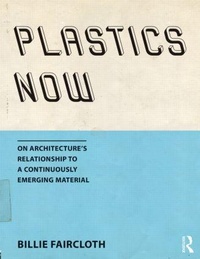
Plastics Now
On Architecture's Relationship to a Continuously Emerging Material
1st Edition
Published on 13. July 2015
Book
Hardback
392 pages
978-1-138-80450-0 (ISBN)
Description
Plastics Now addresses one primary question: why do we build with plastics the way that we do?
For decades, plastics have been described over and over again as "the future," yet we still do not know precisely what to do with them. Billie Faircloth argues that this inertia is due to plastics' indecipherability, which has prevented them from becoming fully known.
The author tracks the process by which plastics became defined as a class of building materials. Drawing on original data from industry press, original timelines, hundreds of historical and contemporary images, advertisements dating to the 1940s, and technical data, this unconventional book explores the emergence of plastics as a building material and presents new findings.
Plastics Now takes a provocative approach that calls on architects to participate in the redefinition of plastics for our time. This is essential reading for professional architects and architecture students to engage with our shared history with the plastics industry.
For decades, plastics have been described over and over again as "the future," yet we still do not know precisely what to do with them. Billie Faircloth argues that this inertia is due to plastics' indecipherability, which has prevented them from becoming fully known.
The author tracks the process by which plastics became defined as a class of building materials. Drawing on original data from industry press, original timelines, hundreds of historical and contemporary images, advertisements dating to the 1940s, and technical data, this unconventional book explores the emergence of plastics as a building material and presents new findings.
Plastics Now takes a provocative approach that calls on architects to participate in the redefinition of plastics for our time. This is essential reading for professional architects and architecture students to engage with our shared history with the plastics industry.
Reviews / Votes
"Plastics Now is a veritable candy store for the mind of the materials enthusiast. This thorough assemblage of essays, timelines, case studies, interviews, and conference proceedings takes the reader on a giddy ride through the vibrant history of one of our most common - and least understood - materials. Faircloth's rich and multilayered portrayal of polymers in architecture is both a masterful work of research scholarship and a useful reference for architects - and as such establishes a new model of materials book." - Blaine Brownell, author of the Transmaterial series and Associate Professor, University of Minnesota, USA"If C.P Snow had not already used 'The Two Cultures' it would have made a fitting subtitle for Billie Faircloth's book Plastics Now. Providing a depth of information on how plastics are made and processed, Faircloth additionally weaves a story of how both technologists and architects, each in their own culture, learn what plastics are, what they can do and what 'plastic' means - practically. And the two cultures do not fully understand one another even after 75 years." - William F. Carroll, Jr., PhD, Adjunct Professor of Chemistry, Indiana University, USA
More details
Language
English
Place of publication
London
United Kingdom
Publishing group
Taylor & Francis Ltd
Target group
Professional and scholarly
Professional and Professional Reference
Product notice
sewn/stitched
Cloth over boards
Illustrations
390 Farbfotos bzw. farbige Rasterbilder, 43 farbige Zeichnungen
43 Line drawings, color; 390 Halftones, color
Dimensions
Height: 246 mm
Width: 189 mm
Weight
1338 gr
ISBN-13
978-1-138-80450-0 (9781138804500)
Copyright in bibliographic data and cover images is held by Nielsen Book Services Limited or by the publishers or by their respective licensors: all rights reserved.
Schweitzer Classification
Other editions
Additional editions
Book
07/2015
1st Edition
Routledge
€91.50
Shipment within 10-20 days
Person
Billie Faircloth is a practicing architect and partner at KieranTimberlake, where she leads transdisciplinary research, design, and problem-solving processes across fields including environmental management, chemical physics, materials science, and architecture. She fosters collaboration between trades, academies, and industries in order to define a relevant problem-solving boundary for the built environment.
Content
Prologue: How Should We Use Plastics? Introduction A Method: How to Wrestle With the Emergence of Plastics 1. Defining Plastics 2. Describing Plastics 3. Plastics. In. Building. 4. All-Plastics 5. Prototyping with Plastics 6. Professing Plastics Epilogue Why We Use Plastics The Way That We Do. Index