

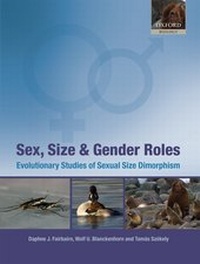
Sex, Size and Gender Roles
Evolutionary Studies of Sexual Size Dimorphism
Published on 5. July 2007
Book
Hardback
278 pages
978-0-19-920878-4 (ISBN)
Description
Why do males and females frequently differ so markedly in body size and morphology?
Sex, Size, and Gender Roles is the first book to investigate the genetic, developmental, and physiological basis of sexual size dimorphism found within and among the major taxonomic groups of animals. Carefully edited by a team of world-renowned specialists in the field to ensure a coherence of style and approach between chapters, it presents a compendium of studies into the evolution, adaptive significance, and developmental basis of gender differences in body size and morphology. Adaptive
hypotheses allude to gender-specific reproductive roles and associated differences in trophic ecologies, life history strategies, and sexual selection. This "adaptationist" approach is balanced by more mechanistic studies of the genetic, developmental and physiological basis of sexual size dimorphism to
provide a comprehensive and authoritative overview of the subject. Throughout the volume the emphasis is on sexual dimorphism in overall size; however, the scope of enquiry encompasses gender differences in body shape, the size and structure of secondary sexual characteristics, patterns of growth (ontogeny), and patterns of gene regulation.
This advanced, research level text is suitable for graduate level students and researchers in the fields of evolutionary biology, behavioural ecology, physiology, developmental biology, and genetics. It will also be of relevance and use to non-biologists from fields such as anthropology and gender studies.
Sex, Size, and Gender Roles is the first book to investigate the genetic, developmental, and physiological basis of sexual size dimorphism found within and among the major taxonomic groups of animals. Carefully edited by a team of world-renowned specialists in the field to ensure a coherence of style and approach between chapters, it presents a compendium of studies into the evolution, adaptive significance, and developmental basis of gender differences in body size and morphology. Adaptive
hypotheses allude to gender-specific reproductive roles and associated differences in trophic ecologies, life history strategies, and sexual selection. This "adaptationist" approach is balanced by more mechanistic studies of the genetic, developmental and physiological basis of sexual size dimorphism to
provide a comprehensive and authoritative overview of the subject. Throughout the volume the emphasis is on sexual dimorphism in overall size; however, the scope of enquiry encompasses gender differences in body shape, the size and structure of secondary sexual characteristics, patterns of growth (ontogeny), and patterns of gene regulation.
This advanced, research level text is suitable for graduate level students and researchers in the fields of evolutionary biology, behavioural ecology, physiology, developmental biology, and genetics. It will also be of relevance and use to non-biologists from fields such as anthropology and gender studies.
Reviews / Votes
This excellent volume is filled with the most current and stimulating research on SSD... I found the efficiency of this format unique and effective... The data presentation and flow of ideas among chapters are superb. The editors and contributors are to be commended for the tight organization of the chapters... The volume represents a veritable toolbox for students - molecular techniques, phylogenetic comparative methods, and well-designed field and laboratoryexperiments are all generously represented. Veteran scholars will find new ideas and approaches in this book because it covers such a wide array of systems... I found this to be an excellent assemblage of contributions that will act as a guiding force in future studies of SSD. * The Quarterly Review of Biology * For any student or researcher interested in addressing the question of why males and females often differ strikingly in adult body size and morphology, this book is a valuable resource that balances case studies with review chapters. * Choice *
More details
Language
English
Place of publication
Oxford
United Kingdom
Target group
College/higher education
Illustrations
numerous halftones and figures
Dimensions
Height: 253 mm
Width: 194 mm
Thickness: 20 mm
Weight
777 gr
ISBN-13
978-0-19-920878-4 (9780199208784)
Copyright in bibliographic data and cover images is held by Nielsen Book Services Limited or by the publishers or by their respective licensors: all rights reserved.
Schweitzer Classification
Other editions
Additional editions
Daphne J. Fairbairn | Wolf U. Blanckenhorn | Tamas Szekely
Sex, Size and Gender Roles
Evolutionary Studies of Sexual Size Dimorphism
Book
11/2008
Oxford University Press
€70.57
Shipment within 15-20 days
Persons
Daphne J. Fairbairn is Professor of Biology at the University of California at Riverside, USA.
Wolf U. Blanckenhorn is Titularprofessor at the Zoologisches Museum, Universitaet Zuerich, Switzerland.
Tamas Szekely is Reader in Evolutionary Biology at the Department of Biology and Biochemistry, University of Bath, UK.
Wolf U. Blanckenhorn is Titularprofessor at the Zoologisches Museum, Universitaet Zuerich, Switzerland.
Tamas Szekely is Reader in Evolutionary Biology at the Department of Biology and Biochemistry, University of Bath, UK.
Content
SECTION 1: MACRO-PATTERNS: EXPLAINING BROAD-SCALE PATTERNS OF VARIATION IN SEXUAL SIZE DIMORPHISM; SECTION 2: MICRO-PATTERNS: CASE STUDIES OF PATTERNS AND EVOLUTIONARY PROCESSES WITHIN AND AMONG SPECIES; SECTION 3: PROXIMATE DEVELOPMENTAL AND GENETIC MECHANISMS