

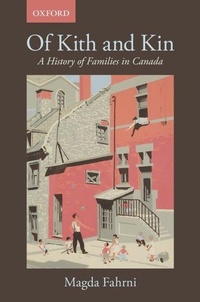
Of Kith and Kin
A History of Families in Canada
Published on 1. February 2022
Book
Paperback/Softback
320 pages
978-0-19-901216-9 (ISBN)
Description
Reviled by some radicals and progressives, a reassuring touchstone for most conservatives, the family has always been both an institution and an idea. Often a source of emotional sustenance and material support, families can also be sites of conflict and abuse. This book traces the changing forms and meanings of family in the territory that now comprises Canada, from the first contacts between Indigenous peoples and French explorers, traders, missionaries, and settlers in northeastern North America in the sixteenth and seventeenth centuries to the present. It draws on the rich historiography of the family in Canada and elsewhere to provide an overview of the many, and sometimes radical, shifts in the composition and significance of family over five centuries.
Of Kith and Kin explores the histories of both Indigenous and settler families in both Quebec and English Canada and draws on both French-language and English-language historiographies. Region, ethnicity, race, and social class shaped the lived experiences of families. Age and gender made a difference within families.
Debates about family - who is allowed to marry and for what reasons, who shall bear children and at what moment in their life, who shall adopt and what child they might adopt, who shall inherit family property - regularly make the headlines. Understanding the variety of family forms and experiences throughout Canada's history can help to better put the present into perspective. All history includes family histories; conversely, families provide us with a fascinating lens through which to view and understand the collective choices made by the state and by civil society.
Of Kith and Kin explores the histories of both Indigenous and settler families in both Quebec and English Canada and draws on both French-language and English-language historiographies. Region, ethnicity, race, and social class shaped the lived experiences of families. Age and gender made a difference within families.
Debates about family - who is allowed to marry and for what reasons, who shall bear children and at what moment in their life, who shall adopt and what child they might adopt, who shall inherit family property - regularly make the headlines. Understanding the variety of family forms and experiences throughout Canada's history can help to better put the present into perspective. All history includes family histories; conversely, families provide us with a fascinating lens through which to view and understand the collective choices made by the state and by civil society.
Reviews / Votes
Magda Fahrni's Of Kith and Kin is essential reading for students, general readers, and historians alike who are interested in the history of the family in Canada. With clear command of the literature, Fahrni has written an engaging history that highlights the variety of family experience over time in relation to larger questions, such as the role of the Canadian state in shaping these experiences. Of Kith and Kin sets a new standard for cutting edge syntheses of major fields in Canadian history. * Mona Gleason, University of British Columbia * This is a brilliant, exemplary, and beautifully written history. An outstanding contribution to many fields, it draws widely and deeply on diverse sources in French and English, and with a rigorous critical approach, Fahrni's account exposes the complex interactions of material living conditions, prevailing ideologies and laws, and larger political processes of conquest, colonization, and settlement that have shaped families and Canadian political and economic life. * Meg Luxton, York University * Despite the nostalgia that frequently surrounds them, families in former times were as diverse, complicated, and potentially fractious as they are today. Of Kith and Kin is as much a 'history of us'-the broad sweep of Canadian history seen through the revealing and universally relatable lens of family-as it is the first published book to offer a sustained, rigorous, and accessible history of family life in this country. * Peter Gossage, Concordia University * This lively and highly anticipated study of the family in the territory that is now Canada brings histories of Indigenous and settler communities, Quebec and English Canada, and public and private life into stimulating conversation with each other. Magda Fahrni's characteristically thoughtful analysis, ranging over a period of six centuries, reminds us that family history-shaped by gender, race, class, and age-is also inextricably bound up with broad political processes including colonialism, migration, and war. * Kristine Alexander, University of Lethbridge * I can in no way find fault with Magda Fahrni's masterful drawing together of so much in so little space. It definitely deserves space in the personal collections of historians - both students and scholars, sociologists and anthropologists - and anyone interested in the ever-fascinating evolution of family lives and family forms. * Cynthia Comacchio, The Canadian Historical Review *More details
Language
English
Place of publication
Toronto
Canada
Target group
College/higher education
Product notice
Paperback (trade)
Unsewn / adhesive bound
Illustrations
32 black and white illustrations
Dimensions
Height: 236 mm
Width: 156 mm
Thickness: 18 mm
Weight
503 gr
ISBN-13
978-0-19-901216-9 (9780199012169)
Copyright in bibliographic data and cover images is held by Nielsen Book Services Limited or by the publishers or by their respective licensors: all rights reserved.
Schweitzer Classification
Person
Magda Fahrni is an associate professor of history at the Universite du Quebec a Montreal, where she teaches women's history, family history, and the history of twentieth-century Quebec and Canada. She is the author of Household Politics: Montreal Families and Postwar Reconstruction, which won the Clio-Quebec Prize by the Canadian Historical Association and was a finalist for the John A. Macdonald Prize of the Canadian Historical Association. She is also the co-author of Canadian Women: A History 3rd edition.
Content
Acknowledgments Introduction: The Writing of Family History in Canada 1: Indigenous Families and French Settler Families, 1500-1750 2: Families in British North America, 1750-1840 3: The Industrial Revolution in Canada, 1840-1889 4: Families and the State, 1840-1914 5: Two World Wars, the Great Depression, and a Mixed Social Economy of Welfare, 1914-1945 6: Thirty Glorious Years? Families and the Postwar Settlement, 1945-1975 7: Metamorphosis and Persistence: Interrogating the Nuclear Family, 1975-2005 Conclusion: Twenty-First-Century Families Notes Selected Works Index