

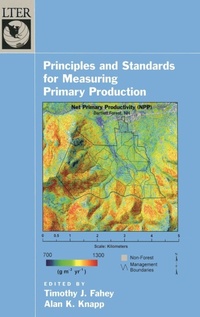
Principles and Standards for Measuring Primary Production
Published on 17. May 2007
Book
Hardback
288 pages
978-0-19-516866-2 (ISBN)
Description
This volume will lay out the best methods for measuring net primary productivity (NPP) in ecological research. Primary productivity is the rate at which energy is stored in the organic matter of plants per unit area of the earth's surface. NPP is the beginning point of the carbon cycle, so our ability to accurately measure NPP is important.
The book includes chapters for each of the critical biome types to offer special techniques that work best in each biome. For example, there are chapters that discuss grassland ecosystems, urban ecosystems, marine pelagic ecosystems, forest ecosystems, and salt marsh ecosystems, among others.
All 26 LTER sites will be expected to collect and report data using these methods, but ecologists more generally should also find these methods useful and authoritative. Currently no standard methods or standards exist. Measuring NPP is fundamental to many ecosystem studies at thousands of sites, and having identified standards and methods would be extremely useful for comparing measurements among sites and for compiling a broad scale understanding of the environmental, biological, and nutrition controls on NPP. This book would resemble the Standard Soil Measurement volume in the LTER series in that it reaches well beyond any single LTER site to apply to any ecosystem. It should be rather more widely used than the soil measurements volume, in that measuring productivity is so fundamental to any ecological analyses as well as agronomy, forestry, fisheries, limnology and oceanography.
The book includes chapters for each of the critical biome types to offer special techniques that work best in each biome. For example, there are chapters that discuss grassland ecosystems, urban ecosystems, marine pelagic ecosystems, forest ecosystems, and salt marsh ecosystems, among others.
All 26 LTER sites will be expected to collect and report data using these methods, but ecologists more generally should also find these methods useful and authoritative. Currently no standard methods or standards exist. Measuring NPP is fundamental to many ecosystem studies at thousands of sites, and having identified standards and methods would be extremely useful for comparing measurements among sites and for compiling a broad scale understanding of the environmental, biological, and nutrition controls on NPP. This book would resemble the Standard Soil Measurement volume in the LTER series in that it reaches well beyond any single LTER site to apply to any ecosystem. It should be rather more widely used than the soil measurements volume, in that measuring productivity is so fundamental to any ecological analyses as well as agronomy, forestry, fisheries, limnology and oceanography.
More details
Series
Language
English
Place of publication
New York
United States
Target group
Professional and scholarly
Illustrations
51 figures, 28 line art, 23 halftones
Dimensions
Height: 240 mm
Width: 161 mm
Thickness: 20 mm
Weight
590 gr
ISBN-13
978-0-19-516866-2 (9780195168662)
Copyright in bibliographic data and cover images is held by Nielsen Book Services Limited or by the publishers or by their respective licensors: all rights reserved.
Schweitzer Classification
Other editions
Additional editions
Timothy J. Fahey | Alan K. Knapp
Principles and Standards for Measuring Primary Production
E-Book
05/2007
1st Edition
OUP eBook
€67.49
Available for download
Timothy J. Fahey | Alan K. Knapp
Principles and Standards for Measuring Primary Production
E-Book
05/2007
1st Edition
OUP eBook
€67.49
Available for download