

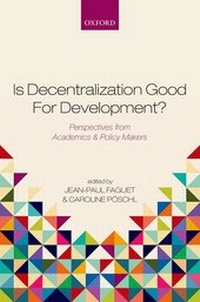
Is Decentralization Good For Development?
Perspectives from Academics and Policy Makers
Published on 13. August 2015
Book
Hardback
352 pages
978-0-19-873750-6 (ISBN)
Description
Is decentralisation good for development? This book offers insights and lessons that help us understand when the answer is 'Yes', and when it is No'. It shows us how decentralisation can be designed to drive development forward, and focuses attention on how institutional incentives can be created for governments to improve public sector performance and strengthen economies in ways that enhance citizen well-being. It also draws attention to the political motives behind decentralisation reforms and how these shape the institutions that result.
This book brings together academics working at the frontier of research on decentralization with policymakers who have implemented reform at the highest levels of government and international organizations. Its purpose is to marry policymakers' detailed knowledge and insights about real reform processes with academics' conceptual clarity and analytical rigor. This synthesis naturally shifts the analysis towards deeper questions of decentralization, stability, and the strength of the state. These are explored in Part 1, with deep studies of the effects of reform on state capacity, political and fiscal stability, and democratic inclusiveness in Bolivia, Pakistan, India, and Latin America more broadly. These complex questions - crucially important to policymakers but difficult to address with statistics - yield before a multipronged attack of quantitative and qualitative evidence combined with deep practitioner insight. How should reformers design decentralisation? Part 2 examines these issues with evidence from four decades of reform in developing and developed countries. What happens after reform is implemented? Decentralization and local service provision turns to decentralization's effects on health and education services, anti-poverty programs with original evidence from 12 countries across Africa, Asia, and Latin America.
This book brings together academics working at the frontier of research on decentralization with policymakers who have implemented reform at the highest levels of government and international organizations. Its purpose is to marry policymakers' detailed knowledge and insights about real reform processes with academics' conceptual clarity and analytical rigor. This synthesis naturally shifts the analysis towards deeper questions of decentralization, stability, and the strength of the state. These are explored in Part 1, with deep studies of the effects of reform on state capacity, political and fiscal stability, and democratic inclusiveness in Bolivia, Pakistan, India, and Latin America more broadly. These complex questions - crucially important to policymakers but difficult to address with statistics - yield before a multipronged attack of quantitative and qualitative evidence combined with deep practitioner insight. How should reformers design decentralisation? Part 2 examines these issues with evidence from four decades of reform in developing and developed countries. What happens after reform is implemented? Decentralization and local service provision turns to decentralization's effects on health and education services, anti-poverty programs with original evidence from 12 countries across Africa, Asia, and Latin America.
More details
Other editions
Additional editions
Jean-Paul Faguet | Caroline Pöschl
Is Decentralization Good For Development?
Perspectives from Academics and Policy Makers
E-Book
08/2015
1st Edition
OUP eBook
€104.99
Available for download
Persons
Jean-Paul Faguet is Professor of the Political Economy of Development at the London School of Economics. He is also Chair of the Decentralization Task Force at Columbia University's Initiative for Policy Dialogue. His research blends quantitative and qualitative methods to investigate the institutions and organizational forms that underpin rapid development. He has published extensively in the academic literature, including Governance from Below: Decentralization and Popular Democracy in Bolivia, which won the W.J.M. Mackenzie Prize for best political science book of 2012. His teaching and research focus on comparative political economy, new institutional economics, economic development and economic history.
Caroline Poeschl is a Ph.D. candidate in the Department of International Development, London School of Economics and Political Science. Her dissertation explores the relationship between taxation and accountability at the local government level in Mexico. Caroline has experience working on decentralisation, subnational management, and taxation at the World Bank and Inter-American Development Bank. Her research interests include local governance and decentralisation.
Caroline Poeschl is a Ph.D. candidate in the Department of International Development, London School of Economics and Political Science. Her dissertation explores the relationship between taxation and accountability at the local government level in Mexico. Caroline has experience working on decentralisation, subnational management, and taxation at the World Bank and Inter-American Development Bank. Her research interests include local governance and decentralisation.
Content
PART I: DECENTRALIZATION, STABILITY AND THE STRENGTHENING OF THE STATE; PART II: DESIGNING DECENTRALIZATION: TAXES, TRANSFER, AND EXPENDITURES; PART III: DECENTRALIZATION AND LOCAL SERVICE PROVISION