

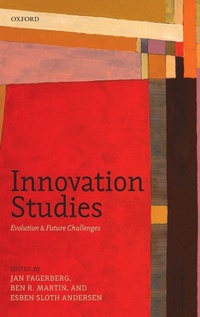
Innovation Studies
Evolution and Future Challenges
Published on 31. October 2013
Book
Hardback
230 pages
978-0-19-968634-6 (ISBN)
Description
Innovation is increasingly recognized as a vitally important social and economic phenomenon worthy of serious research study. Firms are concerned about their innovation ability, particularly relative to their competitors. Politicians care about innovation, too, because of its presumed social and economic impact. However, to recognize that innovation is desirable is not sufficient. What is required is systematic and reliable knowledge about how best to influence innovation and to exploit its effects to the full.
Gaining such knowledge is the aim of the field of innovation studies, which is now at least half a century old. Hence, it is an opportune time to ask what has been achieved and what we still need to know more about. This is what this book sets out to explore. Written by a number of central contributors to the field, it critically examines the current state of the art and identifies issues that merit greater attention. The focus is mainly on how society can derive the greatest benefit from innovation and what needs to done to achieve this. However, to learn more about how society can benefit more from innovation, one also needs to understand innovation processes in firms and how these interact with broader social, institutional and political factors. Such issues are therefore also central to the discussion here.
Gaining such knowledge is the aim of the field of innovation studies, which is now at least half a century old. Hence, it is an opportune time to ask what has been achieved and what we still need to know more about. This is what this book sets out to explore. Written by a number of central contributors to the field, it critically examines the current state of the art and identifies issues that merit greater attention. The focus is mainly on how society can derive the greatest benefit from innovation and what needs to done to achieve this. However, to learn more about how society can benefit more from innovation, one also needs to understand innovation processes in firms and how these interact with broader social, institutional and political factors. Such issues are therefore also central to the discussion here.
More details
Language
English
Place of publication
Oxford
United Kingdom
Target group
College/higher education
Dimensions
Height: 240 mm
Width: 161 mm
Thickness: 18 mm
Weight
529 gr
ISBN-13
978-0-19-968634-6 (9780199686346)
Copyright in bibliographic data and cover images is held by Nielsen Book Services Limited or by the publishers or by their respective licensors: all rights reserved.
Schweitzer Classification
Other editions
Additional editions
Jan Fagerberg | Ben R. Martin | Esben Sloth Andersen
Innovation Studies
Evolution and Future Challenges
Book
10/2013
Oxford University Press
€60.65
Shipment within 15-20 days
Persons
Jan Fagerberg is Professor at the Department of Business and Management at Aalborg University in Denmark and the Centre for Technology, Innovation and Culture (TIK) at the University of Oslo. In his research Fagerberg has, among other areas, focused on the relationship between technology (innovation and diffusion) and competitiveness, economic growth, and development. He has also worked on innovation theory, innovation systems, and innovation policy. Fagerberg has published extensively on these and other topics in books and journals, and his research is widely cited and disseminated.
Ben Martin is Professor of Science and Technology Policy Studies in SPRU, University of Sussex. Between 1996 and 2004, he served as SPRU Director. He is also an Associate Fellow at the Centre for Science and Policy (CSaP), and Senior Visiting Fellow at the Centre for Business Research, Judge Business School, both at the University of Cambridge. His research for the last 35 years has focused on science policy. He helped pioneer techniques for evaluating scientific laboratories, research programmes, and national scientific performance, and for conducting 'technology foresight'. In recent years, he has conducted research on the benefits from government funding of basic research, the changing nature and role of the university, the impact of the UK Research Assessment Exercise, creative knowledge environments, and the evolution of the field of science policy and innovation studies.
Esben Sloth Andersen is Professor of Evolutionary Economics at the Department of Business and Management at Aalborg University. His research has focussed on the theory, modelling and simulation of economic evolution, innovation in a systemic perspective, and evolution in the history of economic thought with special emphasis of the work of Joseph Schumpeter
Ben Martin is Professor of Science and Technology Policy Studies in SPRU, University of Sussex. Between 1996 and 2004, he served as SPRU Director. He is also an Associate Fellow at the Centre for Science and Policy (CSaP), and Senior Visiting Fellow at the Centre for Business Research, Judge Business School, both at the University of Cambridge. His research for the last 35 years has focused on science policy. He helped pioneer techniques for evaluating scientific laboratories, research programmes, and national scientific performance, and for conducting 'technology foresight'. In recent years, he has conducted research on the benefits from government funding of basic research, the changing nature and role of the university, the impact of the UK Research Assessment Exercise, creative knowledge environments, and the evolution of the field of science policy and innovation studies.
Esben Sloth Andersen is Professor of Evolutionary Economics at the Department of Business and Management at Aalborg University. His research has focussed on the theory, modelling and simulation of economic evolution, innovation in a systemic perspective, and evolution in the history of economic thought with special emphasis of the work of Joseph Schumpeter
Editor
Professor, Center for Technology, Innovation and Culture, University of Oslo, and Professor, Department of Business and Management, Aalborg University
Professor of Science and Technology Policy Studies, SPRU, University of Sussex
Professor, Department of Business and Management, Aalborg University
Content
1. Innovation Studies: Towards a New Agenda ; PART I: EVOLUTION, DEVELOPMENTS, AND KEY ISSUES ; 2. Innovation Studies: a Personal Interpretation of the State of the Art ; 3. Innovation, Work Organization, and Systems of Social Protection ; 4. Innovation Systems and Policy for Development in a Changing World ; 5. Innovation, Evolution, and Economics: Where We Are and Where We Should Go ; 6. Is Innovation Always Good? ; PART II: CHALLENGES FOR INNOVATION STUDIES IN THE YEARS AHEAD ; 7. Innovation Studies at Maturity ; 8. Innovation Studies: an Emerging Agenda ; 9. Reflections on the Study of Innovation and on Those Who Study It ; 10. Smart and Inclusive Growth: Rethinking the State s Role and the Risk-Reward Relationship ; 11. An Agenda for Future Research