

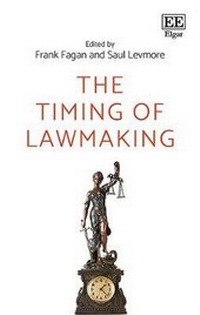
The Timing of Lawmaking
Published on 31. March 2017
Book
Hardback
368 pages
978-1-78536-432-7 (ISBN)
Description
Legal reasoning, pronouncements of judgment, the design and implementation of statutes, and even constitution-making and discourse all depend on timing. This compelling study examines the diverse interactions between law and time, and provides important perspectives on how law's architecture can be understood through time. The book reconsiders older work on legal transitions and breaks new ground on timing rules, especially with respect to how judges, legislators and regulators use time as a tool when devising new rules. At its core, The Timing of Lawmaking goes directly to the heart of the most basic of legal debates: when should we respect the past, and when should we make a clean break for the future?
This unique resource draws on examples from administrative law, banking law, budget law, constitutional law, criminal law, environmental law, inheritance law, national security law, tax law, and tort law, and will be of interest to academics studying law, political science and economics, as well as to policymakers, legislators, and judges.
Contributors include: E. Alston, F. Fagan, D.A. Farber, J.E. Gersen, T. Ginsburg, D. Kamin, S. Levmore, A. Niblett, M.C. Nussbaum, E.A. Posner, J.M. Ramseyer, A.M. Samaha, D. Shaviro, J. Suk
This unique resource draws on examples from administrative law, banking law, budget law, constitutional law, criminal law, environmental law, inheritance law, national security law, tax law, and tort law, and will be of interest to academics studying law, political science and economics, as well as to policymakers, legislators, and judges.
Contributors include: E. Alston, F. Fagan, D.A. Farber, J.E. Gersen, T. Ginsburg, D. Kamin, S. Levmore, A. Niblett, M.C. Nussbaum, E.A. Posner, J.M. Ramseyer, A.M. Samaha, D. Shaviro, J. Suk
Reviews / Votes
'Without doubt, this book is an important brick in the process to the critical theorization of the relationship between law and time, which was until recently largely underappreciated.' -- iConnect Blog 'What a terrific topic for a book - and what a rich and tremendous collection of papers! There are fascinating discussions of whether legal deadlines work, whether traditions deserve respect, when consent (to sex) is relevant, when law is durable, and when law takes effect immediately or instead requires people to act to make it effective in the future. The timing is right: read it now!' -- Cass R. Sunstein, Harvard University, US and author of The World According to Star Wars 'Without doubt, this book Is an important brick In the process to the critical theorization of the relationship between law and time, which was until recently largely underappreciated. The book adequately represents a balanced review onthe Interaction between lawmaking and time, which renders it a valuable material for lawmakers, policymakers and academics alike but also for lawyers, economists and political scientists.' -- International Journal of Constitutional LawMore details
Language
English
Place of publication
Cheltenham
United Kingdom
Target group
Professional and scholarly
Dimensions
Height: 234 mm
Width: 156 mm
ISBN-13
978-1-78536-432-7 (9781785364327)
Copyright in bibliographic data and cover images is held by Nielsen Book Services Limited or by the publishers or by their respective licensors: all rights reserved.
Schweitzer Classification
Persons
Edited by Frank Fagan, Associate Professor, South Texas College of Law and Saul Levmore, William B. Graham Distinguished Service Professor of Law, University of Chicago Law School, US
Content
Contents:
Part I Timing Devices
1. Legal Cycles and Stabilization Rules
Frank Fagan
2. Legislating Crisis
David Kamin
3. The More It Changes, The More It Stays the Same?: Automatic Indexing and Current Policy
Dan Shaviro
4. Racing the Clock: Deadlines, Conflict, and Negotiating in Lawmaking
Daniel A. Farber
5. Playing for Constitutional Time: Interim Constitutions and Transitional Provisions
Tom Ginsburg and Eric Alston
6. Legislative Sunrises: Transitions, Veiled Commitments, and Carbon Taxes
Frank Fagan and Saul Levmore
Part II Law's Architecture
7. Timing of Consent
Jacob E. Gersen and Jeannie Suk
8. Interest Groups and the Durability of Law
Saul Levmore
9. Self-executing Statutes in the Administrative State
Adam Samaha
10. Intellectual Property and Legislative Innovation
Saul Levmore
Part III Time in Judging
11. Janus-Faced Law: A Philosophical Debate
Martha C. Nussbaum
12. Renovating the Efficiency of Common Law Hypothesis
Frank Fagan
13. Delaying Declarations of Constitutional Invalidity
Anthony Niblett
14. The Sins of Their Fathers: Illegitimacy in Japan and Surrogate Punishment across Generations
J. Mark Ramseyer
Index
Part I Timing Devices
1. Legal Cycles and Stabilization Rules
Frank Fagan
2. Legislating Crisis
David Kamin
3. The More It Changes, The More It Stays the Same?: Automatic Indexing and Current Policy
Dan Shaviro
4. Racing the Clock: Deadlines, Conflict, and Negotiating in Lawmaking
Daniel A. Farber
5. Playing for Constitutional Time: Interim Constitutions and Transitional Provisions
Tom Ginsburg and Eric Alston
6. Legislative Sunrises: Transitions, Veiled Commitments, and Carbon Taxes
Frank Fagan and Saul Levmore
Part II Law's Architecture
7. Timing of Consent
Jacob E. Gersen and Jeannie Suk
8. Interest Groups and the Durability of Law
Saul Levmore
9. Self-executing Statutes in the Administrative State
Adam Samaha
10. Intellectual Property and Legislative Innovation
Saul Levmore
Part III Time in Judging
11. Janus-Faced Law: A Philosophical Debate
Martha C. Nussbaum
12. Renovating the Efficiency of Common Law Hypothesis
Frank Fagan
13. Delaying Declarations of Constitutional Invalidity
Anthony Niblett
14. The Sins of Their Fathers: Illegitimacy in Japan and Surrogate Punishment across Generations
J. Mark Ramseyer
Index