

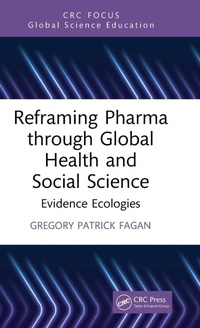
Reframing Pharma through Global Health and Social Science
Evidence Ecologies
1st Edition
Published on 24. April 2026
Book
Hardback
168 pages
978-1-041-32600-7 (ISBN)
Description
This book explores how pharmaceutical evidence is designed, interpreted, and used, drawing on positivist, constructivist, critical realist, pragmatist, feminist, and decolonial traditions. It shows how dominant evidence paradigms often struggle to account for time, population heterogeneity, patient experience, and context across contemporary therapeutic and care settings.
Rather than treating these dimensions as downstream complications, the book advances an evidence ecology approach-understanding evidence as an interacting system of methods, institutions, and social worlds-and offers
a framework for aligning scientific rigor with access, uptake, and sustained therapeutic impact across diverse settings.
* A conceptual framework showing how different philosophical positions influence evidence creation, interpretation,
and governance.
* A practical toolkit for translating those stances into study designs, evaluation metrics, and strategic decision
frameworks.
* A bridge between academic reflection and professional application, enabling researchers, policymakers, and
industry teams to align evidence with ethics, culture, and context.
Rather than treating these dimensions as downstream complications, the book advances an evidence ecology approach-understanding evidence as an interacting system of methods, institutions, and social worlds-and offers
a framework for aligning scientific rigor with access, uptake, and sustained therapeutic impact across diverse settings.
* A conceptual framework showing how different philosophical positions influence evidence creation, interpretation,
and governance.
* A practical toolkit for translating those stances into study designs, evaluation metrics, and strategic decision
frameworks.
* A bridge between academic reflection and professional application, enabling researchers, policymakers, and
industry teams to align evidence with ethics, culture, and context.
More details
Series
Language
English
Place of publication
London
United Kingdom
Publishing group
Taylor & Francis Ltd
Target group
Professional and scholarly
College/higher education
General, Professional Practice & Development, and Professional Reference
Product notice
sewn/stitched
Cloth over boards
Illustrations
20 s/w Abbildungen, 20 s/w Zeichnungen
20 Line drawings, black and white; 20 Illustrations, black and white
Dimensions
Height: 216 mm
Width: 140 mm
Thickness: 13 mm
Weight
363 gr
ISBN-13
978-1-041-32600-7 (9781041326007)
Copyright in bibliographic data and cover images is held by Nielsen Book Services Limited or by the publishers or by their respective licensors: all rights reserved.
Schweitzer Classification
Other editions
Additional editions

E-Book
04/2026
1st Edition
CRC Press
€31.49
Available for download

E-Book
04/2026
1st Edition
CRC Press
€31.49
Available for download
Person
Gregory Patrick Fagan, PhD, is a global health researcher whose work examines how pharmaceutical evidence is produced, interpreted, and governed within real-world health systems. Drawing on sociology, medical anthropology, and applied epistemic analysis, he studies how assumptions embedded in evidence design shape regulation, access, and therapeutic uptake across diverse settings. He has held senior roles in global health and rare disease programs and works at the intersection of pharmaceutical development, humanitarian access, and health systems.
Content
Table of Contents. Preface: Why Evidence Needs Ecology-Now. Acknowledgments. Introduction: Why Evidence No Longer Travels Well. Chapter 1: The Biomedical Compact: Origins, Power, and Limits. Chapter 2: Reductionism and Evidence Design. Chapter 3: Global Health, Access, and Contextual Fracture. Chapter 4: Real-World Evidence: Promise, Inheritance, and Constraint. Chapter 5: Philosophical Stances in Practice. Chapter 6: Methodological Consequences of Pluralism. Chapter 7: Evidence Ecologies: A Framework for Alignment. Chapter 8: Designing for Coherence: Evidence Architecture in Practice. Chapter 9: Social and Anthropological Foundations of Situated Evidence. Conclusion: Designing Evidence for a World That Learns. Index