

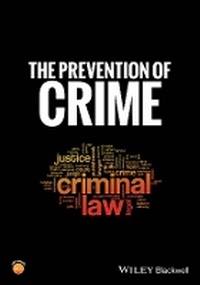
The Prevention of Crime
2nd Edition
Published on 19. February 2024
Book
Paperback/Softback
512 pages
978-1-394-15335-0 (ISBN)
Description
Provides an integrated and holistic review of effective crime prevention programs, practices and policies, their theoretical grounding, the scientific evidence of their effectiveness, and the practical issues involved in their implementation at the community, state and national levels.
The Prevention of Crime offers a comprehensive yet easy-to-understand overview of crime prevention strategies, such as programs and practices guided by life-course developmental theories of crime, situational crime prevention, law enforcement practices and policies, and correctional interventions. Containing the most up-to-date and accurate information about "what works" in crime prevention, this unique textbook introduces students to the public health and prevention science approaches to addressing the causes of crime, with a focus on prevention-oriented, community-based interventions. Throughout the text, the authors emphasize the importance of using high-quality scientific methodologies to identify effective and ineffective interventions that are based on theory, provide expert insights on practical issues relating to crime prevention in communities, and discuss how practitioners can effectively implement a range of crime prevention strategies.
Incorporating recent advances and emerging research in the field, the second edition of The Prevention of Crime contains new and updated coverage of developments in criminological theory and evaluation methods, efforts to avoid and correct discriminatory crime prevention practices, understand how and why communities make adaptations to evidence-based interventions (EBI), strategies to investigate and communicate the impact of EBIs on different populations (including members of racial/ethnic minority groups), and more. This edition includes new links to relevant research and internet resources, additional real-world examples, updated crime statistics, and information on recent changes in EBI registries that list crime prevention interventions.
Describes effective interventions that have been developed, tested, and used in the United States and internationally
Demonstrates the relationship between criminological theories, research, and practice
Discusses the practical challenges of implementing crime prevention strategies and policies
Corrects misconceptions about widely-used prevention models shown to be ineffective in reducing crime
Draws from cutting-edge conceptual frameworks and the latest research in prevention science and crime prevention
Written to be accessible to students without formal training in research methods, The Prevention of Crime, Second Edition, is an excellent textbook for undergraduate and graduate programs in criminology, criminal justice, and prevention science programs, as well as courses on psychology, public health, sociology, and social work.
The Prevention of Crime offers a comprehensive yet easy-to-understand overview of crime prevention strategies, such as programs and practices guided by life-course developmental theories of crime, situational crime prevention, law enforcement practices and policies, and correctional interventions. Containing the most up-to-date and accurate information about "what works" in crime prevention, this unique textbook introduces students to the public health and prevention science approaches to addressing the causes of crime, with a focus on prevention-oriented, community-based interventions. Throughout the text, the authors emphasize the importance of using high-quality scientific methodologies to identify effective and ineffective interventions that are based on theory, provide expert insights on practical issues relating to crime prevention in communities, and discuss how practitioners can effectively implement a range of crime prevention strategies.
Incorporating recent advances and emerging research in the field, the second edition of The Prevention of Crime contains new and updated coverage of developments in criminological theory and evaluation methods, efforts to avoid and correct discriminatory crime prevention practices, understand how and why communities make adaptations to evidence-based interventions (EBI), strategies to investigate and communicate the impact of EBIs on different populations (including members of racial/ethnic minority groups), and more. This edition includes new links to relevant research and internet resources, additional real-world examples, updated crime statistics, and information on recent changes in EBI registries that list crime prevention interventions.
Describes effective interventions that have been developed, tested, and used in the United States and internationally
Demonstrates the relationship between criminological theories, research, and practice
Discusses the practical challenges of implementing crime prevention strategies and policies
Corrects misconceptions about widely-used prevention models shown to be ineffective in reducing crime
Draws from cutting-edge conceptual frameworks and the latest research in prevention science and crime prevention
Written to be accessible to students without formal training in research methods, The Prevention of Crime, Second Edition, is an excellent textbook for undergraduate and graduate programs in criminology, criminal justice, and prevention science programs, as well as courses on psychology, public health, sociology, and social work.
More details
Edition
2nd edition
Language
English
Place of publication
United States
Publishing group
John Wiley & Sons Inc
Target group
Professional and scholarly
Dimensions
Height: 252 mm
Width: 187 mm
Thickness: 28 mm
Weight
1030 gr
ISBN-13
978-1-394-15335-0 (9781394153350)
Copyright in bibliographic data and cover images is held by Nielsen Book Services Limited or by the publishers or by their respective licensors: all rights reserved.
Schweitzer Classification
Other editions
Additional editions
Abigail A. Fagan | Delbert Elliott
The Prevention of Crime
E-Book
01/2024
2nd Edition
Wiley
€52.99
Available for download
Abigail A. Fagan | Delbert Elliott
The Prevention of Crime
E-Book
01/2024
2nd Edition
Wiley
€52.99
Available for download
Previous edition
Delbert Elliott | Abigail Fagan
The Prevention of Crime
Book
03/2017
Wiley
Unfortunately, price unknown
Article exhausted; check for reprint
Persons
Abigail A. Fagan is a Professor in the Department of Sociology and Criminology & Law at the University of Florida. Her research examines the causes and prevention of juvenile delinquency and drug use and how scientific knowledge can be successfully translated into effective programs and practices for preventing crime and delinquency. She is the former President of the Society for Prevention Research and the author of two books and nearly 100 articles in leading criminology, psychology, and public health journals.
Delbert Elliott is a Distinguished Professor Emeritus at the Institute of Behavioral Science (IBS), University of Colorado Boulder. He was the Founding Director of The Center for the Study and Prevention of Violence and the Blueprints for Healthy Youth Development Initiative at IBS. He served as Principal Investigator for the first nine waves of the National Youth Survey and chaired the Criminal and Violent Behavior Review Committee (NIMH). Elliott was Science Editor of the U.S. Surgeon General's Report on Youth Violence and is a past President and Fellow of The American Society of Criminology.
Delbert Elliott is a Distinguished Professor Emeritus at the Institute of Behavioral Science (IBS), University of Colorado Boulder. He was the Founding Director of The Center for the Study and Prevention of Violence and the Blueprints for Healthy Youth Development Initiative at IBS. He served as Principal Investigator for the first nine waves of the National Youth Survey and chaired the Criminal and Violent Behavior Review Committee (NIMH). Elliott was Science Editor of the U.S. Surgeon General's Report on Youth Violence and is a past President and Fellow of The American Society of Criminology.
Content
Preface
Acknowledgements
About the companion website
Section I - Introduction to Crime Prevention
Chapter 1: The Goals and Logic of Crime Prevention
Chapter 2: A Brief History of Crime Prevention
Section II: The Foundations of Prevention Science
Chapter 3: How Theory and Research Inform the Science and Practice of Prevention.
Chapter 4: Evaluation Science
Section III: What Works to Prevent Crime?
Chapter 5: Establishing a Standard for Judging Intervention Effectiveness
Chapter 6: Situational and Legal Crime Prevention Programs, Practices and Policies
Chapter 7: Contextual Interventions
Chapter 8: Individual-Level Crime Prevention: Preventing the Onset of Crime
Chapter 9: Individual-Level: Reducing the Continuity of Offending
Section 4: Crime Prevention in Practice
Chapter 10: Selecting and Implementing Effective Crime Prevention Programs, Practices and Policies in Local Communities
Chapter 11: Dissemination and Implementation Science: Taking Effective Crime Prevention Programs, Practices and Policies to Scale
Chapter 12: The Future of Crime Prevention
Index
Acknowledgements
About the companion website
Section I - Introduction to Crime Prevention
Chapter 1: The Goals and Logic of Crime Prevention
Chapter 2: A Brief History of Crime Prevention
Section II: The Foundations of Prevention Science
Chapter 3: How Theory and Research Inform the Science and Practice of Prevention.
Chapter 4: Evaluation Science
Section III: What Works to Prevent Crime?
Chapter 5: Establishing a Standard for Judging Intervention Effectiveness
Chapter 6: Situational and Legal Crime Prevention Programs, Practices and Policies
Chapter 7: Contextual Interventions
Chapter 8: Individual-Level Crime Prevention: Preventing the Onset of Crime
Chapter 9: Individual-Level: Reducing the Continuity of Offending
Section 4: Crime Prevention in Practice
Chapter 10: Selecting and Implementing Effective Crime Prevention Programs, Practices and Policies in Local Communities
Chapter 11: Dissemination and Implementation Science: Taking Effective Crime Prevention Programs, Practices and Policies to Scale
Chapter 12: The Future of Crime Prevention
Index