

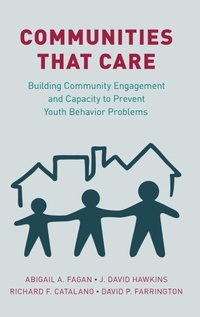
Communities that Care
Building Community Engagement and Capacity to Prevent Youth Behavior Problems
Published on 24. January 2019
Book
Hardback
374 pages
978-0-19-029921-7 (ISBN)
Description
Scholars and policymakers increasingly call for evidence-based, prevention-oriented, and community-driven approaches to improve public health and reduce youth crime, substance use, and related problems. However, few functional models exist. In Communities that Care, four leading experts on prevention describe one such system to illustrate how communities effectively engage in prevention activities. Communities That Care (CTC) is a coalition-based prevention system implemented successfully in dozens of communities across the world that promotes healthy development and reduces crime rates for youth. Drawing on literature from criminology, community psychology, and prevention science this book describes the conditions and actions necessary for effective community-based prevention. The authors illustrate how effective community-based prevention can be undertaken by describing how the CTC prevention system has been developed, implemented, evaluated, and disseminated across the U.S. and internationally. Communities that Care shares invaluable lessons about the implementation and evaluation of community-level interventions and establishes a set of best practices for anyone seeking to engage in and/or evaluate effective prevention efforts.
Reviews / Votes
The book is well written and within the reach of the average reader. It is well referenced and adequately indexed. The authors make effective use of tables, charts, and illustrations. Communities That Care is recommended for the general holdings of all libraries and will be particularly useful to citizen activists, community developers, practitioners, and researchers focused on the treatment of troubled youth. * R. T. Sigler, CHOICE *More details
Language
English
Place of publication
New York
United States
Target group
Professional and scholarly
Illustrations
16 illustrations
Dimensions
Height: 240 mm
Width: 161 mm
Thickness: 25 mm
Weight
722 gr
ISBN-13
978-0-19-029921-7 (9780190299217)
Copyright in bibliographic data and cover images is held by Nielsen Book Services Limited or by the publishers or by their respective licensors: all rights reserved.
Schweitzer Classification
Other editions
Additional editions
Abigail A. Fagan | J. David Hawkins | David P. Farrington
Communities that Care
Building Community Engagement and Capacity to Prevent Youth Behavior Problems
Book
01/2019
Oxford University Press Inc
€48.60
Shipment within 15-20 days
Abigail A. Fagan | J. David Hawkins | David P. Farrington
Communities that Care
Building Community Engagement and Capacity to Prevent Youth Behavior Problems
E-Book
11/2018
1st Edition
OUP eBook
€20.99
Available for download
Abigail A. Fagan | J. David Hawkins | David P. Farrington
Communities that Care
Building Community Engagement and Capacity to Prevent Youth Behavior Problems
E-Book
11/2018
1st Edition
OUP eBook
€15.49
Available for download
Persons
Abigail A. Fagan is an Associate Professor in the Department of Sociology, Criminology & Law at the University of Florida.
David Hawkins is the Endowed Professor of Prevention and Founding Director of the Social Development Research Group at the University of Washington School of Social Work.
Richard F. Catalano is the Bartley Dobb Professor for the Study and Prevention of Violence at the School of Social Work, University of Washington and the co-founder of the Social Development Research Group.
David P. Farrington is Emeritus Professor of Psychological Criminology at the Institute of Criminology at Cambridge University.
David Hawkins is the Endowed Professor of Prevention and Founding Director of the Social Development Research Group at the University of Washington School of Social Work.
Richard F. Catalano is the Bartley Dobb Professor for the Study and Prevention of Violence at the School of Social Work, University of Washington and the co-founder of the Social Development Research Group.
David P. Farrington is Emeritus Professor of Psychological Criminology at the Institute of Criminology at Cambridge University.
Author
Associate Professor, Department of Sociology, Criminology & LawAssociate Professor, Department of Sociology, Criminology & Law, University of Florida
Endowed Professor of PreventionEndowed Professor of Prevention, University of Washington School of Social Work
Emeritus Professor of Psychological CriminologyEmeritus Professor of Psychological Criminology, Cambridge University
Bartley Dobb Professor for the Study and Prevention of ViolenceBartley Dobb Professor for the Study and Prevention of Violence, School of Social Work, University of Washington
Content
Preface by Francis Cullen
Chapter 1: Community-Based Prevention of Youth Behavioral Health Problems
Chapter 2: Theoretical Perspectives Guiding the Development and Evaluation of CTC
Chapter 3: The Development and Evaluation of CTC
Chapter 4: The Importance of Readiness and High-Functioning Coalitions in Community-based Prevention
Chapter 5: Improving Community Capacity to Conduct Comprehensive Prevention Needs Assessments
Chapter 6: Increasing the Use of Evidence-based Interventions to Reduce Youth Behavioral Health Problems
Chapter 7: Ensuring High Quality Implementation and Sustainability of Evidence-based Interventions and Coalitions
Chapters 8: Findings from the Community Youth Development Study
Chapter 9: A State-wide Effectiveness Trial of CTC in Pennsylvania
Chapter 10: The Future of CTC and Community-based Prevention
Chapter 1: Community-Based Prevention of Youth Behavioral Health Problems
Chapter 2: Theoretical Perspectives Guiding the Development and Evaluation of CTC
Chapter 3: The Development and Evaluation of CTC
Chapter 4: The Importance of Readiness and High-Functioning Coalitions in Community-based Prevention
Chapter 5: Improving Community Capacity to Conduct Comprehensive Prevention Needs Assessments
Chapter 6: Increasing the Use of Evidence-based Interventions to Reduce Youth Behavioral Health Problems
Chapter 7: Ensuring High Quality Implementation and Sustainability of Evidence-based Interventions and Coalitions
Chapters 8: Findings from the Community Youth Development Study
Chapter 9: A State-wide Effectiveness Trial of CTC in Pennsylvania
Chapter 10: The Future of CTC and Community-based Prevention