

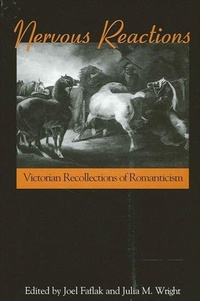
Nervous Reactions
Victorian Recollections of Romanticism
Published on 19. January 2004
Book
Hardback
295 pages
978-0-7914-5971-3 (ISBN)
Description
Addresses how Victorian receptions of Romanticism and Romantic writers were shaped by notions of "nervousness."
Nervous Reactions considers Victorian responses to Romanticism, particularly the way in which the Romantic period was frequently constructed in Victorian-era texts as a time of nervous or excitable authors (and readers) at odds with Victorian values of self-restraint, moderation, and stolidity. Represented in various ways-as a threat to social order, as a desirable freedom of feeling, as a pathological weakness that must be cured-this nervousness, both about and of the Romantics, is an important though as yet unaddressed concern in Victorian responses to Romantic texts. By attending to this nervousness, the essays in this volume offer a new consideration not only of the relationship between the Victorian and Romantic periods, but also of the ways in which our own responses to Romanticism have been mediated by this Victorian attention to Romantic excitability.
Considering editions and biographies as well as literary and critical responses to Romantic writers, the volume addresses a variety of discursive modes and genres, and brings to light a number of authors not normally included in the longstanding category of "Victorian Romanticism": on the Romantic side, not just Wordsworth, Keats, and P. B. Shelley but also Byron, S. T. Coleridge, Thomas De Quincey, Mary Shelley, and Mary Wollstonecraft; and on the Victorian side, not just Thomas Carlyle and the Brownings but also Sara Coleridge, George Eliot, Elizabeth Gaskell, Archibald Lampman, and J. S. Mill.
Contributors include D. M. R. Bentley, Kristen Guest, Joel Faflak, Grace Kehler, Donelle Ruwe, Alan Vardy, Lisa Vargo, Timothy J. Wandling, Joanne Wilkes, and Julia M. Wright.
Nervous Reactions considers Victorian responses to Romanticism, particularly the way in which the Romantic period was frequently constructed in Victorian-era texts as a time of nervous or excitable authors (and readers) at odds with Victorian values of self-restraint, moderation, and stolidity. Represented in various ways-as a threat to social order, as a desirable freedom of feeling, as a pathological weakness that must be cured-this nervousness, both about and of the Romantics, is an important though as yet unaddressed concern in Victorian responses to Romantic texts. By attending to this nervousness, the essays in this volume offer a new consideration not only of the relationship between the Victorian and Romantic periods, but also of the ways in which our own responses to Romanticism have been mediated by this Victorian attention to Romantic excitability.
Considering editions and biographies as well as literary and critical responses to Romantic writers, the volume addresses a variety of discursive modes and genres, and brings to light a number of authors not normally included in the longstanding category of "Victorian Romanticism": on the Romantic side, not just Wordsworth, Keats, and P. B. Shelley but also Byron, S. T. Coleridge, Thomas De Quincey, Mary Shelley, and Mary Wollstonecraft; and on the Victorian side, not just Thomas Carlyle and the Brownings but also Sara Coleridge, George Eliot, Elizabeth Gaskell, Archibald Lampman, and J. S. Mill.
Contributors include D. M. R. Bentley, Kristen Guest, Joel Faflak, Grace Kehler, Donelle Ruwe, Alan Vardy, Lisa Vargo, Timothy J. Wandling, Joanne Wilkes, and Julia M. Wright.
Reviews / Votes
"In its 'nervous' focus, its consideration of a range of genres and literary institutions (reviews, editions, biographies), and its combination of theoretical sophistication and empirical groundedness, Nervous Reactions is a strong contribution to the field." - University of Toronto Quarterly"This book makes an extremely persuasive case for the end to the traditional disciplinary division in English between Romantic and Victorian periods. It demonstrates the compelling practical necessity for critics to abandon their entrapment within the Victorian construct of Romanticism, because they each open up new and manifestly promising areas of inquiry." - Peter Melville Logan, author of Nerves and Narratives: A Cultural History of Hysteria in Nineteenth-Century British Prose
More details
Series
Language
English
Place of publication
Albany, NY
United States
Target group
College/higher education
Professional and scholarly
US School Grade: College Graduate Student and over
Product notice
sewn/stitched
Cloth over boards
Dimensions
Height: 230 mm
Width: 167 mm
Thickness: 24 mm
Weight
522 gr
ISBN-13
978-0-7914-5971-3 (9780791459713)
Copyright in bibliographic data and cover images is held by Nielsen Book Services Limited or by the publishers or by their respective licensors: all rights reserved.
Schweitzer Classification
Other editions
Additional editions
E-Book
02/2012
1st Edition
De Gruyter
€36.49
Available for download
Persons
Joel Faflak is Assistant Professor of English at Wilfrid Laurier University. Julia M. Wright is Canada Research Chair in English at Wilfrid Laurier University. She is the author of Blake, Nationalism, and the Politics of Alienation, the editor of The Missionary: An Indian Tale, and the coeditor (with Tilottama Rajan) of Romanticism, History, and the Possibilities of Genre.
Content
Acknowledgments
Introduction
Joel Faflak and Julia M. Wright
I. NERVOUS CONTAINMENTS: RECOLLECTION AND INFLUENCE
1. De Quincey Collects Himself
Joel Faflak
2. Mrs. Julian T. Marshall's Life and Letters of Mary Wollstonecraft Shelley
Lisa Vargo
3. Between Action and Inaction: The "Performance" of the Prima Donna in Eliot's Closet Drama
Grace Kehler
4. Nervous ReincarNations: Keats, Scenery, and Mind Cure in Canada during the Post-Confederation Period, with Particular Reference to Archibald Lampman and Related Cases
D. M. R. Bentley
II. A MATTER OF BALANCE: BYRONIC ILLNESS AND VICTORIAN CURE
5. Early Romantic Theorists and The Fate of Transgressive Eloquence: John Stuart Mill's Response to Byron
Timothy J. Wandling
6. Dyspeptic Reactions: Thomas Carlyle and the Byronic Temper
Kristen Guest
7. "Growing Pains": Representing the Romantic in Gaskell's Wives and Daughters
Julia M. Wright
III. HESITATION AND INHERITANCE: THE CASE OF SARA COLERIDGE
8. Snuffing Out an Article: Sara Coleridge and the Early Victorian Reception of Keats
Joanne Wilkes
9. Her Father's "Remains": Sara Coleridge's Edition of Essays on His Own Times
Alan Vardy
10. Opium Addictions and Metaphysicians: Sara Coleridge's Editing of Biographia Literaria
Donelle Ruwe
Bibliography
List of Contributors
Index
Introduction
Joel Faflak and Julia M. Wright
I. NERVOUS CONTAINMENTS: RECOLLECTION AND INFLUENCE
1. De Quincey Collects Himself
Joel Faflak
2. Mrs. Julian T. Marshall's Life and Letters of Mary Wollstonecraft Shelley
Lisa Vargo
3. Between Action and Inaction: The "Performance" of the Prima Donna in Eliot's Closet Drama
Grace Kehler
4. Nervous ReincarNations: Keats, Scenery, and Mind Cure in Canada during the Post-Confederation Period, with Particular Reference to Archibald Lampman and Related Cases
D. M. R. Bentley
II. A MATTER OF BALANCE: BYRONIC ILLNESS AND VICTORIAN CURE
5. Early Romantic Theorists and The Fate of Transgressive Eloquence: John Stuart Mill's Response to Byron
Timothy J. Wandling
6. Dyspeptic Reactions: Thomas Carlyle and the Byronic Temper
Kristen Guest
7. "Growing Pains": Representing the Romantic in Gaskell's Wives and Daughters
Julia M. Wright
III. HESITATION AND INHERITANCE: THE CASE OF SARA COLERIDGE
8. Snuffing Out an Article: Sara Coleridge and the Early Victorian Reception of Keats
Joanne Wilkes
9. Her Father's "Remains": Sara Coleridge's Edition of Essays on His Own Times
Alan Vardy
10. Opium Addictions and Metaphysicians: Sara Coleridge's Editing of Biographia Literaria
Donelle Ruwe
Bibliography
List of Contributors
Index