

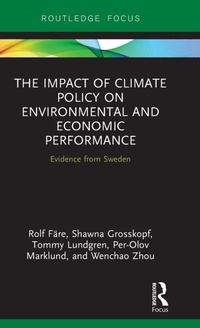
The Impact of Climate Policy on Environmental and Economic Performance
Evidence from Sweden
1st Edition
Published on 13. July 2016
Book
Hardback
146 pages
978-1-138-84747-7 (ISBN)
Description
Sweden has a long history of ambitious environmental, energy and climate policy. Due to the large amount of data available it is possible to perform statistically sound analysis and assess long term changes in productivity, efficiency, and technological development. The data at hand together with Sweden's ambitious energy and climate policy provides a unique opportunity to shed light on pertinent policy issues.
The Impact of Climate Policy on Environmental and Economic Performance answers several key questions: What is the effect of the CO2 tax on environmental performance and profitability of firms? Does including emissions in productivity measurement of the industrial firm matter? Did the introduction of the EU ETS spur technological development in the Swedish industrial firm? What air pollutant is most inhibiting production when regulated? Being aware and learning from the Swedish case can be very relevant for countries that are in the process of shaping their climate policy.
This book is of great importance to researchers and policy makers who are interested in environmental economics, industrial economics and climate change.
The Impact of Climate Policy on Environmental and Economic Performance answers several key questions: What is the effect of the CO2 tax on environmental performance and profitability of firms? Does including emissions in productivity measurement of the industrial firm matter? Did the introduction of the EU ETS spur technological development in the Swedish industrial firm? What air pollutant is most inhibiting production when regulated? Being aware and learning from the Swedish case can be very relevant for countries that are in the process of shaping their climate policy.
This book is of great importance to researchers and policy makers who are interested in environmental economics, industrial economics and climate change.
More details
Series
Language
English
Place of publication
London
United Kingdom
Publishing group
Taylor & Francis Ltd
Target group
College/higher education
Illustrations
35 s/w Abbildungen, 35 s/w Zeichnungen, 18 s/w Tabellen
18 Tables, black and white; 35 Line drawings, black and white; 35 Illustrations, black and white
Dimensions
Height: 222 mm
Width: 145 mm
Thickness: 12 mm
Weight
341 gr
ISBN-13
978-1-138-84747-7 (9781138847477)
Copyright in bibliographic data and cover images is held by Nielsen Book Services Limited or by the publishers or by their respective licensors: all rights reserved.
Schweitzer Classification
Other editions
Additional editions
Rolf Faere | Shawna Grosskopf | Tommy Lundgren
The Impact of Climate Policy on Environmental and Economic Performance
Evidence from Sweden
Book
06/2020
1st Edition
Routledge
€29.70
Shipment within 15-20 days
Rolf Faere | Shawna Grosskopf | Tommy Lundgren
The Impact of Climate Policy on Environmental and Economic Performance
Evidence from Sweden
E-Book
07/2016
Routledge
€31.49
Available for download
Rolf Faere | Shawna Grosskopf | Tommy Lundgren
The Impact of Climate Policy on Environmental and Economic Performance
Evidence from Sweden
E-Book
07/2016
Routledge
€31.49
Available for download
Persons
Rolf Faere is a Professor of Economics and Applied Economics at Oregon State University. As a former student of Ronald W. Shephard, his main research interest is in production theory, especially in an activity analysis or DEA framework, and applications in numerous fields, including environmental economics, energy efficiency, and health. Since 2015 he has been an Adjunct Faculty at the Department of Agricultural and Resource Economics at the University of Maryland, USA.
Shawna Grosskopf is Professor Emerita and currently an adjunct professor at the Centre for Environmental and Resource Economics, Umea, Sweden. Recent research has included work on using directional distance functions to model productivity in the presence of environmental byproducts and assessing performance in the health sector.
Tommy Lundgren is a Professor of Economics at the Centre for Environmental and Resource Economics, Umea, Sweden. His research is mainly focused on applied policy analysis related to the environment. Currently, he is running a project assessing industrial energy demand and energy efficiency in Sweden.
Per-Olov Marklund is a Researcher at the National Institute of Economic Research (NIER), Stockholm, Sweden. His research focuses on applied policy analysis that relates to the environment. He is currently involved in research on green public procurement as an environmental policy instrument.
Wenchao Zhou is a Senior Researcher at the Centre for Regional Sciences at Umea University, Sweden.
Shawna Grosskopf is Professor Emerita and currently an adjunct professor at the Centre for Environmental and Resource Economics, Umea, Sweden. Recent research has included work on using directional distance functions to model productivity in the presence of environmental byproducts and assessing performance in the health sector.
Tommy Lundgren is a Professor of Economics at the Centre for Environmental and Resource Economics, Umea, Sweden. His research is mainly focused on applied policy analysis related to the environment. Currently, he is running a project assessing industrial energy demand and energy efficiency in Sweden.
Per-Olov Marklund is a Researcher at the National Institute of Economic Research (NIER), Stockholm, Sweden. His research focuses on applied policy analysis that relates to the environment. He is currently involved in research on green public procurement as an environmental policy instrument.
Wenchao Zhou is a Senior Researcher at the Centre for Regional Sciences at Umea University, Sweden.
Content
Chapter 1: Introduction
Chapter 2: Method and models
Chapter 3: Productivity: Should we include bads?
Chapter 4: Environmental performance and productivity - the role of national and EU level climate policy
Chapter 5: The Swedish CO2 tax, environmental performance, and impact on profits - A stochastic frontier analysis
Chapter 6: Regulation and unintended consequences: Which bad is worst?
Chapter 7: Cost-benefit analysis with DEA: Measuring expense effectiveness
Chapter 2: Method and models
Chapter 3: Productivity: Should we include bads?
Chapter 4: Environmental performance and productivity - the role of national and EU level climate policy
Chapter 5: The Swedish CO2 tax, environmental performance, and impact on profits - A stochastic frontier analysis
Chapter 6: Regulation and unintended consequences: Which bad is worst?
Chapter 7: Cost-benefit analysis with DEA: Measuring expense effectiveness