

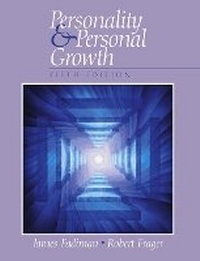
Personality and Personal Growth
5th Edition
Published on 19. August 2002
Book
Hardback
584 pages
978-0-13-040961-4 (ISBN)
Description
For upper-level courses in Personality Theory and Personal Adjustment.
Unique in its cross-cultural, global, and gender-balanced perspectives-and with an emphasis on humanistic and transpersonal psychologists-this text explores the positive aspects of major personality theorists, stressing each one's relevance for personal understanding. Highly praised for its exceptionally well-written style and accessibility, it encourages and supports students in using themselves as the primary touchstone for each theory. Each chapter gives them opportunities to validate their insights through direct experience, and, by observing their own reactions, come to their own conclusions about the utility and value of each theory.
Unique in its cross-cultural, global, and gender-balanced perspectives-and with an emphasis on humanistic and transpersonal psychologists-this text explores the positive aspects of major personality theorists, stressing each one's relevance for personal understanding. Highly praised for its exceptionally well-written style and accessibility, it encourages and supports students in using themselves as the primary touchstone for each theory. Each chapter gives them opportunities to validate their insights through direct experience, and, by observing their own reactions, come to their own conclusions about the utility and value of each theory.
More details
Edition
5th edition
Language
English
Place of publication
United States
Publishing group
Pearson Education (US)
Target group
Professional and scholarly
Dimensions
Width: 262 mm
Thickness: 27 mm
Weight
1292 gr
ISBN-13
978-0-13-040961-4 (9780130409614)
Copyright in bibliographic data and cover images is held by Nielsen Book Services Limited or by the publishers or by their respective licensors: all rights reserved.
Schweitzer Classification
Other editions
New editions
Book
02/2005
6th Edition
Pearson
€147.61
Article exhausted; check for reprint
Previous edition

Robert Frager | James Fadiman
Personality and Personal Growth
Book
10/1997
4th Edition
Pearson
€43.29
Article exhausted; check for reprint
Persons
James Fadiman received his Ph.D. in psychology from Stanford University and has taught at San Francisco State University, Brandeis University, and Stanford. He has his own consulting firm and offers seminars to executives and educators in the United States and abroad. He has written or edited books on holistic health, goalsetting, and abnormal psychology, is an editor for two journals, and sits on the board of several corporations concerned with the preservation of natural resources.
Robert Frager received his Ph.D. in social psychology from Harvard University, where he was a teaching assistant to Erik Erikson. He has taught psychology at ITC Berkeley and UC Santa Cruz and is the founder and first president of the Institute for Transpersonal Psychology. He is also past president of the Association for Transpersonal Psychology. Author of several books and numerous articles in psychology and related fields, he is currently director of the spiritual-guidance program at the Institute of Transpersonal Psychology in Palo Alto, California.
Robert Frager received his Ph.D. in social psychology from Harvard University, where he was a teaching assistant to Erik Erikson. He has taught psychology at ITC Berkeley and UC Santa Cruz and is the founder and first president of the Institute for Transpersonal Psychology. He is also past president of the Association for Transpersonal Psychology. Author of several books and numerous articles in psychology and related fields, he is currently director of the spiritual-guidance program at the Institute of Transpersonal Psychology in Palo Alto, California.
Content
1. Introduction.
2. Sigmund Freud and Psychoanalysis.
3. Anna Freud and the Post-Freudians: Melanie Klein, Donald Winnicott, Heinz Kohut, and the Gestalt Therapy of Fritz and Laura Perls.
4. Carl Gustav Jung and Analytical Psychology.
5. Alfred Adler and Individual Psychology.
6. Karen Horney and Humanistic Psychoanalysis.
7. The Psychology of Women.
8. Erik Erikson and the Life Cycle.
9. Wilhelm Reich and Somatic Psychology.
10. William James and the Psychology of Consciousness.
11. B. F. Skinner and Radical Behaviorism.
12. Applications of Cognitive Psychology.
13. George Kelly and Personal Construct Theory.
14. Carl Rogers and the Person-Centered Perspective.
15. Abraham Maslow and Transpersonal Psychology.
16. Yoga and the Hindu Tradition.
17. Zen and the Buddhist Tradition.
18. Sufism and the Islamic Tradition.
2. Sigmund Freud and Psychoanalysis.
3. Anna Freud and the Post-Freudians: Melanie Klein, Donald Winnicott, Heinz Kohut, and the Gestalt Therapy of Fritz and Laura Perls.
4. Carl Gustav Jung and Analytical Psychology.
5. Alfred Adler and Individual Psychology.
6. Karen Horney and Humanistic Psychoanalysis.
7. The Psychology of Women.
8. Erik Erikson and the Life Cycle.
9. Wilhelm Reich and Somatic Psychology.
10. William James and the Psychology of Consciousness.
11. B. F. Skinner and Radical Behaviorism.
12. Applications of Cognitive Psychology.
13. George Kelly and Personal Construct Theory.
14. Carl Rogers and the Person-Centered Perspective.
15. Abraham Maslow and Transpersonal Psychology.
16. Yoga and the Hindu Tradition.
17. Zen and the Buddhist Tradition.
18. Sufism and the Islamic Tradition.