

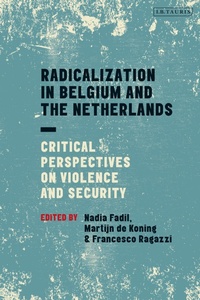
Radicalization in Belgium and the Netherlands
Critical Perspectives on Violence and Security
Published on 30. May 2019
Book
Hardback
344 pages
978-1-78453-889-7 (ISBN)
Description
The concept of 'radicalization' is now used to account for all forms of violent and non-violent political Islam. Used widely within the security services and picked up by academia, the term was initially coined by the General Intelligence and Security Service of the Netherlands (AIVD) after the 9/11 and Pentagon attacks, an origin that is rarely recognised.
This book comprises contributions from leading scholars in the field of critical security studies to trace the introduction, adoption and dissemination of 'radicalization' as a concept. It is the first book to offer a critical analysis and history of the term as an 'empty signifier', that is, a word that might not necessarily refer to something existing in the real world. The diverse contributions consider how the term has circulated since its emergence in the Netherlands and Belgium, its appearance in academia, its existence among the people categorized as 'radicals' and its impact on relationships of trust between public officials and their clients. Building on the traditions of critical security studies and critical studies on terrorism, the book reaffirms the importance of a reflective approach to counter-radicalization discourse and policies. It will be essential reading for scholars of security studies, political anthropology, the study of Islam in the west and European studies.
This book comprises contributions from leading scholars in the field of critical security studies to trace the introduction, adoption and dissemination of 'radicalization' as a concept. It is the first book to offer a critical analysis and history of the term as an 'empty signifier', that is, a word that might not necessarily refer to something existing in the real world. The diverse contributions consider how the term has circulated since its emergence in the Netherlands and Belgium, its appearance in academia, its existence among the people categorized as 'radicals' and its impact on relationships of trust between public officials and their clients. Building on the traditions of critical security studies and critical studies on terrorism, the book reaffirms the importance of a reflective approach to counter-radicalization discourse and policies. It will be essential reading for scholars of security studies, political anthropology, the study of Islam in the west and European studies.
Reviews / Votes
"This tightly organized and superbly edited volume on radicalization reveals the development, application, and effects of the term's post 9/11 adoption in the Netherlands (its point of origin) and Belgium. The book offers a compelling analysis of a key political term for our times, one with broad applicability and implication well beyond Northern Europe. An exemplary analysis for anyone interested in critical security studies, contemporary political and critical theory, and European studies." -- David Theo Goldberg, Director and Distinguished Professor, University of California "A superb collection of critical scholarship that powerfully locates the origins of today's 'age of radicalisation' in discursive shifts in the Netherlands and Belgium over the last twenty years." -- Arun Kundnani, Visiting Assistant Professor, New York University -- Steinhardt "In a world increasingly defined, and divided, by a naive and interested opposition between 'democratic citizens' and 'radical terrorists,' this collection interrogates the assumptions that sustain this opposition while providing concrete insight into the histories and politics of de/radicalization in the Netherlands and Belgium. It will be an essential point of departure for scholars and policymakers in the field for years to come." -- Elizabeth Shakman Hurd, Professor, Northwestern UniversityMore details
Language
English
Place of publication
United Kingdom
Publishing group
Bloomsbury Publishing PLC
Target group
College/higher education
Illustrations
6 b+w integrated
Dimensions
Height: 240 mm
Width: 161 mm
Thickness: 23 mm
Weight
675 gr
ISBN-13
978-1-78453-889-7 (9781784538897)
Copyright in bibliographic data and cover images is held by Nielsen Book Services Limited or by the publishers or by their respective licensors: all rights reserved.
Schweitzer Classification
Other editions
Additional editions
Nadia Fadil | Francesco Ragazzi | Martijn de Koning
Radicalization in Belgium and the Netherlands
Critical Perspectives on Violence and Security
E-Book
05/2019
1st Edition
I.B. Tauris
€36.49
Available for download
Persons
Nadia Fadil is Associate Professor in Anthropology at the Interculturalism, Migration and Minorities Research Centre (IMMRC) at Catholic University of Leuven (KU Leuven) in Belgium. She has published extensively in academic journals, including HAU, Ethnicities, Identities, Social Anthropology, Ethnic and Racial Studies and the Feminist Review as well as in edited volumes.
Francesco Ragazzi is Lecturer in International Relations at Leiden University and Associated Scholar at the Centre D'Etude sur les Conflits, Liberte Security (CCLS). He has published widely in peer-reviewed journals including International Political Sociology, Security Dialogue and Political Geography. He has been consulted as an expert on security by the European Parliament, the Council of Europe and the French Senate.
Martijn de Koning teaches at the Department of Islamic Studies at Radboud University Nijmegen in the Netherlands. He is also a post-doctoral researcher at the Department of Anthropology at the University of Amsterdam. He has published in the Journal of Muslims in Europe, Anthropology Today and Contemporary Islam.
Francesco Ragazzi is Lecturer in International Relations at Leiden University and Associated Scholar at the Centre D'Etude sur les Conflits, Liberte Security (CCLS). He has published widely in peer-reviewed journals including International Political Sociology, Security Dialogue and Political Geography. He has been consulted as an expert on security by the European Parliament, the Council of Europe and the French Senate.
Martijn de Koning teaches at the Department of Islamic Studies at Radboud University Nijmegen in the Netherlands. He is also a post-doctoral researcher at the Department of Anthropology at the University of Amsterdam. He has published in the Journal of Muslims in Europe, Anthropology Today and Contemporary Islam.
Content
Introduction. Radicalization: Tracing the Trajectory of an "empty signifier" in the Low Lands
Nadia Fadil, Martijn de Koning & Francesco Ragazzi
Part I: The circulations of a contested concept
Radicalization. De geboorte van een ambigu conceptThe origins and limits of a contested concept
Rik Coolsaet
Turning 'radicalization' into science. Ambivalent translations into the Dutch(speaking) academic field
Nadia Fadil & Martijn de Koning
Considering internal debates on "radicalism" within the Brussels' Islamic community
Mieke Groeninck
Part II: De/Radicalization policies on the ground
Foreign fighters on trial. Sentencing risk, 2013-2017
Beatrice de Graaf
Pre-emptive measures against radicalization and local partnerships in Antwerp
Ineke Roex & Floris Vermeulen
Countering Radicalization: Hijacking Trust? Dilemmas of Street-Level Bureaucrats in The Netherlands
Francesco Ragazzi & Lili-Anne de Jongh
(De-)radicalization as a negotiated practice. An ethnographic case study in Flanders
Silke Jamine & Nadia Fadil
Part III: De/Radicalization and its effects
Routinisation and Mobilisation of Injustice: How to live in a regime of surveillance
Martijn de Koning
Can the 'Muhajir' Speak? European Syria Fighters & the Digital Un/Making of Home
Jaafar Alloul
No escape: the force of the security frame in academia and beyond
Annelies Moors
Conclusions
From convert to radical: making critique illegible
Iman Lechkar
The maze of radicalization: justification and professional interests
Didier Bigo
Afterword
Afterword: A De/Radicalised Future
Paul Silverstein
Nadia Fadil, Martijn de Koning & Francesco Ragazzi
Part I: The circulations of a contested concept
Radicalization. De geboorte van een ambigu conceptThe origins and limits of a contested concept
Rik Coolsaet
Turning 'radicalization' into science. Ambivalent translations into the Dutch(speaking) academic field
Nadia Fadil & Martijn de Koning
Considering internal debates on "radicalism" within the Brussels' Islamic community
Mieke Groeninck
Part II: De/Radicalization policies on the ground
Foreign fighters on trial. Sentencing risk, 2013-2017
Beatrice de Graaf
Pre-emptive measures against radicalization and local partnerships in Antwerp
Ineke Roex & Floris Vermeulen
Countering Radicalization: Hijacking Trust? Dilemmas of Street-Level Bureaucrats in The Netherlands
Francesco Ragazzi & Lili-Anne de Jongh
(De-)radicalization as a negotiated practice. An ethnographic case study in Flanders
Silke Jamine & Nadia Fadil
Part III: De/Radicalization and its effects
Routinisation and Mobilisation of Injustice: How to live in a regime of surveillance
Martijn de Koning
Can the 'Muhajir' Speak? European Syria Fighters & the Digital Un/Making of Home
Jaafar Alloul
No escape: the force of the security frame in academia and beyond
Annelies Moors
Conclusions
From convert to radical: making critique illegible
Iman Lechkar
The maze of radicalization: justification and professional interests
Didier Bigo
Afterword
Afterword: A De/Radicalised Future
Paul Silverstein