


Working with Time in Qualitative Research
Case Studies, Theory and Practice
1st Edition
Published on 25. September 2023
Book
Paperback/Softback
218 pages
978-0-367-71479-6 (ISBN)
Description
This collection brings together researchers and scholars from across the Arts, Humanities and Social Sciences who are actively exploring the many different ways in which time might be understood, imagined and used in qualitative research. Taken together, the contributions begin to trace the contours of what it might mean to work reflexively with time as an epistemologically constitutive element of research design.
The book explores how the choice to work with pasts or futures, with speed or delay, with clocks or the time of the body, with utopias or failed futures (among other things) reframe how social and cultural phenomena are perceived and brought into existence in qualitative research. Drawing on fields as disparate as futures studies and history, literary analysis and urban design, utopian studies and science and technology studies, this collection serves as a resource for both new and experienced researchers in the humanities and social sciences. It is a critically important resource for beginning to explore the wide repertoire of theoretical and methodological tools for working with time in the research process.
The book also draws attention to the way that institutional research timescapes - from university workload patterns to funding processes and project timescales - themselves shape how and what it is possible to know in and about the world. It concludes with a rousing manifesto for scholars and researchers, proposing 10 key attributes of temporally reflexive research.
The book explores how the choice to work with pasts or futures, with speed or delay, with clocks or the time of the body, with utopias or failed futures (among other things) reframe how social and cultural phenomena are perceived and brought into existence in qualitative research. Drawing on fields as disparate as futures studies and history, literary analysis and urban design, utopian studies and science and technology studies, this collection serves as a resource for both new and experienced researchers in the humanities and social sciences. It is a critically important resource for beginning to explore the wide repertoire of theoretical and methodological tools for working with time in the research process.
The book also draws attention to the way that institutional research timescapes - from university workload patterns to funding processes and project timescales - themselves shape how and what it is possible to know in and about the world. It concludes with a rousing manifesto for scholars and researchers, proposing 10 key attributes of temporally reflexive research.
More details
Series
Language
English
Place of publication
London
United Kingdom
Publishing group
Taylor & Francis Ltd
Target group
College/higher education
Postgraduate and Undergraduate Advanced
Illustrations
19 s/w Abbildungen, 17 s/w Photographien bzw. Rasterbilder, 2 s/w Zeichnungen
2 Line drawings, black and white; 17 Halftones, black and white; 19 Illustrations, black and white
Dimensions
Height: 234 mm
Width: 156 mm
Thickness: 13 mm
Weight
363 gr
ISBN-13
978-0-367-71479-6 (9780367714796)
Copyright in bibliographic data and cover images is held by Nielsen Book Services Limited or by the publishers or by their respective licensors: all rights reserved.
Schweitzer Classification
Other editions
Additional editions
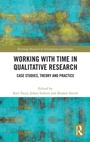
Keri Facer | Johan Siebers | Bradon Smith
Working with Time in Qualitative Research
Case Studies, Theory and Practice
Book
12/2021
1st Edition
Routledge
€206.30
Shipment within 15-20 days
Keri Facer | Johan Siebers | Bradon Smith
Working with Time in Qualitative Research
Case Studies, Theory and Practice
E-Book
12/2021
1st Edition
Routledge
€59.49
Available for download
Keri Facer | Johan Siebers | Bradon Smith
Working with Time in Qualitative Research
Case Studies, Theory and Practice
E-Book
12/2021
1st Edition
Routledge
€59.49
Available for download
Persons
Keri Facer is Professor of Educational and Social Futures at the University of Bristol. She works on the relationship between education, knowledge practices, and long-term environmental, social and technological change. She is Joint Editor-in-Chief of Futures, was Zennstroem Professor of Climate Change Leadership at Uppsala University (2018-2020), AHRC Leadership Fellow for the Connected Communities Programme (2012-2018), and research director of Futurelab (2001-2008). She publishes in areas ranging from technological change to learning cities, university futures, and climate change. She is co-editor of the book series Routledge Research in Anticipation and Futures.
Johan Siebers is Associate Professor of Philosophy and Religion in the Department of Criminology and Sociology at Middlesex University London and Director of the Ernst Bloch Centre for German Thought at the Institute of Modern Languages Research, School of Advanced Study, University of London. He is the co-editor of Models of Communication (Routledge, 2019) and the founding and principal editor of Empedocles: European Journal for Philosophy of Communication. He is co-editor of the book series Routledge Research in Anticipation and Futures.
Bradon Smith is an Honorary Research Associate at the University of Bristol with research interests in the Environmental and Energy Humanities - particularly the representation of climate change and energy futures in contemporary literature and culture - and temporality in research. He was a Research Associate on the AHRC-funded project Stories of Change: Exploring energy and community in the past, present and future (2014-2017), and co-editor of a special double issue of the journal Resilience entitled 'Stories of Energy' (2019).
Johan Siebers is Associate Professor of Philosophy and Religion in the Department of Criminology and Sociology at Middlesex University London and Director of the Ernst Bloch Centre for German Thought at the Institute of Modern Languages Research, School of Advanced Study, University of London. He is the co-editor of Models of Communication (Routledge, 2019) and the founding and principal editor of Empedocles: European Journal for Philosophy of Communication. He is co-editor of the book series Routledge Research in Anticipation and Futures.
Bradon Smith is an Honorary Research Associate at the University of Bristol with research interests in the Environmental and Energy Humanities - particularly the representation of climate change and energy futures in contemporary literature and culture - and temporality in research. He was a Research Associate on the AHRC-funded project Stories of Change: Exploring energy and community in the past, present and future (2014-2017), and co-editor of a special double issue of the journal Resilience entitled 'Stories of Energy' (2019).
Content
Introduction: working with time as method Keri Facer, Johan Siebers and Bradon Smith 1. The Paris boulevard autrement Carlos Lopez Galviz 2. No futures: design for a renewed focus on the present Larissa Pschetz 3. Times of urgencies: scenarios as speculative improvisations for the Anthropocene Renata Tyszczuk 4. Bringing the past back to life? Working with time in community history Sarah Lloyd 5. Site time: the process of building through and with time Prue Chiles 6. Paying attention to time in communication research Johan Siebers 7. Doing time in social science and humanities research: working with repetition and re-reading Elizabeth Hoult 8. Plagues, time, traumas and responsibilities: reading time as a way of living Victor Jeleniewski Seidler 9. The rhythms of research Kate Spencer-Bennett 10. Clocking invisible labour in academia: the politics of working with time Paulina Sliwa, Arathi Sriprakash, Ella Whiteley and Tyler Denmead 11. Working with/in time: how university timescapes shape knowledge Keri Facer and Bradon Smith A (temporary) glossary Time as method: a manifesto Keri Facer, Johan Siebers and Bradon Smith