

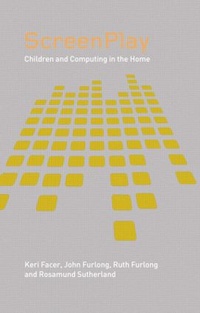
Screenplay
Children and Computing in the Home
1st Edition
Published on 4. August 2003
Book
Paperback/Softback
272 pages
978-0-415-29843-8 (ISBN)
Description
What are young people really doing on computers at home?
Computers feature heavily in the lives of today's young people, and this book sets out to question commonplace assumptions about the use of technology by children at home. Bringing together research from the perspective of psychology, sociology, education and media studies, the authors ask whether we are really witnessing the rise of a new 'digital generation'.
Drawing upon the results of their in-depth research project, the authors filter and assess their findings accessibly, offering fascinating reading on:
* how computers are used in the home
* how parents and children negotiate access to and use of the computer
* what role the computer plays in the day to day lives of families.
This book makes use of illuminating case studies, and highlights key issues of concern around issues of equality and access in a wider social context. This truly interdisciplinary perspective will be instrumental in reshaping the understanding of teachers, ICT advisors, policy makers and all involved in ICT for children.
Computers feature heavily in the lives of today's young people, and this book sets out to question commonplace assumptions about the use of technology by children at home. Bringing together research from the perspective of psychology, sociology, education and media studies, the authors ask whether we are really witnessing the rise of a new 'digital generation'.
Drawing upon the results of their in-depth research project, the authors filter and assess their findings accessibly, offering fascinating reading on:
* how computers are used in the home
* how parents and children negotiate access to and use of the computer
* what role the computer plays in the day to day lives of families.
This book makes use of illuminating case studies, and highlights key issues of concern around issues of equality and access in a wider social context. This truly interdisciplinary perspective will be instrumental in reshaping the understanding of teachers, ICT advisors, policy makers and all involved in ICT for children.
More details
Language
English
Place of publication
London
United Kingdom
Publishing group
Taylor & Francis Ltd
Target group
College/higher education
Dimensions
Height: 216 mm
Width: 138 mm
Weight
500 gr
ISBN-13
978-0-415-29843-8 (9780415298438)
Copyright in bibliographic data and cover images is held by Nielsen Book Services Limited or by the publishers or by their respective licensors: all rights reserved.
Schweitzer Classification
Other editions
Additional editions
E-Book
12/2003
Routledge
€45.99
Available for download
E-Book
12/2003
Routledge
€45.99
Available for download

Book
09/2003
1st Edition
Routledge Falmer
€163.42
Article exhausted; check different version
Persons
John Furlong is a sociologist at Cardiff University School of Social Sciences.
Rosamund Suthelrand is Professor of Education at the University of Bristol.
Ruth Furlong is at the University of Wales, Newport
Keri Facer is a research officer at the Graduate School of Education, University of Bristol
Rosamund Suthelrand is Professor of Education at the University of Bristol.
Ruth Furlong is at the University of Wales, Newport
Keri Facer is a research officer at the Graduate School of Education, University of Bristol
Content
Part 1 Introduction; Chapter 1 The ScreenPlay project; Chapter 2 Setting the scene; Part 2 The domestic context; Chapter 3 Computer histories, computer roles in the home; Chapter 4 The computer in family life; Part 3 Young people's computer use in the home; Chapter 5 The digital landscape; Chapter 6 Writing, designing and making; Part 4 Digital cultures; Chapter 7 Computers, consumption and identity; Chapter 8 Computers, gender and class; Chapter 9 Digital childhood; Part 5 Learning with the computer; Chapter 10 Learning with computers at home; Chapter 11 Learning with computers in school; Part 6 Conclusion; Chapter 12 Conclusion;