


Recognizing States
International Society and the Establishment of New States Since 1776
1st Edition
Published on 25. February 2010
Book
Hardback
272 pages
978-0-19-956444-6 (ISBN)
Description
This book examines recognition of new states, the practice historically employed to regulate membership in international society. The last twenty years have witnessed new or lingering demands for statehood in different areas of the world. The claims of some, like those of Bosnia and Herzegovina, Eritrea, Croatia, Georgia and East Timor, have achieved general recognition; those of others, like Kosovo, Tamil Eelam, South Ossetia, Abkhazia and Somaliland, have not. However, even as most of these claims gave rise to major conflicts and international controversies, the criteria for acknowledgment of new states have elicited little systematic scholarship. Drawing upon writings of English School theorists, this study charts the practice from the late eighteenth century until the present. Its central argument is that for the past two hundred years state recognition has been tied to the idea of self-determination of peoples. Two versions of the idea have underpinned the practice throughout most of this period - self-determination as a negative and a positive right. The negative idea, dominant from 1815 to 1950, took state recognition to be acknowledgment of an achievement of de facto statehood by a people desiring independence. Self-determination was expressed through, and externally gauged by, self-attainment. The positive idea, prevalent since the 1950s, took state recognition to be acknowledgment of an entitlement to independence in international law. The development of self-determination as a positive international right, however, has not led to a disappearance of claims of statehood that stand outside of its confines. Groups that are deeply dissatisfied with the countries in which they presently find themselves continue to make demands for independence even though they may have no positive entitlement to it. The book concludes by expressing doubt that contemporary international society can find a sustainable basis for recognizing new states other than the original standard of de facto statehood.
Reviews / Votes
Fabry...has produced a book that is well-written, well-constructed, well-documented, and truly comprehensive. Fabry's book is an exemplary account of the theory, history and practice of recognising new states. His range is impressive, his nuances valid and his scholarship impeccable. Historians, lawyers and international relations specialists should all welcome this book. * Alan Sked, Diplomacy and Statecraft * The book is highly successful in demonstrating how norms and principles have changed with respect to recognizing states. Fabry is particularly good at clarifying principles and comparing and contrasting them from one period to the next. The cases throughout are well researched and display solid judgment and analysis. The book is crisply written and well organized. * Robert S. Snyder, The Review of Politics * This book is vividly written, well adorned with supporting citations, and one of the best substantive restatements of the law of state recognition. That it features historical details about each period covered, coupled with practical contemporary applications, makes it must reading for anyone in search of expertise on the recognition of statehood. * ASIL UN21 Newsletter * This work contributes positively to collections emphasizing international relations theory and the evolution and operation of international norms, law, and institutions. * S. P. Duffy, Social and Behavioral Sciences * Well-crafted historical chapters ... not over-burdened with theoretical discussions and debate ... [a] rich historical account of two centuries of the birthing of new states. * Daniel M. Green, International Studies Review *More details
Language
English
Place of publication
Oxford
United Kingdom
Target group
College/higher education
Scholars and students of political science, international relations, international law, and international history.
Dimensions
Height: 240 mm
Width: 161 mm
Thickness: 19 mm
Weight
573 gr
ISBN-13
978-0-19-956444-6 (9780199564446)
Copyright in bibliographic data and cover images is held by Nielsen Book Services Limited or by the publishers or by their respective licensors: all rights reserved.
Schweitzer Classification
Other editions
Additional editions
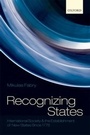
Mikulas Fabry
Recognizing States
International Society and the Establishment of New States Since 1776
E-Book
02/2010
1st Edition
Oxford University Press
€179.50
Available for download
Person
Mikulas Fabry is an Assistant Professor in the Sam Nunn School of International Affairs at the Georgia Institute of Technology. His research focuses on questions of state and governmental legitimacy in international relations and he published several journal articles and chapters in edited volumes on these topics. Prior to his current position, Dr. Fabry was an Andrew W. Mellon Postdoctoral Fellow and Lecturer at Smith College.
Content
List of Tables ; Acknowledgements ; Introduction ; 1. State Recognition prior to 1815 ; 2. New States in Latin America ; 3. New States in Nineteenth-Century Europe ; 4. New States between 1918 and 1945 ; 5. New States in Decolonization after 1945 ; 6. New States in the Post-Cold War Period ; Conclusion ; Bibliography