

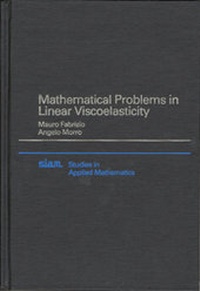
Mathematical Problems in Linear Viscoelasticity
Will be published approx. on 30. June 2006
Book
Hardback
212 pages
978-0-89871-266-7 (ISBN)
Description
A crucial stability condition in linear viscoelasticity is that the Fourier cosine transform of the stress relaxation modulus be positive definite. The subject of this book is the derivation of this condition from thermodynamics and its implications for the mathematical analysis of the equations of linear viscoelasticity.
The authors investigate the connection between thermodynamic restrictions and well-posedness of initial and boundary value problems. A thorough thermodynamic analysis of linear viscoelasticity is included. New results are established and previous ones are shown to follow as particular cases from the general scheme. The authors demonstrate that significant improvements can be obtained in existence, uniqueness, and asymptotic stability theorems by starting from the thermodynamic restrictions as mathematical hypotheses for the initial boundary value problems.
Describes general mathematical modeling of viscoelastic materials as systems with fading memory.
Discusses the interrelation between topics such as existence, uniqueness, and stability of initial boundary value problems, variational and extremum principles, and wave propagation.
Demonstrates the deep connection between the properties of the solution to initial boundary value problems and the requirements of the general physical principles.
Discusses special techniques and new methods, including Fourier and Laplace transforms, extremum principles via weight functions, and singular surfaces and discontinuity waves.
Royalties from the sale of this book are contributed to the SIAM Student Travel fund.
The authors investigate the connection between thermodynamic restrictions and well-posedness of initial and boundary value problems. A thorough thermodynamic analysis of linear viscoelasticity is included. New results are established and previous ones are shown to follow as particular cases from the general scheme. The authors demonstrate that significant improvements can be obtained in existence, uniqueness, and asymptotic stability theorems by starting from the thermodynamic restrictions as mathematical hypotheses for the initial boundary value problems.
Describes general mathematical modeling of viscoelastic materials as systems with fading memory.
Discusses the interrelation between topics such as existence, uniqueness, and stability of initial boundary value problems, variational and extremum principles, and wave propagation.
Demonstrates the deep connection between the properties of the solution to initial boundary value problems and the requirements of the general physical principles.
Discusses special techniques and new methods, including Fourier and Laplace transforms, extremum principles via weight functions, and singular surfaces and discontinuity waves.
Royalties from the sale of this book are contributed to the SIAM Student Travel fund.
More details
Series
Language
English
Place of publication
New York
United States
Target group
Professional and scholarly
Dimensions
Height: 235 mm
Width: 163 mm
Thickness: 20 mm
Weight
522 gr
ISBN-13
978-0-89871-266-7 (9780898712667)
Copyright in bibliographic data and cover images is held by Nielsen Book Services Limited or by the publishers or by their respective licensors: all rights reserved.
Schweitzer Classification
Content
Introduction
Part I: Preliminaries on Materials With Fading Memory
Part II: Thermodynamics of Simple Materials
Part III: Linear Viscoelasticity
Part IV: Existence, Uniqueness, and Stability
Part V: Variational Formulations and Minimum Properties
Part VI: Wave Propagation
Part VII: Unbounded Relaxation Functions and Rayleigh Problem
Appendix: Precis of the Properties of the Relaxation Function
References
Index.
Part I: Preliminaries on Materials With Fading Memory
Part II: Thermodynamics of Simple Materials
Part III: Linear Viscoelasticity
Part IV: Existence, Uniqueness, and Stability
Part V: Variational Formulations and Minimum Properties
Part VI: Wave Propagation
Part VII: Unbounded Relaxation Functions and Rayleigh Problem
Appendix: Precis of the Properties of the Relaxation Function
References
Index.