

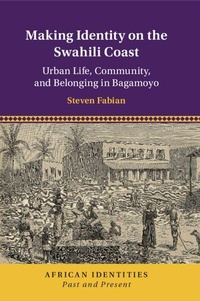
Making Identity on the Swahili Coast
Urban Life, Community, and Belonging in Bagamoyo
Published on 28. October 2021
Book
Paperback/Softback
370 pages
978-1-108-71004-6 (ISBN)
Description
Situated at a crossroads of trade in the late nineteenth century, and later the economic capital of German East Africa, the thriving caravan and port town of Bagamoyo, Tanzania is one of many diverse communities on the East African coast which has been characterized as 'Swahili'. Seeking an alternate framework for understanding community and identity, Steven Fabian combines extensive archival sources from African and European archives alongside fieldwork in Bagamoyo to move beyond the category of 'Swahili' as it has been traditionally understood. Revealing how townspeople - Africans, Arabs, Indians, and Europeans alike - created a local vocabulary which referenced aspects of everyday town life and bound them together as members of a shared community, this first extensive examination of Bagamoyo's history from the pre-colonial era to independence uses a new lens of historical analysis to emphasize the importance of place in creating local, urban identities and suggests a broader understanding of these concepts historically along the Swahili Coast.
Reviews / Votes
'By taking seriously the roles of spatial identity and local attachment, Fabian has pried open a new window on Swahili culture and African urban history. Understood in these new terms, Bagamoyo's political and social history becomes a story of re-conceptualizing tradition, belonging, and urban citizenship in territorial terms as a means to confront external encroachments and displacements.' James R. Brennan, University of Illinois at Urbana, Champaign 'Meticulously researched and a delight to read, Fabian reminds us that studies of small places have big things to say. His ability to foreground the importance of people on the margins of scholarship to the creation of spatially grounded Swahili urban publics, is an exemplary achievement.' Laura Fair, Michigan State University 'This history of one of East Africa's most important nineteenth-century urban centers has been worth the wait. Fabian offers a nuanced study that links the emergence of the 'local' in Bagamoyo to the everyday interactions of residents and itinerants from both of its hinterlands: the Indian Ocean world and the East African interior. This is a much-needed corrective to the overburdening of 'Swahili' identity found in many previous studies of the East African coast.' Stephen Rockel, University of Toronto, ScarboroughMore details
Series
Language
English
Place of publication
Cambridge
United Kingdom
Target group
Professional and scholarly
Product notice
Paperback (trade)
Illustrations
Worked examples or Exercises; 4 Maps; 10 Halftones, black and white
Dimensions
Height: 229 mm
Width: 152 mm
Thickness: 20 mm
Weight
536 gr
ISBN-13
978-1-108-71004-6 (9781108710046)
Copyright in bibliographic data and cover images is held by Nielsen Book Services Limited or by the publishers or by their respective licensors: all rights reserved.
Schweitzer Classification
Other editions
Additional editions
Book
11/2019
Cambridge University Press
€140.40
Shipment within 15-20 days
Person
Steven Fabian is an Associate Professor of History at the State University of New York at Fredonia. Awarded two of Canada's most prestigious scholarships by the Izaak Walton Killam Memorial Trust Foundation and the Social Sciences and Humanities Research Council of Canada, his research has appeared in journals such as the International Journal of African Historical Studies, the Canadian Journal of African Studies, and the Journal of Eastern African Studies. He was President of the Tanzania Studies Association from 2015-2017 and currently serves as co-chair of Radical History Review.
Content
Introduction; 1. Owners of the town: Shomvi, Zaramo, Nyamwezi, and Indians; 2. Owners of the town: Baluchis, Omanis, and Spiritans; 3. Becoming Wabagamoyo: a local vocabulary for a Swahili town; 4. The particularities of place: space, identity, and the Coastal Rebellion of 1888-1890; 5. Colonial power, community identity, and consultation; 6. 'Curing the cancer of the colony': undermining local attachments.