

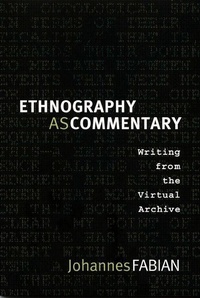
Ethnography As Commentary
Writing from the Virtual Archive
Published on 26. August 2008
Book
Paperback/Softback
152 pages
978-0-8223-4283-0 (ISBN)
Description
The Internet allows ethnographers to deposit the textual materials on which they base their writing in virtual archives. Electronically archived fieldwork documents can be accessed at any time by the writer, his or her readers, and the people studied. Johannes Fabian, a leading theorist of anthropological practice, argues that virtual archives have the potential to shift the emphasis in ethnographic writing from the monograph to commentary. In this insightful study, he returns to the recording of a conversation he had with a ritual healer in the Congolese town of Lubumbashi more than three decades ago. Fabian's transcript and translation of the exchange have been deposited on a website (Language and Popular Culture in Africa), and in Ethnography as Commentary he provides a model of writing in the presence of a virtual archive.In his commentary, Fabian reconstructs his meeting with the healer Kahenga Mukonkwa Michel, in which the two discussed the ritual that Kahenga performed to protect Fabian's home from burglary. Fabian reflects on the expectations and terminology that shape his description of Kahenga's ritual and meditates on how ethnographic texts are made, considering the settings, the participants, the technologies, and the linguistic medium that influence the transcription and translation of a recording and thus fashion ethnographic knowledge. Turning more directly to Kahenga-as a practitioner, a person, and an ethnographic subject-and to the questions posed to him, Fabian reconsiders questions of ethnic identity, politics, and religion. While Fabian hopes that emerging anthropologists will share their fieldwork through virtual archives, he does not suggest that traditional ethnography will disappear. It will become part of a broader project facilitated by new media.
Reviews / Votes
"Ethnography as Commentary is a timely contribution to contemporary problems of anthropological knowledge-making. It is an argument about what ethnography has come to and an experiment about what it might still become more than two decades after the intense period of critiquing anthropology's emblematic research practices."-George E. Marcus, co-author of Designs for an Anthropology of the Contemporary "Johannes Fabian is one of the most prominent and original thinkers in anthropology. With Ethnography as Commentary, he makes a significant contribution to debates about modes of writing in anthropology and adjacent disciplines and to anthropological knowledge of postcolonial Central African culture and society. Younger scholars especially will find it a very instructive close-up portrayal of intensive ethnographic work."-Ulf Hannerz, author of Foreign News: Exploring the World of Foreign CorrespondentsMore details
Language
English
Place of publication
North Carolina
United States
Target group
College/higher education
Professional and scholarly
Product notice
Paperback (trade)
Dimensions
Height: 221 mm
Width: 152 mm
Thickness: 10 mm
Weight
227 gr
ISBN-13
978-0-8223-4283-0 (9780822342830)
Copyright in bibliographic data and cover images is held by Nielsen Book Services Limited or by the publishers or by their respective licensors: all rights reserved.
Schweitzer Classification
Other editions
Additional editions
E-Book
08/2008
1st Edition
De Gruyter
€178.99
Available for download
Person
Johannes Fabian is Professor Emeritus of Cultural Anthropology at the University of Amsterdam and a member of the Amsterdam School of Social Research. He is the author of many books, including Memory against Culture: Arguments and Reminders, also published by Duke University Press; Out of Our Minds: Reason and Madness in the Exploration of Central Africa; Remembering the Present: Painting and Popular History in Zaire; Language and Colonial Power: The Appropriation of Swahili in the Former Belgian Congo, 1880-1938; and Time and the Other: How Anthropology Makes Its Object.
Content
Preface vii
Introduction. Closing House--A Late Ethnography 1
Chapter 1. An Event: Closing the House 21
Chapter 2. A Text: Made, Not Found 39
Chapter 3. Kahenga's Work 55
Chapter 4. Kahenga's World 73
Chapter 5. Kahenga's Thoughts 91
Chapter 6. Endings and Ends 111
Notes 125
Works Cited 133
Index 137
Introduction. Closing House--A Late Ethnography 1
Chapter 1. An Event: Closing the House 21
Chapter 2. A Text: Made, Not Found 39
Chapter 3. Kahenga's Work 55
Chapter 4. Kahenga's World 73
Chapter 5. Kahenga's Thoughts 91
Chapter 6. Endings and Ends 111
Notes 125
Works Cited 133
Index 137