

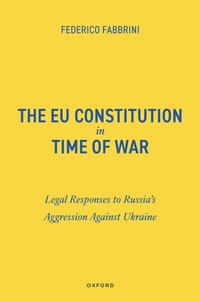
The EU Constitution in Time of War
Legal Responses to Russia's Aggression Against Ukraine
Published on 26. February 2025
Book
Hardback
192 pages
978-0-19-896348-6 (ISBN)
Description
Russia's illegal aggression against Ukraine has been a watershed moment for the European Union (EU). The return of large-scale conventional warfare to the European continent, unseen since the Second World War, shattered the illusion of perpetual peace and forced the EU to confront the reality of hard power. Originally created to maintain internal peace, the EU was never conceived to handle the challenges of war. Yet, the war in Ukraine required the EU to repurpose its machinery of government to do just that.
Embracing a comparative analytical framework, this book examines how the EU constitution has functioned in response to Russia's aggression. It scrutinizes the EU's legal reactions across five key policy areas: foreign, security, and defence policy; economic and fiscal policy; justice and home affairs; energy and industrial policy; and enlargement and reform. In doing so, it investigates whether the EU constitution has enabled the EU to respond effectively to the war, how EU treaties have been interpreted to authorize war-related actions, and whether these responses have adhered to constitutional limits.
Advancing a threefold argument, this book asserts that the EU constitution has demonstrated sufficient flexibility to permit wartime actions. Secondly, it highlights the limitations exposed by the return of conventional warfare in Europe, noting structural constraints and governance shortcomings that hinder decisive action, and instances where laws inadequately constrain EU action, particularly regarding fundamental rights and the rule of law. Finally, it evaluates the long-term constitutional implications of war for EU governance and proposes legal reforms that could shape a more perfect EU for both times of war and peace.
Embracing a comparative analytical framework, this book examines how the EU constitution has functioned in response to Russia's aggression. It scrutinizes the EU's legal reactions across five key policy areas: foreign, security, and defence policy; economic and fiscal policy; justice and home affairs; energy and industrial policy; and enlargement and reform. In doing so, it investigates whether the EU constitution has enabled the EU to respond effectively to the war, how EU treaties have been interpreted to authorize war-related actions, and whether these responses have adhered to constitutional limits.
Advancing a threefold argument, this book asserts that the EU constitution has demonstrated sufficient flexibility to permit wartime actions. Secondly, it highlights the limitations exposed by the return of conventional warfare in Europe, noting structural constraints and governance shortcomings that hinder decisive action, and instances where laws inadequately constrain EU action, particularly regarding fundamental rights and the rule of law. Finally, it evaluates the long-term constitutional implications of war for EU governance and proposes legal reforms that could shape a more perfect EU for both times of war and peace.
Reviews / Votes
The author reflects on the possibility that the war in Ukraine could lead to constitutional changes. [...] Although the book is written by a legal expert, it offers sharp political insights and very useful reflections. * Beda Romano, IlSole24Ore * [In this book] Fabbrini invokes a phrase attributed to Lincoln, that the Constitution must not be a 'suicide pact.' To remain relevant, the European Union Constitution must enable action in the general interest of Europeans, while safeguarding fundamental rights, the rule of law, and democracy. * Julio Baquero Cruz, Politica Exterior *More details
Language
English
Place of publication
Oxford
United Kingdom
Target group
College/higher education
Product notice
sewn/stitched
Cloth over boards
Dimensions
Height: 236 mm
Width: 166 mm
Thickness: 19 mm
Weight
463 gr
ISBN-13
978-0-19-896348-6 (9780198963486)
Copyright in bibliographic data and cover images is held by Nielsen Book Services Limited or by the publishers or by their respective licensors: all rights reserved.
Schweitzer Classification
Other editions
Additional editions
Federico Fabbrini
The EU Constitution in Time of War
Legal Responses to Russia's Aggression Against Ukraine
E-Book
02/2025
OUP eBook
€92.49
Available for download
Federico Fabbrini
The EU Constitution in Time of War
Legal Responses to Russia's Aggression Against Ukraine
E-Book
02/2025
OUP eBook
€92.49
Available for download
Person
Federico Fabbrini is Full Professor of European Law at the School of Law and Government in Dublin City University, Ireland where he is also the Founding Director of the Brexit Institute and the Dublin European Law Institute. He is the Principal Investigator of several EU-funded research projects, including the Jean Monnet Network BRIDGE, the Jean Monnet Centre of Excellence REBUILD, and the Jean Monnet Network PROSPER. Federico is the author of four monographs in English including EU Fiscal Capacity (OUP, 2022) and Brexit and the Future of the European Union (OUP, 2020). He has also edited over a dozen volumes and special journal issues, and drafted numerous articles, book chapters, and reports. He is the recipient of the Charlemagne Price fellowship, the DCU President's Research Award, and in June 2021 he was made a knight of the Order of the Star of Italy.
Content
1: Introduction 2: To 'provide for the common defense': developments in foreign affairs and defence 3: To 'promote the general welfare': developments in fiscal and economic policy 4: To 'establish justice': developments in justice and home affairs 5: To 'insure domestic tranquility': developments in energy and industrial policy 6: To 'secure the blessings of liberty': developments in enlargement and reforms 7: Conclusion