

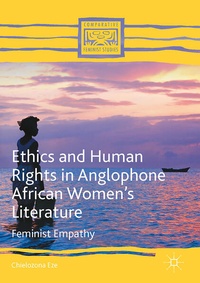
Ethics and Human Rights in Anglophone African Women's Literature
Description
Reviews / Votes
"A remarkable work, both for its compassion and critical insights, Chielozona Eze's Ethics and Human Rights in Anglophone African Women's Literature: Feminist Empathy 'liberates' empathy from ideology and offers a focused way of reading literature within and across borders that also transcends limiting contexts." (Dr. Maik Nwosu, University of Denver, USA)
"In a thus far unsurpassed "sharing of affect," Professor Eze artfully deploys what he calls "feminist empathy" for third-generation Anglophone African women writers. In the wake of their foremothers' rejection of the double yoke of colonialism and patriarchy, this millennial generation of women writers reclaims "a body of their own" and its unaccountable pain. Eze's bold yet gentle gesturing towards these new female subjectivities makes him a male feminist , definitely a rare commodity on the Nigerian scene. His book is a high risk/high gain venture opening wide the portal of "human flourishing" for other African empathizers in the post-nation-state." (Chantal Zabus, author of "Between Rites and Rights: Excision in Women's Experiential Texts and Human Contexts", Université Paris 13 - Sorbonne Paris Cité)
"Eze deftly demonstrates how contemporary African writing by women deploys feminist empathy to link ethics and human rights in a fresh interpretation of ubuntu -- the African philosophy of individual and community interdependence. With nuance and a rare attention to not only fiction but also poetry, essays and new media, Eze shows how recent works extending longstanding African feminist theories into new territory, proving Adichie and her sister-authors right: we should all be feminists." (Tsitsi Jaji, author of "Africa in Stereo: Modernism, Music and Pan-African Solidarity")
More details
Other editions
Additional editions

Person
Chielozona Eze is Associate Professor of English and Cultural Studies at Northeastern Illinois University, USA. He has held fellowships including the UCLA Global Fellowship and the Stellenbosch Institute for Advanced Studies (STIAS).
Content
Introduction: The Ethical Turn in African Literature.- Chapter 1: Feminism as Fairness.- Chapter 2: Diary of Intense Pain: Postcolonial Trap and Women's Rights.- Chapter 3: The Body in Pain and the Politics of Culture.- Chapter 4: Abstractions as Disablers of Women's Rights.- Chapter 5: The Enslaved Body as a Symbol of Universal Human Rights Abuse.- Chapter 6: Human Rights as Liberatory Social Thought.- Chapter 7: The Obligation to Bear Testimony to Human Rights Abuses.- Bibliography.-