

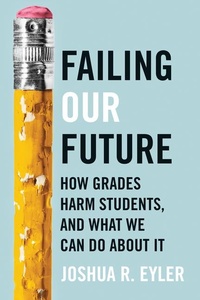
Failing Our Future
How Grades Harm Students, and What We Can Do about It
Published on 22. October 2024
Book
Hardback
208 pages
978-1-4214-4993-7 (ISBN)
Description
An indictment of the grading system in American schools and colleges-and a blueprint for how we can change it.
One of the most urgent and long-standing issues in the US education system is its obsession with grades. In Failing Our Future, Joshua R. Eyler shines a spotlight on how grades inhibit learning, cause problems between parents and children, amplify inequities, and contribute to the youth mental health crisis.
Eyler, who runs the Center for Excellence in Teaching and Learning at the University of Mississippi, illustrates how grades interfere with students' intrinsic motivation and perpetuate the idea that school is a place for competition rather than discovery. Grades force students to focus on rewards and distract them from exploring ideas or pursuing interests beyond what they'll be tested on. In fact, grades significantly impede the learning process. They are also significantly affecting children's physical, emotional, and psychological well-being. Rates of anxiety, depression, and suicidal ideation have spiked, and academic stress tied to grades is a leading cause of this escalation.
Eyler shares success stories of grading reform efforts that are already under way as an antidote to the harms caused by the practices currently used in educational institutions. Equal parts scathing and hopeful, Failing Our Future aims to improve the lives of students by encouraging them to define success on their own terms. Parents, educators, policymakers, and students will find in these pages a rallying cry for change and a blueprint for how to implement reforms in our homes and classrooms.
One of the most urgent and long-standing issues in the US education system is its obsession with grades. In Failing Our Future, Joshua R. Eyler shines a spotlight on how grades inhibit learning, cause problems between parents and children, amplify inequities, and contribute to the youth mental health crisis.
Eyler, who runs the Center for Excellence in Teaching and Learning at the University of Mississippi, illustrates how grades interfere with students' intrinsic motivation and perpetuate the idea that school is a place for competition rather than discovery. Grades force students to focus on rewards and distract them from exploring ideas or pursuing interests beyond what they'll be tested on. In fact, grades significantly impede the learning process. They are also significantly affecting children's physical, emotional, and psychological well-being. Rates of anxiety, depression, and suicidal ideation have spiked, and academic stress tied to grades is a leading cause of this escalation.
Eyler shares success stories of grading reform efforts that are already under way as an antidote to the harms caused by the practices currently used in educational institutions. Equal parts scathing and hopeful, Failing Our Future aims to improve the lives of students by encouraging them to define success on their own terms. Parents, educators, policymakers, and students will find in these pages a rallying cry for change and a blueprint for how to implement reforms in our homes and classrooms.
More details
Language
English
Place of publication
Baltimore, MD
United States
Product notice
sewn/stitched
Cloth over boards
Dimensions
Height: 236 mm
Width: 159 mm
Thickness: 22 mm
Weight
422 gr
ISBN-13
978-1-4214-4993-7 (9781421449937)
DOI
10.56021/9781421449937
Copyright in bibliographic data and cover images is held by Nielsen Book Services Limited or by the publishers or by their respective licensors: all rights reserved.
Schweitzer Classification
Person
Joshua R. Eyler is the director of the Center for Excellence in Teaching and Learning and a clinical assistant professor of teacher education at the University of Mississippi. He is the author of How Humans Learn: The Science and Stories behind Effective College Teaching.
Content
Preface: Scarlet Letters
Acknowledgments
Introduction: What Is a Grade? And Other Important Questions
Part I: The Many Problems with Grades
1. The Race Nobody Can Win: Grades as Obstacles to Motivation and Learning
2. Helicopters, Lawnmowers, and Stealth Fighters: Parents and the Pressure to Get Good Grades
3. The Weight of Their World: Grades and the Mental Health Crisis in America
4. Mirror, Mirror, on the Wall: How Grades Reflect and Extend Inequities
Part II: How We Can Help
5. Building Up and Bouncing Back: What Parents Can Do at Home
6. Reinventing Education: How Teachers Are Exploring New Approaches to Grades and Grading in the Classroom
7. Climbing Mountains: Changing Our Schools, Colleges, and Universities
Epilogue: A Future without Letters?
Bibliography
Index
Acknowledgments
Introduction: What Is a Grade? And Other Important Questions
Part I: The Many Problems with Grades
1. The Race Nobody Can Win: Grades as Obstacles to Motivation and Learning
2. Helicopters, Lawnmowers, and Stealth Fighters: Parents and the Pressure to Get Good Grades
3. The Weight of Their World: Grades and the Mental Health Crisis in America
4. Mirror, Mirror, on the Wall: How Grades Reflect and Extend Inequities
Part II: How We Can Help
5. Building Up and Bouncing Back: What Parents Can Do at Home
6. Reinventing Education: How Teachers Are Exploring New Approaches to Grades and Grading in the Classroom
7. Climbing Mountains: Changing Our Schools, Colleges, and Universities
Epilogue: A Future without Letters?
Bibliography
Index