

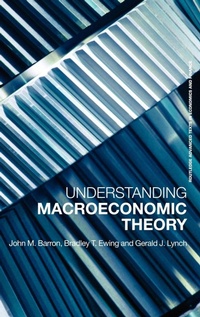
Understanding Macroeconomic Theory
1st Edition
Published on 23. May 2006
Book
Hardback
234 pages
978-0-415-70195-2 (ISBN)
Description
At each point in time, individuals make choices with respect to the acquisition, sale, and/or use of a variety of different goods. Such activity can be summarized by aggregate variables such as an economy's total production of various goods and services, the aggregate level of unemployment, the general level of interest rates, and the overall level of prices.
The focus of this book is on developing simple theoretical models that provide insight into the reasons for fluctuations in such aggregate variables. The models included explore how shocks or 'impulses' to the economy (e.g. changes to technology, the money supply, or government policy) impact individuals' behaviour in specific markets, and the resulting implications in terms of changes in aggregate variables.
This book provides the reader with an in-depth understanding of standard theoretical models: Walrasian, Keynesian and Neoclassical. Pedagogically sophisticated, it is theoretically based, rigorous and includes a host of real world case studies and exercises. Underpinned by solid microfoundations, it is written in a concise, accessible style and is an indispensable tool for all students who wish to a gain a firm grounding in the complexities of macroeconomic theories as well as government and private sector researchers of macroeconomics.
The focus of this book is on developing simple theoretical models that provide insight into the reasons for fluctuations in such aggregate variables. The models included explore how shocks or 'impulses' to the economy (e.g. changes to technology, the money supply, or government policy) impact individuals' behaviour in specific markets, and the resulting implications in terms of changes in aggregate variables.
This book provides the reader with an in-depth understanding of standard theoretical models: Walrasian, Keynesian and Neoclassical. Pedagogically sophisticated, it is theoretically based, rigorous and includes a host of real world case studies and exercises. Underpinned by solid microfoundations, it is written in a concise, accessible style and is an indispensable tool for all students who wish to a gain a firm grounding in the complexities of macroeconomic theories as well as government and private sector researchers of macroeconomics.
More details
Series
Language
English
Place of publication
London
United Kingdom
Publishing group
Taylor & Francis Ltd
Target group
College/higher education
Illustrations
8 s/w Abbildungen, 8 s/w Zeichnungen, 1 s/w Tabelle
1 Tables, black and white; 8 Line drawings, black and white; 8 Illustrations, black and white
Dimensions
Height: 240 mm
Width: 161 mm
Thickness: 18 mm
Weight
534 gr
ISBN-13
978-0-415-70195-2 (9780415701952)
Copyright in bibliographic data and cover images is held by Nielsen Book Services Limited or by the publishers or by their respective licensors: all rights reserved.
Schweitzer Classification
Other editions
Additional editions
Bradley T. Ewing | John M. Barron | Gerald J. Lynch
Understanding Macroeconomic Theory
E-Book
09/2006
1st Edition
Routledge
€86.99
Available for download
Bradley T. Ewing | John M. Barron | Gerald J. Lynch
Understanding Macroeconomic Theory
E-Book
09/2006
1st Edition
Routledge
€86.99
Available for download
Bradley T. Ewing | John M. Barron | Gerald J. Lynch
Understanding Macroeconomic Theory
Book
05/2006
1st Edition
Routledge
€94.20
Shipment within 15-20 days
Persons
John M. Barron is the Loeb Professor of Economics in the Krannert School of
Management at Purdue University.
Bradley T. Ewing is the Jerry S. Rawls Endowed Professor in Operations
Management in the Rawls College of Business at Texas Tech University.
Gerald J. Lynch is Professor of Economics in the Krannert School of Management
at Purdue University.
Management at Purdue University.
Bradley T. Ewing is the Jerry S. Rawls Endowed Professor in Operations
Management in the Rawls College of Business at Texas Tech University.
Gerald J. Lynch is Professor of Economics in the Krannert School of Management
at Purdue University.
Content
1. Introduction 2. Walrasian Economy 3. Firms as Market Participants 4. Households as Market Participants 5. Summarizing the Behavior and Constraints of Firms and Households 6. The Simple Neoclassical Macroeconomic Model (Without Government or Depository Institutions) 7. Empirical Macroeconomics: Traditional Approaches and Time Series Models 8. The Neoclassical Model 9. The 'Keynesian Model' with Fixed Money Wage: Modifying the Neoclassical Model 10. The Lucas Model 11. Policy 12. Open Economy