

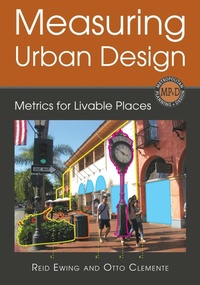
Measuring Urban Design
Metrics for Livable Places
Published on 20. July 2013
Book
Paperback/Softback
200 pages
978-1-61091-194-8 (ISBN)
Description
What makes strolling down a particular street enjoyable? The authors of "Measuring Urban Design" argue it's not an idle question. Inviting streets are the centrepiece of thriving, sustainable communities, but it can be difficult to pinpoint the precise design elements that make an area appealing. This accessible guide removes the mystery, providing clear methods to measure urban design. In recent years, many "walking audit instruments" have been developed to measure qualities like building height, street length, and pavement width. But while easily quantifiable, these physical features do not fully capture the experience of walking down a street. In contrast, this book addresses broad perceptions of street environments. It provides operational definitions and measurement protocols of five intangible qualities of urban design, specifically: imageability, visual enclosure, human scale, transparency, and complexity. The result is a reliable field survey instrument grounded in constructs from architecture, urban design, and planning.
Readers will also find a case study applying the instrument to 588 streets in New York City, which shows that it can be used effectively to measure the built environment's impact on social, psychological, and physical well-being. Finally, readers will find illustrated, step-by-step instructions to use the instrument and a scoring sheet for easy calculation of urban design quality scores. For the first time, researchers, designers, planners, and lay people have an empirically tested tool to measure those elusive qualities that make us want to take a stroll.
Readers will also find a case study applying the instrument to 588 streets in New York City, which shows that it can be used effectively to measure the built environment's impact on social, psychological, and physical well-being. Finally, readers will find illustrated, step-by-step instructions to use the instrument and a scoring sheet for easy calculation of urban design quality scores. For the first time, researchers, designers, planners, and lay people have an empirically tested tool to measure those elusive qualities that make us want to take a stroll.
More details
Language
English
Place of publication
Washington
United States
Target group
College/higher education
Professional and scholarly
Product notice
Paperback (trade)
Dimensions
Height: 254 mm
Width: 177 mm
Thickness: 15 mm
Weight
503 gr
ISBN-13
978-1-61091-194-8 (9781610911948)
Copyright in bibliographic data and cover images is held by Nielsen Book Services Limited or by the publishers or by their respective licensors: all rights reserved.
Schweitzer Classification
Other editions
Additional editions
E-Book
07/2013
1st Edition
NYU Press
from
€59.49
Available for download
Persons
Reid Ewing is Professor of City and Metropolitan Planning at the University of Utah and the author of Best Development Practices (9781884829109) and Growing Cooler (9780874200829). He is co-editor with Arthur C. Nelson of the Island Press series in Metropolitan Planning + Design. Reid lives in Salt Lake City, Utah. Otto Clemente is a senior transportation planner working and living in the Washington, DC region.