

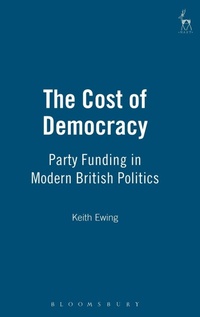
The Cost of Democracy
Party Funding in Modern British Politics
Published on 9. March 2007
Book
Hardback
294 pages
978-1-84113-716-2 (ISBN)
Description
Party funding has given rise to great controversy since 1997, and continues to do so. In recent years, row has followed row - from million-pound donations, to the so-called 'loans for peerages' affair. The question was the subject of an official investigation by Sir Hayden Phillips, whose blueprint for reform was produced in March 2007. This book charts the evolution of the party funding problem in recent years and explores the weaknesses of the Political Parties, Elections and Referendums Act 2000, which was enacted in a vain attempt to clean up British politics. The book sets out a number of core principles which should inform the development of public policy in this field, and examines the different strategies for the implementation of these principles. Having regard to the experience of othercountries, including Canada, Germany and Sweden, a radical framework ofreform is proposed, designed to address the emerging crisis of party government with serious implications for democracy itself.
The main concern is with the development of bold reform initiatives to encourage political parties to recruit and retain members, and give members rights in relation to the government and administration of these parties. This thoughtful yet hard-hitting account by one of the leading scholars in the field will be of interest to constitutional lawyers and political scientists, as well as journalists and those with an interest in the way we are governed.
The main concern is with the development of bold reform initiatives to encourage political parties to recruit and retain members, and give members rights in relation to the government and administration of these parties. This thoughtful yet hard-hitting account by one of the leading scholars in the field will be of interest to constitutional lawyers and political scientists, as well as journalists and those with an interest in the way we are governed.
Reviews / Votes
...an authoritative account of party funding. It deserves to become the standard work on the subject. Vernon Bogdanor The Times Higher Education Supplement July 2007 This thoughtful yet hard-hitting account provides a route map through the complex maze and is an unsurpassable text book on one of the building blocks of British democracy. For anybody interested in the way we are governed and the fair and transparent funding of politics it is well worth paying the price. Chris McLaughlin Tribune 23 March 2007 ...Sir Hayden does not have the monopoly on good ideas for party reform. There are other academics in the country who have come up with alternative, but similar proposals. May I ask my right hon. Friend to look at the work of Professor Keith Ewing... Mr. Tom Watson (West Bromwich, East) (Lab) Reference from the House of Commons 15 March 2007 Ewing does a thorough job in identifying the problems in the system. Emile Meyer Unlock Democracy May-07 In this timely new book, Keith Ewing addresses the root causes of the current cash-for-honours affair... Richard Muir Progress Magazine May-07 ...The Cost of Democracy is an exemplary lesson in how to address the vexed issue of party funding in particular context...The general discussion of regulatory objectives and methods in chapters two and three can hardly be bettered. And the exploration of how these objectives and methods apply in the United Kingdom is both illuminating and thought provoking. Andrew Geddis Public Law Review K. D. Ewing provides an excellent survey of the problems facing British parties in the light of the 'cash for peerages' funding scandal...this book will prove valuable to anyone interested in current debates on party funding. It deserves to shape the future development of Britain's party finance regime. Thomas Quinn Political Studies Review Vol 6, No. 2, May 2008 The book is a model of clarity, superbly structured and extremely well written: it will provide students and others with an excellent introduction to the subject and political participants with a clinical appreciation of the current situation...a very substantial contribution to debates about what will be done next, through his clear analysis of the contemporary scene. The book is required reading for all concerned with the nature of British politics. Ron Johnston Representation 2008 Ewing's book is an excellent contribution to the debate on the funding of political parties. It examines the ways that legal regulations can be used to advance democratic ideals, but in a way that appreciates the practical implications for UK politics. As a result, its arguments and proposals are realistic. The text also provides a valuable and accessible account of the history of and trend toward the legal regulation of political parties, as well an analysis of the data on party funding held by the Electoral Commission. As with any text on this topic, there is much to take issue with. The Cost of Democracy provides a persuasive and original take on the funding of political parties, and will be an important reference point in future debates on this issue. Jacob Rowbottom Public Law 2008More details
Language
English
Place of publication
Oxford
United Kingdom
Publishing group
Bloomsbury Publishing PLC
Target group
Professional and scholarly
Dimensions
Height: 240 mm
Width: 161 mm
Thickness: 21 mm
Weight
611 gr
ISBN-13
978-1-84113-716-2 (9781841137162)
Copyright in bibliographic data and cover images is held by Nielsen Book Services Limited or by the publishers or by their respective licensors: all rights reserved.
Schweitzer Classification
Other editions
Additional editions
E-Book
03/2007
1st Edition
Hart Publishing
€83.49
Available for download
Person
Content
Preface 1 A Drama Unfolds Introduction The Conservative Funding Legacy The 'Arms Race' The Labour Party's Response Questions for the Labour Party The Ecclestone Affair The Neill Committee Conclusion 2 Regulatory Objectives The Prevention of Corruption and Conflicts of Interest Equality of Opportunity and Fair Competition for Political Office A Need to Ensure that Political Parties are Adequately Funded Promoting Citizen Participation in the Funding of Political Parties Respect for the Nature and Diversity of Party Structure The Protection of Human Rights Conclusion 3 Regulatory Methods Introduction Transparency and Disclosure Contribution Controls Spending Controls State Aid and Public Funding Self-Regulation or State Regulation? Supervision and Enforcement Conclusion 4 Party Autonomy and Public Accountability Introduction Diversity of Party Structure The Principle of Party Autonomy Autonomy of Party Organisation: The Role of Legislation Autonomy and Legality From Autonomy to Accountability: Registration and Party Identity State Supervision: Registration and Financial Accountability Conclusion 5 Donations to Political Parties: The Regulatory Framework Introduction Disclosure and Corruption Who May Donate to Political Parties? The Mechanics of Reporting and Disclosure Who Does Donate to Political Parties? The Problem of Avoidance Loopholes in the Regulatory Framework Conclusion 6 From 'Sleaze' to 'High-Value Donors' to Loans Introduction 'Sleaze': The Continuing Problem of Political Donations The Labour Party's Response 'High-Value Donors': The Labour Party 'High-Value Donors': The Conservative Party The Loans Affair: A New Problem Erupts Implications and Consequences of the Loans Affair Conclusion 7 Spending Limits in Election Campaigns Regulatory Challenges The Victorian Legacy: Candidate Limits The Problem of Third Parties Spending Limits on Political Parties Calculating and Enforcing the Limit Spending Limits and Third Parties Spending Limits in Practice - The First Cycle The General Election 2005 Conclusion 8 The Role of the State: Supporting Candidates and Political Parties Introduction Regulatory Challenges Responsibility of the State Meeting the State's Responsibility Party Political Broadcasts: Transferring the State's Obligations New Forms of State Support Proposals for Additional State Support Reluctance and Resistance to Change Tax Relief - A False Trail Conclusion 9 Lessons from Canada Introduction Political Parties in Canada The Election Expenses Act 1974 The Parties and their Funds Bill C-24, Political Donations and State Funding The Impact of Bill C-24 Bill C-24 and Party Structure Conclusion 10 Building on PPERA Introduction The Next Step - Regulatory Objectives The Problems with Contribution Limits Donations - Let the Members Decide A Focus on Spending State Aid: Building on the British Model? Making a Fresh Start - Back to Houghton Qualifying Conditions for State Support Promoting Democracy: A Quid Pro Quo Conclusion Appendices Appendix 1: Exchange of Letters between the Labour Party and Sir Patrick Neill QC Appendix 2: Annual Accounts of the Political Parties Appendix 3: The Structure of the Labour Party Appendix 4: From Election Funding to Political Funding in Germany Appendix 5: State Funding in Sweden - Party Autonomy and Public Funding